
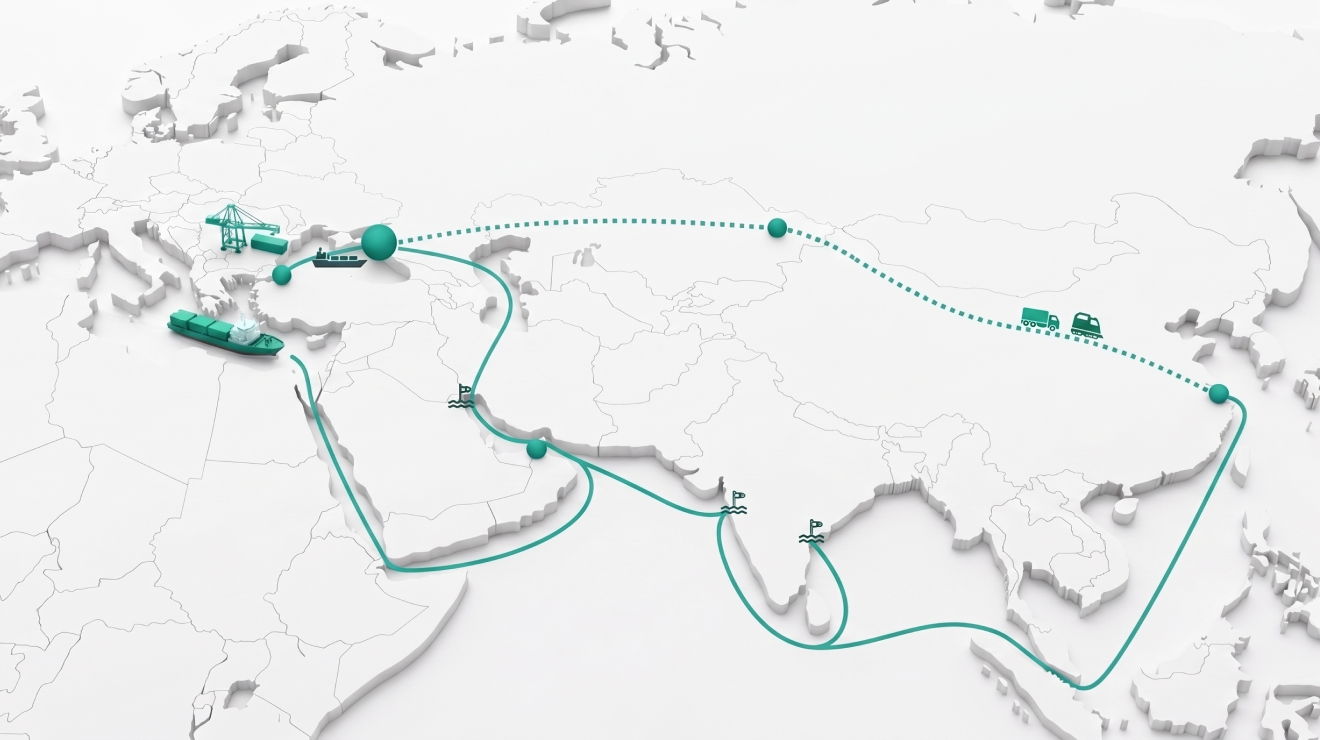

By the end of 2025, Novorossiysk's container turnover reached approximately 1.11 million TEU, increasing by about 4.3% compared to 2024. The port maintains third place among Russian container ports after St. Petersburg and Vladivostok. Cargo flows from four fundamentally different regions converge at the port of Novorossiysk: China, India, Turkey, and the UAE. Each direction has its own logic of transit times, costs, and risks – choosing the wrong corridor increases both transit times and transportation costs.
Novorossiysk: Port Capabilities and Limitations
The port is located in Tsemes Bay on the Black Sea, 1,227 km from Moscow along the M-4 highway. Navigation is year-round: there are no ice restrictions even in February. Through the Bosphorus, the port gains access to the Mediterranean, and through it to all key Atlantic and Asian hubs.
The two main container operators are the NUTEP terminal of the Delo Group (approx. 624 thousand TEU in 2025) and NLE of the NCSP Group (approx. 468 thousand TEU). NUTEP maintains leadership in container exports on the Black Sea coast. By the end of 2025, the total container turnover of Novorossiysk reached approximately 1.11 million TEU, an increase of about 4.3% compared to 2024.
Yet the port does have limitations. During periods of seasonal cargo growth and unfavorable weather conditions, the workload of container terminals increases, which can lead to vessel and container handling delays. Railway infrastructure on the approaches to the port continues to be modernized in line with traffic growth, but during certain periods its utilization remains high. In winter, stormy conditions in the Black Sea waters have an additional impact, causing delays for individual voyages ranging from several hours to several days.
Novorossiysk surpasses all Russian ports in one key parameter: it is the closest sea point to Moscow with unrestricted access to the Mediterranean and direct regular maritime services with Turkey, the UAE, India, and the Middle East.
The port's location determines its logic: Novorossiysk is justified primarily for importers whose warehouses are located in the Central, Southern, North Caucasian, or Volga Federal Districts. For the Urals, Siberia, and the Far East, the overland leg eastward from Novorossiysk negates maritime savings.
Route from China: Three Corridors with Different Priorities
The three routes from China to Novorossiysk differ fundamentally in speed, price, and reliability. Choosing between them is primarily a choice between cost and delivery time.
Sea Route via the Suez Canal
Classic route: Shanghai, Ningbo, or Qingdao → Suez Canal → Bosphorus → Novorossiysk. Distance is about 18,000 km. Transit time: 35–50 days depending on intermediate ports of call and line congestion. In the first half of 2026, sea freight from major Chinese ports to Novorossiysk typically ranges from 1,500–1,800 USD per 20DC and 2,800–3,500 USD per 40HC. During peak seasons or line congestion, costs may be higher.
This is the most cost-effective option from China for large volumes. The minimum threshold of efficiency is one full container (FCL): for consolidated shipments (LCL), consolidation costs and waiting for the departure partially offset the price advantage.
A risk that emerged at the end of 2023: Houthi attacks on vessels in the Red Sea forced several major lines to secure escort or convoy passage through hazardous areas, which increased delivery times and incurred additional surcharges of 500–800 USD. In the second half of 2025 and in 2026, certain carriers continue to use the route via the Suez Canal and the Bosphorus, as it remains the most economical route, though transit times can still increase by 7–14 days depending on the carrier line.
Railway Route via Russia
The Trans-Siberian Railway brings Chinese cargo to Moscow in 12–18 days. From there to Novorossiysk, cargo is moved by road via the M-4 highway (1,227 km, 2 days) or by container train with weekly departures. Total time from the Chinese border: 16–22 days.
Rail freight cost: from $9,000 per 40-foot container via CR. The route is justified for urgent cargo, hazardous materials, and oversized items—where shipping lines refuse cargo or a 40+ day transit time is unacceptable. For standard consumer goods, rail is a compromise between speed and cost.
For Novorossiysk, this route is less organic than for Vladivostok: it is more logical to receive cargo via the Trans-Siberian Railway at Moscow bonded warehouses (TSW) than to haul it another 1,200 km south. The exception is if the end recipient is in Krasnodar, Rostov, or Stavropol, in which case moving south adds no redundant haulage.
Route from India: INSTC Corridor vs. Suez Canal
India supplies Russia with pharmaceuticals, textiles, agricultural raw materials, rolled metal products, and automotive components. Main ports of loading are Nhava Sheva (Mumbai), Mundra (Gujarat), and Chennai. Two fundamentally different routes lead from India to Novorossiysk: the sea route via the Suez Canal and the INSTC corridor through Iran.
Sea Route via the Suez Canal
Nhava Sheva → Suez Canal → Bosphorus → Novorossiysk. Transit time is 12–20 days for FCL shipments without tight deadlines. FESCO Transportation Group operates the regular FIL-W (FESCO Indian Line Westbound) service along the route Nhava Sheva – Mundra – Jebel Ali – Novorossiysk. From Nhava Sheva to Novorossiysk, it takes 12–20 days, with bi-weekly departures.
Route from Turkey: 7–12 Days Across the Black Sea
Turkey and Novorossiysk are separated by approximately 1,100 km of the Black Sea. From Istanbul (Ambarli, Mardas, and Gebze terminals), the sea passage to Novorossiysk usually takes 2–5 days, and the total transit time from container gate-in at the port of origin to customs release after discharge in Novorossiysk is about 7–12 days. From Mersin and Izmir, transit is typically longer: 10–16 days, as the vessel must navigate the eastern Mediterranean, straits, and Black Sea. This is the shortest sea transit of all four directions considered.
According to Turkish statistics and industry reports, in 2025 trade turnover between Russia and Turkey declined to $49.1 billion compared to $52.6 billion a year earlier. Turkish exports to Russia amounted to approximately $6.7 billion, while Turkish imports from Russia were about $42.4 billion. The trade balance remains heavily skewed in favor of Russian energy and raw commodities; however, for Russian imports from Turkey, containerized shipments are vital: machinery, textiles, foodstuffs, chemicals, components, and parallel import goods. The vast majority of physical cargo turnover between the countries passes through the Black Sea basin, and Novorossiysk remains the key Russian entry point for seaborne shipments from Turkey.
Turkey is not only a source of domestic goods, but also the largest re-export hub for the Russian market. Goods from EU countries, Asia, and North America are unloaded in Mersin, Istanbul, Gebze, and Izmir, consolidated, re-documented, and dispatched to Novorossiysk via container lines or road transport using Black Sea ferry and Ro-Ro services. In 2025–2026, Turkey retains this role, although payment settlements, banking compliance, and sanctions screening for specific product categories have tightened noticeably.
The range of Turkish cargo via Novorossiysk is broad: textiles and finished garments, marble tiles and natural stone, rolled metal products, furniture fittings, agricultural commodities (tomato paste, citrus fruits, vegetable oils), household chemicals, industrial machinery. The re-export flow adds electronics, auto parts, and European brand goods imported through Turkish intermediaries.
Ferry service is a distinct segment of Black Sea logistics. Ro-Ro and ferry vessels carrying trucks operate regularly on Turkey – Krasnodar Krai ports routes. The truck drives onto the ferry in a Turkish port, crosses the Black Sea in 36–48 hours, and after discharge drives directly to the recipient. The total transit time from a Turkish warehouse to the Russian consignee's gate is typically 3–5 days, including customs clearance procedures. For perishable goods and shipments with strict deadlines, this format is unmatched among all Black Sea options.
Route from the UAE: FESCO Direct Service and Transshipment
Jebel Ali is one of the world's largest container ports and the primary logistics hub in the Middle East. Through it, cargo from the UAE, India, Pakistan, China, Southeast Asia, and Europe is consolidated. The port handles ultra-large container vessels, operates as a regional distribution center, and remains one of the key hubs for re-export to Russia.
FESCO's direct FIL-W service is the most consistent shipping method from the UAE to Novorossiysk. According to FESCO, the route connects India, the UAE, and Novorossiysk, with an estimated transit time on the line of 18–25 days depending on the port of origin, vessel rotation, and schedule. After discharging in Novorossiysk, the container can be forwarded by road or rail service to Moscow and other regions of Russia. The frequency of inland dispatch depends on the operator and line capacity, so it must be confirmed per specific booking.
An alternative to direct service is transshipment routes: Jebel Ali → transshipment hub (Piraeus, Malta, Port Said, Mersin, or another Mediterranean hub) → Novorossiysk. Delivery time is typically 25–40 days. The cost can be lower than the direct option, but the risk of transshipment delay is higher—especially during peak seasons when hub terminals operate near capacity or alter schedules due to the Red Sea situation.
Freight rates for the Jebel Ali – Novorossiysk route in 2026 depend heavily on the geopolitical environment, container type, equipment availability, and chosen service. In commercial quotes for direct or near-direct routes, a 20-foot DV generally starts from around $10,000, and a 40-foot HC from $12,000. The spread is wide because some quotes are for regular service, some for transshipment, and some include surcharges for route complexities.
The Red Sea crisis, which began in late 2023, continues to affect routes between Asia, the Middle East, and the Black Sea. During escalation periods, certain carriers divert around the Cape of Good Hope, adding 7–14 days to transit and increasing insurance and freight rates. In 2025–2026, direct services via the UAE remain more predictable than long transshipment chains, but schedules must still be verified prior to each booking.
One practical advantage of the UAE is the ability to aggregate cargo from various sources. Suppliers from India, China, Pakistan, and other Asian countries regularly send small shipments to Jebel Ali, where they are consolidated into a single container and dispatched to Novorossiysk via direct or transshipment service. This reduces the unit shipping cost compared to direct LCL service from each originating country.
Selection Matrix by Cargo Type and Objective
Urgency is the primary filter. If cargo is needed in 2–3 weeks, the choice narrows to two options: Turkey via the Black Sea or direct service from the UAE. Service from India covers a 15–20 day window, but only if the cargo is ready to ship. Maritime Suez from China with a 35–50 day transit time is suitable for those planning shipments with a month-and-a-half lead time.
Cargo type has a major impact. Pharmaceuticals and short-shelf-life foodstuffs do not tolerate a 40–50 day transit well—here Turkey, Egypt, India, or direct UAE services hold the advantage. Metal, bulk cargo, and raw materials easily endure 50 days in a container: storage causes no damage, and affordable sea freight reduces the logistics share in the product cost. Electronics from China require dedicated evaluation: 15–25 extra days by sea may be cheaper than expedited delivery, but the cost of frozen working capital for the additional 2–3 weeks in transit must be calculated.
The destination region within Russia refines the choice. For consignees in southern Russia—Krasnodar, Rostov, Stavropol—any route via Novorossiysk is logical: road delivery from the quayside takes 1–2 days. For Moscow, the frequency of container trains and trucking is critical: departures depend on the operator, schedule, and terminal capacity, so this time must be factored into the overall lead time. For the Urals and Siberia, Novorossiysk often loses to Vladivostok—cargo would need to travel 2,500–4,000 km eastward, eliminating sea freight savings.
Route risks are a separate variable that shifts from year to year. Suez corridors are vulnerable to Red Sea instability. The Turkish route is the most predictable: the Black Sea in good weather offers stable transit, while winter storms from December to February can add delays ranging from several hours to several days to certain voyages.
For most importers working with multiple origin regions simultaneously, a resilient strategy is cargo flow diversification: standard planned stock arrives via Suez from China, urgent replenishment comes from Turkey or the UAE via direct service, and Indian cargo is routed based on slot availability on upcoming departures.
Choosing a route via Novorossiysk cannot be reduced to a single formula. An accurate calculation requires three parameters: cargo origin, inland destination in Russia, and the daily carrying cost of inventory given working capital constraints. Freight rate is only part of the equation. A company that chooses the wrong corridor ultimately pays twice: for shipping and for unnecessary weeks of inventory tied up in transit.