
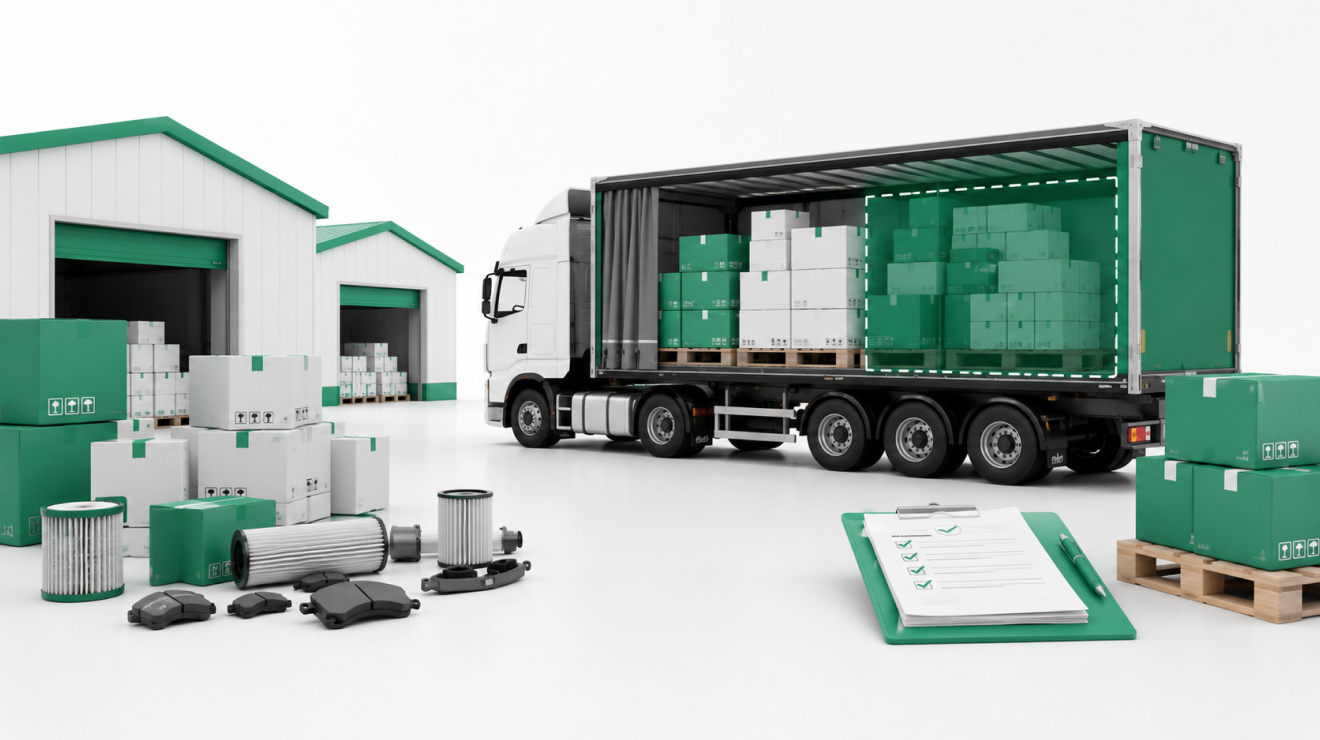

An online auto parts store was importing goods from China via cargo channels. While volumes were small, the scheme seemed convenient. Problems began as sales increased: marketplaces requested documents for filters and brake pads, but the seller could not promptly verify legal import and product compliance with EAEU requirements. Product listings faced the risk of suspension, while a new 900 kg batch was already being prepared across several Chinese suppliers.
TransGID’s objective was to transition auto parts imports from China to a fully compliant scheme while maintaining delivery times to Moscow. To achieve this, it was necessary to consolidate goods from various factories, verify documentation for each item, prepare the cargo for customs clearance, and dispatch it by road freight via Kazakhstan.
Why cargo channels started hindering marketplace sales
Under the cargo scheme, the client received the goods, but not the complete document package linking the specific batch to the importer. As long as no one requested proof of origin, the issue remained unnoticed. Once product listings were audited on the marketplace, the lack of documents posed a direct threat to sales.
The previous scheme had three weak points.
- Product documentation. The seller needed commercial invoices, conformity assessment documents, and proof of customs clearance. Without these, it was difficult to respond to the platform's inquiry and prove that filters, brake pads, and sensors were legally imported.
- Taxes and payments. Cargo shipping did not allow the client to transparently verify customs value, payment of customs duties, and VAT. With growing turnover, such uncertainty disrupts accounting, banking relations, and sales to legal entities.
- Delivery times. The client could not plan warehouse replenishment in advance: dispatch and border crossing dates depended on the cargo channel. For an online store, delays mean top-selling items run out of stock, product listings lose sales ranking, and capital remains tied up in goods that haven't arrived yet.
How official delivery from China via Kazakhstan was organized
The Central Asian route was maintained, but transport and documentation were structured into a unified legal scheme. The work began prior to truck dispatch: the team verified product and supplier details, calculated customs duties and taxes, and prepared the shipment for consolidation.
1. Verified contract, invoices, and line items
For official import, a foreign trade contract and invoices with clear descriptions for each line item were prepared. The documents reconciled product names, quantities, costs, manufacturers, and countries of origin. This is vital for customs clearance of cargo from China: discrepancies in descriptions or value can result in additional inspections and release delays.
Filters, brake pads, sensors, and other components were individually classified under FEA commodity codes (HS codes). The code determines duty rates and required permit documentation, so items cannot simply be grouped under a generic “auto parts” label.
2. Determined conformity document requirements
For each product category, we verified whether a declaration or certificate of conformity was required. All mandatory declarations were prepared prior to shipping. As a result, the paperwork for the auto parts was fully ready for customs control and subsequent marketplace audits.
The client knew in advance what documents they would receive after import to forward to the marketplace or wholesale buyers. This approach minimizes the risk of cargo detention due to missing paperwork or discrepancies between declarations and commercial invoices.
3. Consolidated goods from multiple factories at one warehouse
Suppliers shipped components on different dates and in varied packaging. At the warehouse in China, the goods were received, cross-checked against packing lists, and consolidated into a single 900 kg batch. Boxes were repalletized, labeled, and secured to prevent shifting during transit.
Consolidation allowed shipping the spare parts as a single consignment without paying for separate transport from each factory. Warehouse inspections also helped identify discrepancies before dispatch, when contacting suppliers and repackaging is much simpler.
4. Dispatched shipment as LTL groupage cargo
For a 900 kg batch, booking a dedicated truck would be uneconomical, so LTL road transport from China was selected. In an LTL format, the client only pays for the cargo space utilized, while multiple consignees share the same vehicle.
A CMR consignment note was issued for the international leg. The route ran through Kazakhstan, delivering the cargo directly to Moscow. Total road transit time was 12–14 days — comparable to the timeframe the client experienced when working with cargo channels.
What the online store achieved
Following customs clearance, the client received the consignment along with a complete package of documents certifying official import. The seller can now promptly respond to marketplace requests, confirm product origin, and provide paperwork to major wholesalers and corporate clients.
The warehouse dispatch schedule became fixed, allowing procurement to be planned in advance taking into account production lead times, consolidation, road haulage, and customs clearance. For the business, this translates to fewer stockouts and reduced risk of running out of high-demand items.
To calculate fully compliant door-to-door delivery from China, we require product specifications, value, weight, volume, supplier pickup addresses, and cargo readiness dates. Based on this data, the TransGID team will determine FEA commodity codes, verify regulatory requirements, and propose an optimal route. We handle imports from China, Turkey, and Uzbekistan; our offices are located in Vladivostok, Moscow, and Novorossiysk.
Get a quote for compliant shipping and professional consultation on required documentation.