
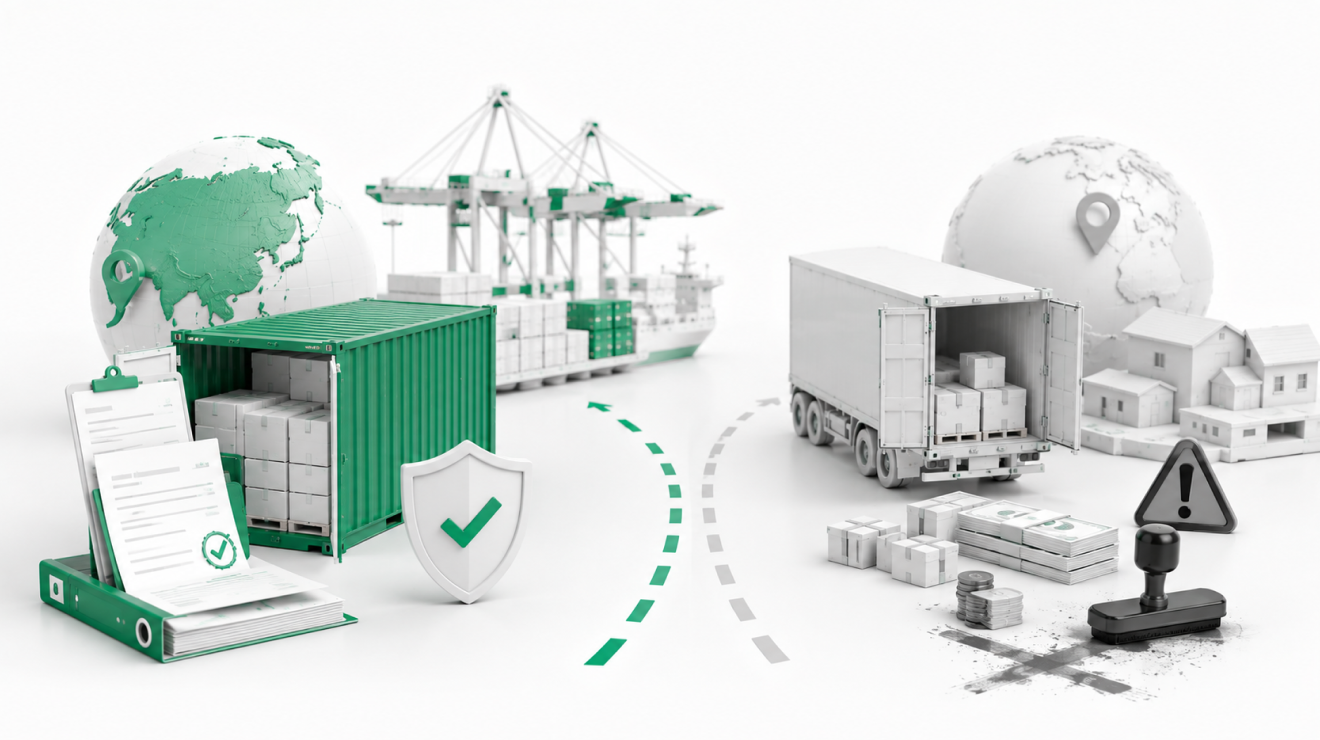

In September–October 2025, long queues of trucks carrying cargo from China formed at the Russia–Kazakhstan border. Market participants reported estimates of up to 10,000 trucks and waiting times of up to a week. On October 24, Decree No. 778 was issued, introducing a temporary procedure for the import and subsequent customs clearance of certain goods via Kazakhstan and Kyrgyzstan. For those shipping via grey cargo schemes, such a traffic jam results not just in delays, but in the risk of cargo seizure. Under tightened control, undocumented goods simply have nowhere to go. We have been transporting containers and consolidated cargo (LCL) from China for fourteen years and are included in the FCS Register of Customs Representatives. Below, we explain how white customs clearance differs from cargo schemes, what happened to parallel imports, and why the economics of grey schemes no longer add up. You will do the math; the figures and calculation methodology are ours.
Why we do not work with grey schemes
We do not work with grey import schemes. A customs representative is jointly and severally liable with the declarant to the customs authorities for customs duties and taxes within the limits established by law. If the price in an invoice is undervalued, additional duty assessments and other statutory charges may affect both parties. We do not assume such a risk merely to save on customs duties.
For the same reason, we do not route cargo through shell companies in other EAEU member states and do not split commercial shipments into parcels for personal use. Below, we analyze these schemes as market practices rather than services provided by our company.
A one-time delivery of a small batch is a different situation. If you are testing a niche with a shipment worth two hundred thousand rubles, do not sell products through marketplaces, and do not plan regular shipments, this involves a different scale and risk profile. Such shipments are evaluated individually. The rest of this article focuses on those who regularly import goods from China.
How cargo schemes work and where they originated
Cargo is an informal industry term for grey import schemes, not a legal definition. In this case, goods cross the border without a complete customs declaration in the name of the ultimate consignee. Such a scheme is typically set up in three ways: undervaluing the customs value on the invoice, stating three dollars per unit instead of the actual ten; splitting a commercial shipment into parcels to clear them as personal effects—yet keeping weight under 31 kg alone is not enough, as value, intended use, and other import criteria are also evaluated; or clearing goods through a company in Kazakhstan, Armenia, or Belarus, relying on the single customs territory regime. However, the transit route itself does not make Chinese goods duty-free, nor does it replace official customs clearance.
Prior to 2022, the logic was straightforward. According to market participant estimates, grey cargo was 30–50% cheaper than white delivery due to unpaid taxes and duties—primarily import VAT (then 20%, whereas starting January 1, 2026, the standard rate is 22%), customs duties (0–15% for most codes, higher for specific items), and excise taxes where applicable. In an indicative calculation for a shipment with an invoice value of 10 million rubles, legitimate customs clearance added an extra 2.5–4 million. The exact amount depends on the HS code, the structure of payments, and the delivery terms. For small businesses, this was often the deciding factor in whether to proceed with an import at all.
February 2022 disrupted direct supplies from hundreds of Western brands, causing demand for grey channels to spike. Importers who previously operated officially turned to cargo schemes to source discontinued brands bypassing distributors. By the end of 2022, the volume of brand imports without the trademark owner's consent exceeded $20 billion, with monthly flows exceeding $2.5 billion during peak periods. Part of this was covered by white customs clearance under the Ministry of Industry and Trade list, while another portion went into cargo schemes without declarations.
Cargo did not thrive because customs was blind. Digital control systems had simply not yet been consolidated into a single unified framework. Starting in 2023, this changed, and below we will show exactly how.
White delivery: what the procedure consists of
White delivery is also a market term. For customs authorities, it is standard import clearance under the EAEU Customs Code. The declarant submits a declaration, pays all statutory fees and duties, and receives a full package of documents.
What the procedure entails:
- Foreign trade contract with the supplier: specification, unit price, total amount, and Incoterms delivery conditions. Required for currency control; payment amounts must match the contract and invoice.
- Supplier invoice establishes the price. Customs checks its price against the customs value index (CVI) for your HS code.
- Customs value declaration (DTS-1 or DTS-2) substantiates the declared price. Transaction Value Method 1 is based on the transaction price plus delivery to the border; if the customs inspector does not accept it, the declaration is subject to value adjustment.
- Goods declaration (GD, formerly CCD) completes the procedure. It is submitted by the customs representative via the FEA participant's personal account; upon payment of duties and VAT, the inspector issues a release order.
- Certificates and declarations of conformity under EAEU technical regulations are mandatory for most consumer goods, electronics, children's products, and electrical equipment. Goods cannot be released without them.
We compile a complete document package in 3–5 days for a new supplier and in 1–2 days for an established one. Customs release with complete documentation and a zero-risk profile takes anywhere from two hours to two business days. We examine documents more scrupulously than any grey intermediary—not just out of diligence, but because of joint and several liability. If an error in the declaration affects customs payments, liability may be shared jointly within statutory limits.
Beyond security, a white scheme offers financial benefits. Import VAT (22% from January 1, 2026; the tax base depends on customs value, duty, and other statutory charges) can be claimed as an input tax deduction if you use the standard taxation system, the goods are used in taxable activities, and all documentary requirements are met. Under the simplified tax system, VAT can be treated as an expense or capitalized into the cost of goods—depending on the tax base and chosen regime. Banks can finance imports under white contracts, providing letters of credit, bank guarantees, and trade finance. The availability of such instruments depends on the bank and deal structure; obtaining them without official documentation is generally much more difficult.
Parallel import: a legal channel that is narrowing
Parallel import permits the importation of branded goods without the trademark holder's consent. In Russia, it was legalized by Government Decree No. 506 dated March 29, 2022; the list for applying this mechanism took effect on May 7, 2022. It allowed importing goods from the Ministry of Industry and Trade list without trademark owner approval, provided customs and other mandatory regulatory requirements are observed. The supply channel may vary—from a third-country distributor to a marketplace—but this alone does not eliminate declaration and customs control requirements.
Following its peak, volumes have been declining. According to the Ministry of Industry and Trade, $23.1 billion passed through the mechanism in 2025, while in January 2026 the figure dropped to $1 billion—the lowest level since its inception. This was reported on February 20, 2026, by Deputy Minister of Industry and Trade Roman Chekushov (RBC). The mechanism remains operational in 2026, and the Ministry of Industry and Trade list is updated as market conditions and domestic Russian manufacturing evolve.
A clarification we frequently repeat to our clients: parallel import does not legalize grey importing. The right to import a brand without owner consent does not waive customs compliance obligations. Goods imported via cargo schemes without a declaration remain illegal imports, whether the brand is on the Ministry of Industry and Trade list or not. The same brand imported via a white channel is legitimate, while shipping it via cargo constitutes a violation of the Customs Code.
What changed over 2025–2026
Five shifts over two years have upended the economics of grey schemes.
The FCS uses international data exchange, including information sharing with PRC customs authorities, alongside a risk management system. The scope and details of this verification depend on the specific commodity and shipment: declared data may be cross-checked against accessible export data. If a thousand units were exported at twenty dollars each, but declared in Russia at eight dollars per unit, such a discrepancy can trigger an in-depth audit.
Concurrently, the risk management system takes into account customs value benchmarks and other indicators based on the HS code. A price that deviates significantly from risk profile benchmarks may result in additional customs control measures and requests for bank payment orders, supplier price lists, and the Chinese export declaration.
Since the autumn of 2025, border inspections at the Kazakhstan border have intensified, creating truck queues at certain checkpoints. Market participants reported delays of up to a week and estimated the queue at up to 10,000 trucks in October; specific numbers varied by checkpoint and reporting source. On the Russian side, the FCS also tightened controls. A temporary procedure for specific goods was enacted by Decree No. 778.
Meanwhile, grey logistics costs have climbed. According to our estimates, border intermediaries, extended storage fees during prolonged inspections, and risk surcharges drove cargo scheme tariffs up by 20–30% in 2024–2025 across select routes. The final impact depends on the route, cargo type, and service scope. For many product groups, the price gap compared to white schemes has narrowed to the point where cargo's primary cost advantage has vanished.
Finally, post-clearance audits remain an ongoing factor. Declared information and customs payments are subject to audit for up to three years post-release. By then, the goods have been sold, the profits spent, and a cash deficit emerges when there is nothing left to cover it.
Cargo scheme risks in specific figures
The FCS statistics for 2024 leave little room for doubt. Over the course of the year, 166,336 administrative offense cases were initiated, 98,022 of which fell under Chapter 16 of the Code of Administrative Offences (CAO RF), with 68,701 of these involving smuggling-related offenses (Articles 16.1–16.4). In addition, 1,914 criminal cases were initiated. Fines totaling 3.8 billion rubles were collected, and seized assets worth over 6 billion rubles were transferred to authorized agencies.
Three articles of law are typically applied to participants in grey schemes.
- Article 16.2 of the Administrative Code punishes false declaration. Depending on the offense, the fine can range from 50% to 200% of the customs duties and taxes payable, with potential confiscation. Exactly who will be charged with the violation depends on the person's role and the circumstances of the case.
- Article 16.21 of the Administrative Code covers the acquisition, storage, transportation, and use of illegally imported goods. For legal entities, the fine can range from 50% to 200% of the value of the goods, with potential confiscation. The buyer's liability does not arise automatically: the fact of acquisition, the status of the goods, and the circumstances of the case are essential.
- Article 194 of the Criminal Code punishes evasion of customs payments. In 2024, 301 criminal cases were opened under this article. The threshold depends on the product category: for most cases, a large scale is over 3 million rubles, and an especially large scale is over 9 million; special thresholds of 2 and 6 million apply to certain goods. Depending on the offense, punishment may include a fine of up to 500,000 rubles or imprisonment for up to two years, while for an especially large scale, the term reaches up to five years.
Alongside fines, losses accumulate that are usually not included in the initial estimate.
Marketplaces. Wildberries, Ozon, and Yandex Market may request a customs declaration (DT/GTD) number and other supporting documents, depending on the product, country of origin, delivery scheme, and specific platform requirements. If the documents do not confirm the legality of the import, the product card or sales may be restricted. If you are an established seller, such a turnover freeze is comparable to going out of business.
VAT. Without verified import, input VAT cannot usually be accepted for deduction. Sales VAT is calculated according to general rules, and the lack of documentation adds customs, tax, and penalty risks. The combined impact of non-deductible import VAT, potential additional assessments, and penalties can exceed the cost of the first batch.
Banks. Import payments without a confirmed foreign economic goal may fall under control pursuant to Federal Law No. 115-FZ: the bank is entitled to request documents, deny an individual transaction, restrict online banking, or terminate the agreement under conditions provided by law. Therefore, problematic payments via cargo schemes can lead to the loss of access to your checking account at the most inconvenient moment.
Where the grey route is still considered advantageous. These are single test batches of unverified goods, goods with a customs duty above 15% where the price gap remains significant, and small consignments where a customs broker is not cost-effective. For the first two, we remind clients about Article 16.21 and fines up to 200%—these calculations do not account for the probability of post-clearance audits. For the third, we offer an efficient solution: consolidated LCL cargo, where customs broker expenses are shared among two or three clients.
Official customs clearance is especially critical if specific platform or product category requirements involve proof of import, you regularly claim VAT deductions, obtain credit lines for working capital, import goods subject to mandatory certification, or already have a recorded violation—the FCS may inspect subsequent declarations more rigorously based on the risk profile.
How the FCS detects undervaluation before the truck arrives
Prior to 2023, an inspector evaluated what was physically on the desk—the paper declaration, invoice, and packing list. Today, by the time the truck reaches the border crossing, the automated risk management system has already processed the declaration.
First, the risk profile is triggered. The system cross-references the HS code, country of origin, cost per kilogram, supplier, and consignee against the historical violation database. Any combination associated with past violations automatically routes the shipment to supplementary control.
Next, the Chinese database comes into play. For cargo from China, export data is requested at the time of declaration filing, and any discrepancy between the Chinese export price and your declared value is immediately apparent. Then comes verification against the price index. If below the threshold, bank payment orders, the supplier's price list, and the contract are requested.
When value adjustments occur, you are offered two options: deposit collateral in the amount of the estimated additional assessment and release the goods, or leave the cargo in storage until the dispute is resolved. Storage at a temporary storage warehouse (TSW) is at your expense, and while you search for liquid working capital for collateral, the goods sit at the TSW, getting more expensive by the day.
What you saved on undervaluation will be assessed after the goods are sold—that is, precisely when available cash is lowest. The mechanism is analyzed in detail in the RU-POINT article on customs value.
Routes and payments in 2026
We maintain offices in Moscow, Vladivostok, and Novorossiysk, so for sea and rail freight we calculate lead times directly from our own port hubs rather than generic market averages. Here are the routes from China under white delivery schemes.
- By sea via Vladivostok and Vostochny. Transit from Shanghai, Ningbo, and Qingdao takes 8–14 days; the port facility capacity is about 1 million TEU per year. For cargo from Southern China, sea shipping often rivals rail both in transit time and freight rates.
- By rail via Zabaikalsk–Manzhouli. From Xi'an or Zhengzhou to Moscow by accelerated container trains takes 12–16 days. The Trans-Siberian Railway operates near peak capacity, with slots booked 60–90 days in advance.
- By rail via Mongolia, the Naushki–Sükhbaatar border crossing. A longer route, but it serves as an alternative when Zabaikalsk is congested: from Inner Mongolia to the European part of Russia takes 18–22 days.
- By road via Kazakhstan. Following the events of autumn 2025, we incorporate an additional 5–10 days into the lead time for this crossing and notify clients in advance, before signing.
Through Novorossiysk, we handle more than just import traffic: in previous projects, we handled food exports—11 containers of chickpeas, totaling 297 tons, outbound to Israel.
Cross-border payments remain a separate challenge. Since March 2024, when secondary sanctions pressure on Chinese banks peaked, direct SWIFT transfers to China became inaccessible for most Russian companies. Currently, operations rely on regional Chinese banks without SWIFT integration, payment agents in Hong Kong, the UAE, and Kazakhstan, the CIPS system for selected partners, and SPFS for settlements within the EAEU.
Payment processing through an agent typically takes 2–4 weeks, which must be factored into the shipment schedule beforehand. The supplier dispatches cargo only after advance payment; thus, with a two-week payment delay and a two-week transit time, you will receive the cargo in a month rather than two weeks. This is the planning oversight we observe most frequently.
Documents we require from the client
The document package is divided into two parts: customs and certification. Customs documents, in addition to the contract, commercial invoice, and value declaration (DTS), include the packing list, transport document (Bill of Lading, CIM/SMGS consignment note, or CMR for road haulage), Form A certificate of origin for tariff preferences, and insurance certificate.
For conformity assessment under EAEU technical regulations, the following documents are required:
- Declaration or certificate of conformity under the applicable technical regulation
- Test report from an accredited testing laboratory
- Power of attorney from the manufacturer if you act as the declarant
- Technical documentation and operating manual
- For food products: a phytosanitary or veterinary certificate from the exporting country and a state registration certificate from Rospotrebnadzor or Rosselkhoznadzor
Regarding the HS code: an incorrect code leads to an incorrect duty rate, which customs classifies as misdeclaration regardless of whether the error was intentional or accidental. For this reason, we determine the HS code ourselves based on our product expertise rather than copying it from the supplier's commercial invoice.
Most often, customs clearance is delayed by four factors: the code in the invoice does not match the code in the declaration, the contract lacks product specifications, the actual gross weight deviates from the packing list, or an insurance certificate is missing under CIF terms. Each issue adds days to the timeline and costs to your storage bill.
How to calculate the total cost and choose the right scheme
Whether to choose white delivery or cargo schemes is determined by your commercial budget, not your overall risk tolerance. The tipping point occurs when total landed costs across all budget lines are calculated, rather than just ocean freight.
The cost breakdown for white delivery from China under FOB terms is structured as follows:
- Ocean freight and cargo insurance will range from $800 to $2,500 per 20-foot container by sea via Vladivostok, depending on the port of loading and seasonality
- Customs clearance broker services cost between 15,000 and 40,000 rubles per declaration, depending on complexity
- Customs duties based on the designated HS code
- Import VAT, which under simplified taxation can be expensed or capitalized, while under the general tax system it can be claimed for deduction subject to statutory requirements
- Certification costs 30,000–200,000 rubles as a one-time fee, covering the certificate validity period from one to five years
- Storage at a TSW during clearance delays costs approximately 1,500–3,000 rubles per TEU per day
Based on our practice, for selected mass-market categories from China—such as consumer electronics, apparel, and household goods—the total cost of white delivery can add 25–40% to the ex-works purchasing price. For goods carrying import duties above 15%, such as motor vehicles, alcoholic beverages, and luxury goods, specific calculations show the markup reaching 60–100%. These are not universal rates: the bottom line depends on the HS code, customs value, shipping route, certification requirements, and applicable tax regime. Comparisons must be made not against outdated 2021 cargo rates, but against current real-world shipment terms.
| Parameter | White Delivery | Cargo Scheme | Parallel Import via White Channel |
|---|---|---|---|
| Customs declaration and supporting documents | Yes | No verified import documentation | Yes, subject to product-specific requirements |
| Legal status | Fully compliant | Violation of Administrative or Criminal Code | Fully compliant for goods on the approved list |
| Import VAT deduction | Eligible subject to compliance | No qualifying documentation | Eligible subject to compliance |
| Marketplace sales | Subject to platform and product requirements | High risk of restrictions | Subject to platform and product requirements |
| Bank financing | Generally smoother with verified documents | May be restricted | Depends on the bank and documentation |
| Post-clearance audit | Possible within the statutory period | Significantly higher risk | Possible within the statutory period |
| Logistics costs in 2026 | Predictable under contract | Contingent on route and risk factors | Predictable under contract |
The argument that cargo shipping is cheaper collapses when reviewing the complete estimate: to the carrier's baseline rate, one must add border intermediaries, demurrage and storage during prolonged inspections, non-deductible VAT, legal fees during FCS disputes, and the risk of complete cargo forfeiture. White delivery involves higher upfront costs, but within the total landed cost structure, it often proves more cost-effective. We recommend evaluating this variance before placing orders with suppliers, not after.
Transitioning from cargo to an official white scheme proceeds as follows. First, a preliminary calculation of customs duties and taxes based on your HS code—conducted prior to placing the purchase order, because changes cannot be made once production begins. Next, product certification runs concurrently with manufacturing, rather than while the container is held at the border. An official shipping channel allows you to predetermine duties and build realistic lead-time buffers, though the specific financial outcome depends on the commodity, route, and paperwork.
Want to know the accurate landed cost of your consignment? Send us your HS code, proforma invoice, and Incoterms—we will calculate all customs duties and logistics costs prior to your advance payment. The preliminary estimate is completely free: it demonstrates how the final price is structured and how white clearance compares to cargo delivery for your specific cargo. Customs clearance is one of our core competencies. TransGID is an officially licensed customs representative registered with the FCS, assuming liability for the declaration within the limits established by law.