

RZD-Partner published interesting statistics on rail car turnaround times in 2021–2023.
Rail car turnaround is the time spent by a rail car on all loading and transit operations over the period from the start of one loading to the start of the next (or from loading to unloading). This metric directly indicates loading and transit speeds: high turnaround time is negative, low turnaround is positive.
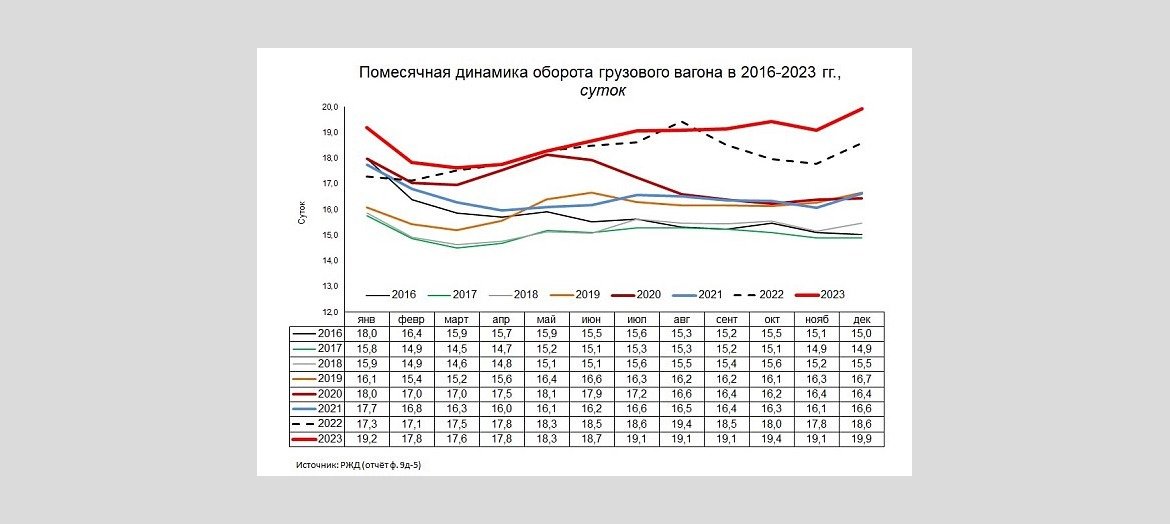
The graph from JSC RZD's report illustrates rail car turnaround figures over the past 8 years, along with intra-year fluctuations:
- Over the past two years, car turnaround times have been the worst in the last 8 years (even in 14 years, since the introduction of the new calculation methodology).
- Freight car turnaround in 2023 was 18.8 days — 3.9% (17 hours) longer than last year (18.0 days flat).
- Typically, turnaround time increases (deteriorates) in April–May–June and then decreases again. The last two years have been exceptions: in 2022 and 2023, the usual improvement did not occur between September and December.
At the same time, analyzing the turnaround breakdown in percentages reveals that in 2022 and 2023, the share of idle time under loading operations was lower than in 2021 (45.1% and 45.5% vs. 48.0%, respectively). Conversely, idle time at technical stations in 2022 and 2023 grew compared to 2021 (34.7% and 35.0% vs. 31.4%).
Over the last three years, the components of car turnaround dependent on shippers have improved, whereas the elements dependent on JSC RZD — specifically yard operations management — have deteriorated.