
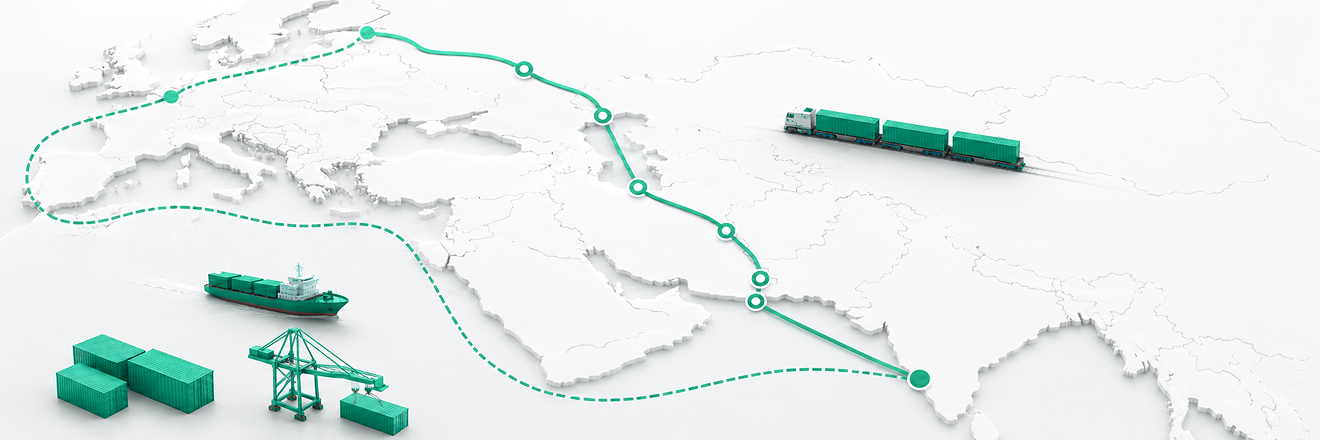

During the first four months of 2026, freight traffic along the North–South International Transport Corridor reached 2.2 million tons, which is 68% more than in the same period last year. These data were announced at SPIEF during a meeting between the Governor of the Astrakhan Region Igor Babushkin and the Iranian Ambassador to Russia Kazem Jalali.
New agreements expand the partner network
The increase in traffic confirms that the route is becoming increasingly in demand for trade between Russia, Iran, India, and the Persian Gulf countries.
In parallel, the Ministry of Transport of Russia is preparing new transportation agreements with India, the UAE, Oman, Qatar, and Saudi Arabia—previously, similar documents were signed with Iran and Bahrain.
What is behind the growth in traffic
One of the growth drivers is the coordinated tariff policy of the corridor's member states.
According to the Minister of Transport of the Russian Federation Andrey Nikitin, discounts of up to 50% on transportation are currently active on the eastern branch of the North–South ITC via Kazakhstan and Turkmenistan, and container traffic volume in this direction grew by 60% in 2025.
The countries along the route are jointly improving the corridor's competitiveness. For cargo owners, this means an alternative route that, thanks to discounts, is more cost-effective than standard routes.
What the growth in traffic offers to business
The North–South ITC connects Russia with the countries of South Asia and the Middle East through a network of rail, road, and sea routes.
Today, cargo shipments from India, Iran, the UAE, and other countries in the region are actively increasing along the corridor, and businesses are increasingly utilizing this route in import and export operations.
Infrastructure is also expanding. The Astrakhan Region is increasing port capacity and building new vessels for the Caspian Basin, while Russia and Iran are carrying out joint investment projects.
Industry experts consider the Trans-Caspian route via Caspian Sea ports to be the probable next step in developing the corridor, as it reduces the number of transit countries along the cargo's path.
Logistics expert's opinion
Until recently, the North–South ITC was discussed as a project for the future. Today, statistics show that the route is becoming a full-fledged part of international logistics.
A 68% increase in cargo traffic, expanded cooperation with Persian Gulf countries, and a coordinated tariff policy among participants point to the long-term development of this trade lane.
For Russian importers and exporters, this means more opportunities for working with India, Iran, the UAE, and other countries in the region. The larger the transport volume and the higher the competition among market participants, the lower the tariffs and the more attractive the route itself becomes.