
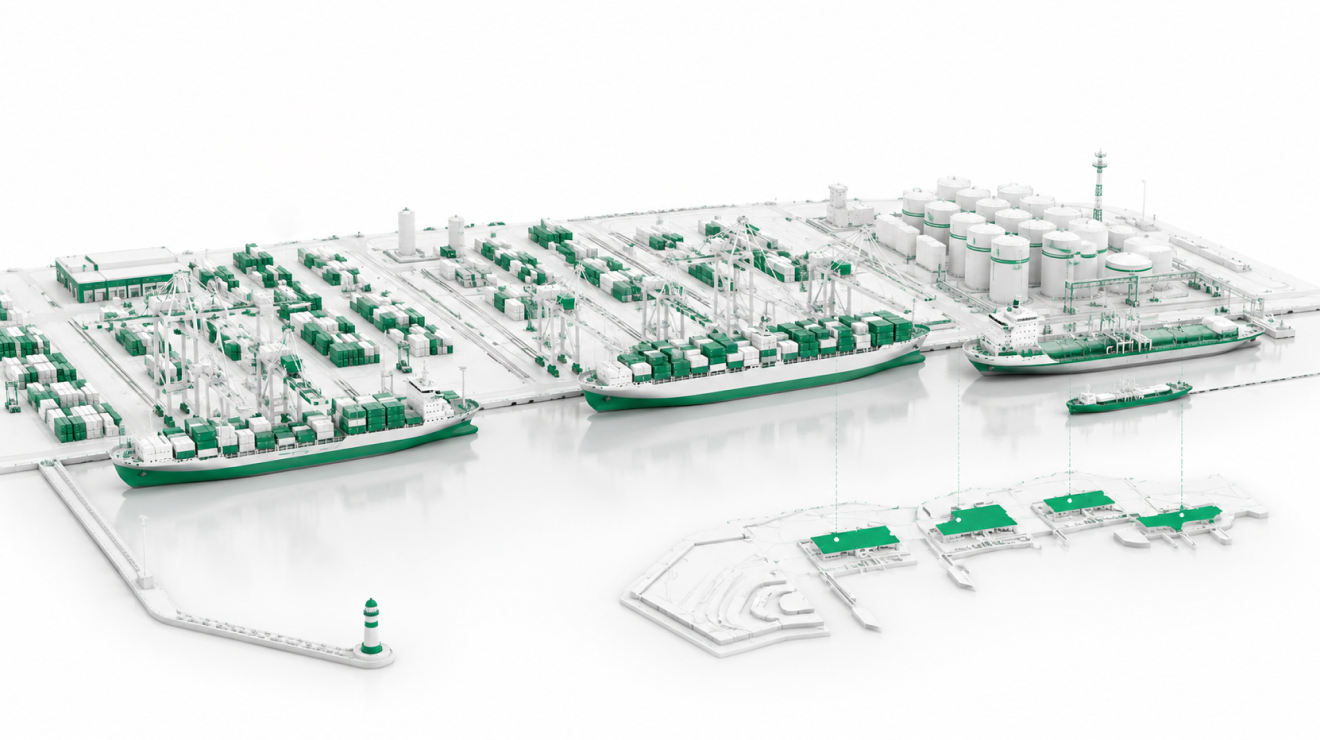

Novorossiysk is Russia's largest port by total cargo turnover. In 2025, 168 million tons passed through it, accounting for about 19% of the total Russian cargo flow. The city ranks third among the country's container hubs, handling 1,111 thousand TEU compared to 1,470 thousand in Vladivostok and 1,400 thousand in Saint Petersburg. Almost the entire container traffic is shared between two terminals: NUTEP (part of the Delo Group) and NLE (part of the NMTP / NCSP holding). We have an office in Novorossiysk, which allows us to coordinate the choice between these facilities with the client before booking a shipping line, rather than after the vessel arrives. Below are capacities, reconstruction projects, and our approach to vessel port calls.
Novorossiysk on the map of Russian container ports
In 2025, the container throughput of Russian seaports reached 5,342 thousand TEU, which is 4.4% less than the previous year. Against the backdrop of a nationwide decline, Novorossiysk's container throughput increased by 4.3%, while Vladivostok dropped by 10.6% and Big Port Saint Petersburg grew by 1.9%. 1,111 thousand TEU handled through a single port represents 20.8% of the country's total container transshipment. This figure cannot be directly compared to the port's overall tonnage share of about 19%: one metric counts total cargo turnover in tons, while the other accounts strictly for containers.
Market structure is crucial. Saint Petersburg and Vladivostok distribute container flows differently from the Black Sea hub. However, for cargo moving via the Black Sea or along the North–South ITC to Iran and India, there is no viable alternative to Novorossiysk: neither Tuapse nor Taman offers comparable combined capacity.
Two operators handle this flow unevenly. In 2025, NUTEP processed 624.3 thousand TEU, capturing about 56% of the local container volume. NLE handled 467.1 thousand TEU, or roughly 42%. Together, NUTEP and NLE account for around 98% of the city's container throughput. We transport cargo via both terminals, and below we outline how they differ in day-to-day operations.
NUTEP: Russia's second-largest terminal by volume
Novorossiysk Hub Transportation and Forwarding Enterprise (NUTEP) was established in 1994. In 2002, NUTEP joined Sergey Shishkarev's Delo Group. Today, the terminal is part of DeloPorts, co-owned by Rosatom. The terminal itself was built from scratch between 2002 and 2004: rather than upgrading aging berths, a completely new modern complex was erected.
In the 2025 Russian container terminal operator rankings, NUTEP secured second place with 624.3 thousand TEU. Only the Commercial Port of Vladivostok (FESCO) ranked higher with 805.8 thousand TEU. Container Terminal Saint Petersburg (CTSP) placed behind with 556.8 thousand TEU. NUTEP accounts for about 12% of Russia's total container turnover. The terminal remains number one by volume in the Azov-Black Sea basin.
NUTEP continues to expand despite the contraction across the Russian container market: its volume rose by 1.9% while national figures fell by 4.4%. Novorossiysk's container throughput climbed even faster, growing by 4.3%. In May 2025, NUTEP set a monthly record of 77.3 thousand TEU. The annual throughput reached 624.3 thousand TEU, proving that the figure was based on steady performance rather than mere extrapolation of a peak month. In the first half of 2026, transshipment totaled 348 thousand TEU, down 3.8% year-on-year. Although overall volumes across the Azov-Black Sea basin contracted, NUTEP retained first place in the basin and second place nationwide.
NUTEP berths, cranes, and railway infrastructure
The terminal operates four berths: two container berths (No. 38 and No. 39) and two Ro-Ro berths. Berth No. 38 is deepwater: approximately 390 m long, with a depth of 15.00 m alongside and an allowable draft of 14.70 m. It accommodates post-Panamax vessels carrying 10,000–14,000 TEU. Berth No. 39 features a shallower depth of 10.5 to 12.2 m with a length of 397 m, servicing Panamax and sub-Panamax vessels. Auxiliary berth No. 39A, measuring 211.5 m in length with a depth of 9.4 m, is used for auxiliary operations.
Handling equipment includes STS gantry cranes and RTG yard cranes. An electronic terminal operating system tracks every container in real time. The terminal enjoys direct access from the M-4 Don federal highway without entering public port roads. The railway infrastructure includes 6 receiving-and-departure tracks, enabling block trains to be assembled under a single consignment note without intermediate marshalling. Two additional tracks serve auxiliary needs. In our comparison below, we only count the six receiving-and-departure tracks used for container dispatch. For exporters shipping to China through this port, this setup saves 1 to 2 days compared to standard groupage trains.
Total capital expenditure in the terminal has exceeded 15 billion rubles, covering initial construction from scratch in 2002–2004 and all subsequent expansion phases.
Reconstruction of berth No. 38 and growth up to 1 million TEU
In August 2024, DeloPorts launched the reconstruction of berth No. 38. Cargo operations remain uninterrupted, and vessels continue scheduled calls. Completion of the project is scheduled for the end of 2027.
The reconstruction will lengthen the berth by 1.5 times, from 390 to 600 meters. The adjacent container yard capacity will expand from 3,080 to 4,830 TEU of static storage, and the yard area will grow from 4 to 6.4 hectares. As a result, NUTEP's total handling capacity will rise from 700 thousand to 1 million TEU per year, representing a 43% increase.
The project received Glavgosexpertiza approval on December 13, 2023. The contractor tender was announced in April 2024 with a contract value of 7 billion rubles. When berth No. 38 was originally commissioned in 2019 for $125 million, NUTEP doubled its capacity from ~350 to 700 thousand TEU. This next phase targets an additional 43% increase rather than doubling.
Beyond 2027, NUTEP will be able to moor large ocean-going vessels along an extended quay line and handle more ships simultaneously. For shipping lines on China–Black Sea routes, this is a vital advantage: an extended quay wall enables two large vessels to moor alongside without waiting in the outer roads.
NLE: The country's fourth-largest terminal with 11.8% growth
JSC Novoroslesexport (NLE) was established in 1956 as a specialized timber port. Its container terminal opened in 1999—43 years after the enterprise was founded—as part of a strategic port diversification effort. As timber exports steadily declined, container handling grew. Today, containers represent the bulk of cargo operations, though general cargo handling continues.
In 2025, NLE handled 467.1 thousand TEU, up 11.8% year-on-year. This places it fourth among Russian container terminal operators and accounts for about 9% of the country's total container turnover. NLE is currently growing faster than NUTEP. If your shipment combines general cargo and containers, we factor this in when selecting the handling terminal.
The bay, Panamax, and 19 railway tracks of NLE
The terminal is situated in the sheltered northeastern part of Novorossiysk Bay. Breakwaters significantly mitigate the impact of the northeasterly bora wind, which periodically disrupts open berth operations. NLE operates year-round without seasonal downtime, giving it a tangible edge over open-sea terminals.
The total site covers over 60 hectares, with a 12-hectare water area. The facility includes 11 berths spanning more than 1,600 m in total length. The container terminal alone occupies 16.77 hectares. Its rail infrastructure features 19 tracks—three times more than NUTEP. For cargo owners moving containers by rail, this means shorter wait times for railcars to be accumulated and dispatched.
The container terminal accommodates Panamax vessels up to 4,500 TEU capacity. Water depth at berths No. 29 and No. 30 is 14.5 m, and at berths No. 28A and No. 28 it is 13.6 m. While shallower than NUTEP's berth No. 38 (15.0 m), this is entirely sufficient for the vast majority of vessels calling in the Black Sea. Post-Panamax vessels of 10,000+ TEU do not call here, but such vessels remain rare in the Black Sea basin.
NLE expansion up to 500 thousand TEU
The reconstruction of the Timber Pier berths (Nos. 28A, 28, 29, and 30) is designed to bring the container terminal's throughput capacity to 500 thousand TEU annually. Having already handled 467.1 thousand TEU, the terminal is approaching this threshold. The project addresses three main areas.
First, the Timber Pier berths will be extended by 50 meters, enabling them to accommodate vessels with capacities up to 7,000 TEU instead of the current 4,500 TEU limit. Existing depths will be maintained: 13.6 m at Nos. 28A and 28 following completed capital dredging, and 14.5 m at Nos. 29 and 30 maintained via maintenance dredging. Third, the storage yards will be expanded, which is expected to boost cargo throughput by approximately 30%.
NLE previously announced plans to add another 300 thousand TEU of capacity beyond Phase 1. An additional expansion over the 500-thousand target would lift total capacity to approximately 800 thousand TEU. As firm timelines for Phase 2 have not yet been released, our operational planning up to 2028 focuses exclusively on Phase 1—reaching the 500-thousand TEU mark.
NMTP as a stevedoring holding: Oil, grain, and containers
PJSC Novorossiysk Commercial Sea Port (NMTP / NCSP) is not simply an individual container terminal alongside NUTEP and NLE, but a major stevedoring holding with port assets across Novorossiysk, Primorsk, and Baltiysk. Its largest shareholder is Transneft, with the Russian state holding a 20% stake. The holding operates NLE as a subsidiary.
The holding's total cargo throughput reached 65 million tons in 2025 (+5.1%). Meanwhile, the entire Port of Novorossiysk—factoring in non-NMTP operators and excluding NMTP's external assets—handled 168 million tons (+1.9%). The difference is due to third-party operators running grain terminals, NUTEP, and oil-loading facilities outside the NMTP perimeter.
Within the Port of Novorossiysk's breakdown, liquid bulk accounted for 122 million tons (+11%) and dry cargo for 45.5 million tons (−16%). The oil sector continues to drive the port's overall tonnages, while NLE's container throughput develops independently of liquid bulk trends. NMTP's container business in Novorossiysk is centered around NLE; the holding does not operate other dedicated container terminals in the city.
Comparative table of both terminals
| Parameter | NUTEP | NLE | NMTP (Holding) |
|---|---|---|---|
| Owner / Group | Delo Group / DeloPorts | PJSC NMTP | PJSC NMTP + Transneft |
| Year founded (terminal) | 1994 (rebuilt 2002–2004) | 1956 (containers since 1999) | N/A |
| Specialization | Containers, general cargo, Ro-Ro | Containers, general cargo, timber | Crude oil, oil products, grain, containers |
| Capacity, th. TEU/year | 700 (up to 1,000 by end of 2027) | Actual 467; Phase 1 target: 500 | N/A (holding total) |
| Throughput in 2025 | 624.3 th. TEU (+1.9%) | 467.1 th. TEU (+11.8%) | 65 mln tons (+5.1%) |
| Rank in Russia | 2nd (~12% of container market) | 4th (~9% of container market) | Holding: 65 mln t; Port of Novorossiysk: ~19% of RF port tonnage |
| Berths (container) | 2 (+ 2 Ro-Ro) | 11 total (4 on Timber Pier) | N/A |
| Depth alongside, m | Up to 15.0 (Berth No. 38) | Up to 14.5 (Berths No. 29–30) | N/A |
| Vessel class | Post-Panamax (from 10,000 TEU) | Panamax (currently up to 4,500 TEU; up to 7,000 post-reconstruction) | N/A |
| Railway tracks | 6 receiving-and-departure tracks | 19 tracks | N/A |
| Customs post | South-Eastern | Western | N/A |
| Capital investments | Over 15 bln RUB cumulative; 7 bln RUB for Berth No. 38 reconstruction | Timber Pier berths reconstruction | N/A |
The NMTP column is included to provide corporate context. When evaluating container handling, compare NUTEP directly with NLE; the first two columns cover all terminal-specific metrics.
Who this analysis is not for
If you are importing a one-off private parcel or an ad-hoc shipment without regular commercial imports, capacity charts and expansion schedules are largely irrelevant. You only need to verify which terminal your shipping line calls at and coordinate cargo release with your broker. The remainder of this overview is intended for businesses planning regular shipments, comparing rail versus road cartage, or choosing an entry port for an annual supply contract.
We do not handle unauthorized cargo schemes or undervalued declarations. Our customs representative license entails joint and several liability for declarations, and we do not assume legal risk for an importer's attempt to cut duties. From here on, we discuss strictly compliant, white-channel logistics.
How we select a terminal for your cargo
Choosing between NUTEP and NLE depends on the vessel call, the designated customs post, specific liner services, and intra-port forwarding tariffs applicable to your consignment. Because public forwarder tariff brackets are rarely available in advance, we quote every case individually.
Most mainline container carriers serving the Black Sea call at NUTEP in Novorossiysk. Berth No. 38, with a 15-meter depth, regularly handles post-Panamax vessels sailing Far Eastern routes via Suez. NLE is restricted to Panamax vessels: up to 4,500 TEU today and up to 7,000 TEU after reconstruction. While this limits the list of eligible lines compared to NUTEP, major regional Black Sea carriers call at NLE as well.
For rail-based container evacuation, NLE offers a superior layout: 19 rail tracks versus 6 at NUTEP. During volume spikes, this cuts wait times and accelerates platform turnaround. For road transport, NUTEP is more convenient due to its direct off-ramp to the M-4 Don highway, eliminating transit through crowded port streets.
The terminals operate under different customs posts: NUTEP is cleared through the South-Eastern post, while NLE is assigned to the Western post. For some cargo owners, working through a specific post matters due to established customs workflows, proven documentation practices, or specific commodity profiles. In practice, TransGID brokers work on both posts, so this factor is rarely decisive if documents are prepared beforehand.
Reefer cargo requires separate planning. NLE is located adjacent to the Port Lesnoy cold storage warehouse, allowing refrigerated containers to be transported to storage without a genset (clip-on generator). For perishables, this minimizes handling risks and costs. When shipping temperature-controlled freight, we evaluate NLE and the cold-chain setup first, before benchmarking liner options.
Key takeaways for cargo owners
If your cargo arrives via mainline carriers on long-haul routes (China, Southeast Asia, the Persian Gulf), the vessel will most likely berth at NUTEP. It offers more liner options, deeper draft, and higher departure frequencies. The terminal closed 2025 at 624.3 thousand TEU and is expanding to reach 1 million TEU capacity by late 2027.
If your cargo travels on feeder routes across the Black and Mediterranean Seas or via ferry services, NLE matches NUTEP in operational reliability while holding an edge over open-sea berths due to its sheltered location. When shipping inland by rail, its 19 tracks deliver a clear advantage. NLE's 2025 growth rate (+11.8%) outperformed NUTEP, and the terminal is already operating close to its Phase 1 limit of 500 thousand TEU.
Between 2026 and 2027, the main industry milestone will be the completion of NUTEP's reconstruction by the end of 2027. Once commissioned, the combined capacity of both terminals will reach approximately 1.5 million TEU annually (1 million at NUTEP plus roughly 500 thousand at NLE). If NLE completes Phase 2 and increases its own capacity to ~800 thousand TEU, Novorossiysk's overall throughput could reach 1.7–1.8 million TEU. No definitive dates have been confirmed for Phase 2. NUTEP's first-half 2026 results (−3.8%) demonstrate that throughput is governed by wider basin demand, not berth capacity alone.
Direct calls by MSC, CMA CGM, and Maersk largely ceased after 2022. Their space has been taken by regional and Asian carriers. We confirm every vessel call individually against carrier schedules tailored to your consignment. For annual volume benchmarks, consider 2025 figures: 624.3 thousand TEU at NUTEP and 467.1 thousand TEU at NLE.
If you are selecting a terminal for an annual supply contract or planning your first shipment via Novorossiysk, send us your FEA commodity code (HS code), delivery terms, and preferred inland mode—truck or rail. We will confirm which terminal offers the best slot availability for your cargo and calculate customs clearance costs in advance. Freight forwarding and customs clearance are core services of TransGID, and our Novorossiysk branch ensures full hands-on supervision of your freight on site.