
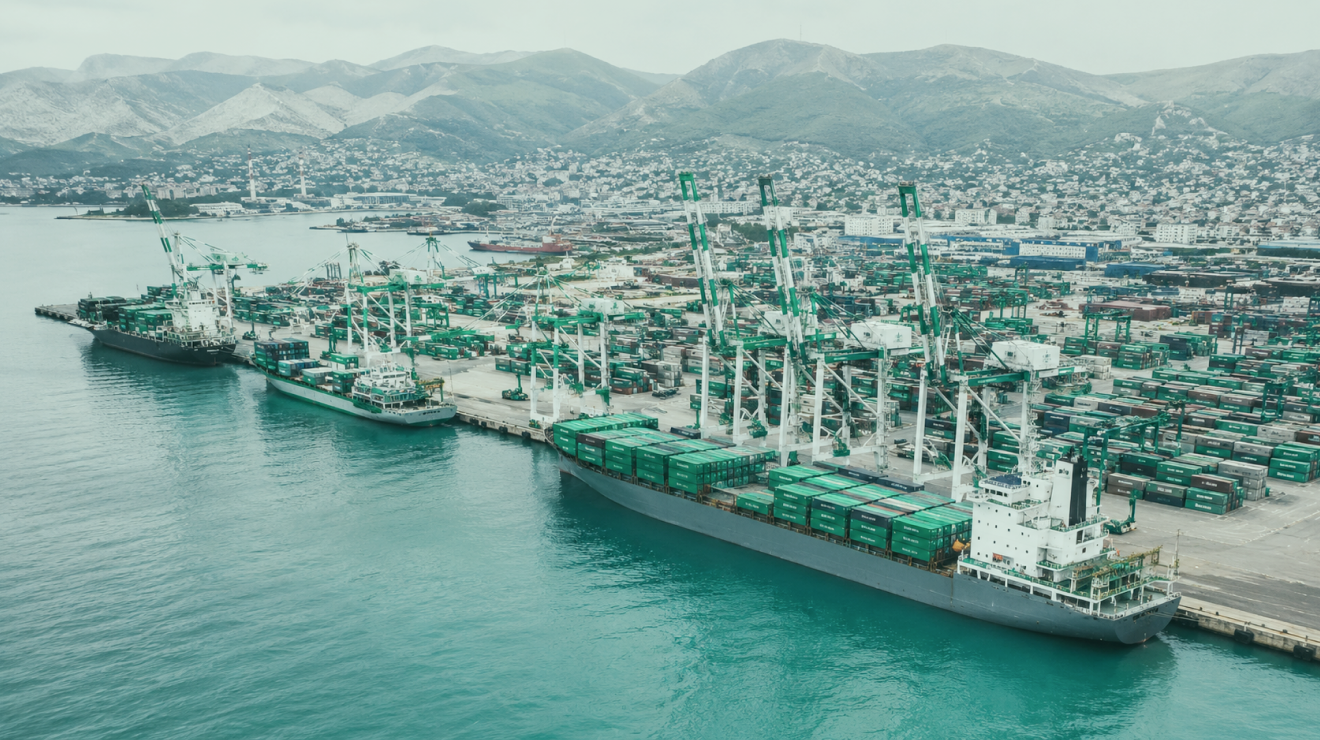

In 2025, Novorossiysk handled 168 million tons of cargo — 29% more than Ust-Luga, its closest competitor port (130 million tons), and twice as much as Vostochny Port in the Far East. Every fifth ton of Russian seaborne exports passed through Novorossiysk — Urals crude and the Kazakh CPC Blend, wheat for Egyptian grain elevators, containers with fertilizers and metals for Asian and African markets. In 2026, a terminal worth 120.7 billion rubles is under construction in the port, the Caspian Pipeline Consortium plans to transship a record 72 million tons of crude oil through the local mooring complex, and container throughput exceeded 1.1 million TEU for the first time. Behind these numbers lie three factors: the reorientation of Russian exports from the Baltic to southern routes, a pivot toward Asian markets, and large-scale infrastructure investments.
Russian Port Rankings 2025 — 168 Million Tons and 19% Market Share
According to InfraNews, Novorossiysk retained its leadership among the country's sea ports at the end of 2025. Total transshipment reached 168 million tons, representing 19% of the aggregate cargo turnover across all Russian ports. The gap with competitors is not closing. Ust-Luga took second place with 130 million tons (-3% year-on-year), while Vostochny Port took third with 85 million tons (-4%). Fourth, fifth, and sixth places are held by Primorsk, Saint Petersburg, and another Baltic port.
In the Azov-Black Sea Basin, Novorossiysk stands apart. The basin's total cargo turnover in 2025 reached 265.4 million tons, with Novorossiysk alone generating 63% of this volume. Taman handled 29.5 million tons (+4.1%), while Tuapse handled 21.8 million tons (+1.7%). Ports Kavkaz and Rostov-on-Don, on the other hand, saw steep declines — down 35% and 19.7% respectively, pulling the basin's average down by 3.9%.
The Ministry of Transport of Krasnodar Krai notes that up to 30% of all foreign trade and transit cargo moving through Russian sea ports passes through the region's ports. Novorossiysk generates the majority of this traffic and, unlike its competitors, posted growth rather than a decline in 2025.
In the cargo transshipment breakdown, crude oil holds a dominant position. Liquid bulk cargo grew by 11% in 2025 to 122 million tons. Dry bulk cargo dropped by 16% to 45.5 million tons, impacted by a weak grain season and a drop in metallurgical exports through the region. At the same time, the ratio of liquid to dry bulk is steadily shifting toward oil, reflecting the logic of reorienting Russian hydrocarbon exports toward southern routes.
CPC Transshipped a Record 70 Million Tons of Oil Through a Single Terminal
A few kilometers north of Novorossiysk, in a bay near Yuzhnaya Ozereyevka, three single point moorings (SPMs) of the Caspian Pipeline Consortium are in operation. In 2025, an all-time record 70.52 million tons of oil passed through them across 587 tankers, of which 142 were Aframax and 445 were Suezmax vessels. According to official CPC data, this is 7 million tons and three vessels more than the previous year.
The 1,511 km Tengiz–Novorossiysk pipeline transports more than two-thirds of Kazakhstan's total export crude. The CPC marine terminal accounts for over 80% of Kazakhstan's seaborne oil exports. Russia also moves its own raw materials from Caspian fields via the CPC.
For 2026, the consortium set a target of 72 million tons — a 2% increase over the already record-setting 2025. This single terminal surpasses many Russian ports in total volume: the entire Vostochny Port handled 85 million tons across all cargo types in 2025. CPC General Director Nikolay Gorban stated during a meeting with Kazakhstan's Energy Minister that both new SPMs have already been manufactured, one has been delivered to Novorossiysk, and installation works are underway.
CPC assets were repeatedly targeted in 2025–2026. In February 2026, seven UAVs struck the Kropotkinskaya pump station. In November 2025, an unmanned surface vessel damaged SPM-2. In April 2026, strikes damaged a mooring unit and a crude berth. The consortium initiated the replacement of both legacy SPMs alongside repair operations and decided not to revise its annual transshipment targets downward.
The Black Sea Pivot — How Novorossiysk Captured Baltic Traffic
Prior to 2022, Russian oil exports were distributed relatively evenly across several maritime basins. Ust-Luga and Primorsk generated a significant share of Baltic loadings. After 2022, the trade flow structure changed. European buyers departed, and routes shifted toward Asia and the Middle East — destinations far more conveniently served from Black Sea and Far Eastern ports.
In February 2026, the Center for Price Indices (CPI) registered a 63.6% increase in crude exports via Novorossiysk, reaching 54 thousand tons per day. The port's share of total Russian seaborne oil loadings expanded from 8% to 14%. Simultaneously, the Baltic lost volumes due to logistical and geopolitical challenges, redirecting part of the freight traffic to the Black Sea corridor and the Far East.
The Black Sea routing provides several key advantages. Turkey has not joined Western sanctions and continues to receive Russian crude. The Suez Canal provides the closest gateway to the Indian Ocean and Asian markets. Transit time from Novorossiysk to Indian refineries via the route around Africa (circumventing the volatile Red Sea) takes around 35 days — fully viable for long-term contracts with Indian off-takers.
In April 2026, UAV attacks on the Sheskharis terminal halted Urals oil loadings from April 13 to April 19. By the following week, exports had already rebounded: total seaborne exports of Russian oil climbed to 406 thousand tons per day, 14.5% higher than the preceding week. During the initial week of resumed shipments, two tankers departed: a Suezmax destined for China and an Aframax with a confidential destination. The recovery speed demonstrated that the port managed the incident as a routine operational interruption rather than a systemic shutdown.
Grain Terminals — 2025 Slump and Return to Growth
Russia's two largest grain terminals are situated in Novorossiysk. The KSK terminal (DeloPorts stevedoring holding) handled 7.4 million tons in 2025 — 28.6% less than the year prior (10.3 million tons). The Novorossiysk Grain Terminal (NZT, Demetra-Holding) shipped 5.47 million tons — down 24.4% compared to the record set in 2024 (7.24 million tons). Both preserved their market leadership: KSK remained the nation's top grain terminal, and NZT remained the largest complex for handling grain and non-hazardous liquid cargoes.
The downturn had nothing to do with infrastructure constraints at the facilities. The primary factor was the poor 2024 grain harvest: yields were simply insufficient to sustain higher export volumes. In addition, the government established a grain export quota of 10.6 million tons for the first half of 2025, compared to 29 million tons during the same period in 2024. The market began rebounding in the second half of the year: in August, October, and November, KSK handled over 1 million tons of grain per month. In Q4 2025, KSK's transshipment volume increased by 4.3% year-on-year.
In 2025, 32.9 million tons of grain passed through Krasnodar Krai ports, of which wheat accounted for 30.7 million tons — 93% of the region's overall grain exports. The primary destinations were Egypt, Turkey, Iran, and North African countries. As the deep-water Black Sea port situated closest to the country's grain-producing hubs, Novorossiysk maintains an inherent geographical advantage over any Baltic grain terminal.
In 2025, KSK commissioned a ship unloader capable of receiving export grain cargoes from river-sea vessels and loading them directly onto ocean-going bulk carriers. Previously, the facility received grain strictly by truck and rail. The new inland waterway route mitigates bottlenecks along the congested southern rail corridor and minimizes reliance on offshore lightering near Port Kavkaz.
Through 2028, NZT is executing a capital development program covering rail infrastructure upgrades, new conveyance and vessel-loading installations, and expanded storage capacities. This will provide the terminal with the necessary capacity reserve ahead of expected volume increases in the upcoming agricultural season.
Containers and New Services to China
In 2023, Novorossiysk processed over 1 million TEU for the first time — an important milestone for a major seaport. In 2025, volume totaled 1.11 million TEU (+4.3% compared to 2024). The port secured third place in Russia by container throughput with a 20.8% market share, behind Vladivostok and the Big Port of Saint Petersburg. According to PortNews, the NUTEP container terminal (DeloPorts) ranked second nationwide by volume at 624.3 thousand TEU (+1.9%), maintaining its top position across the Azov-Black Sea Basin.
The primary growth catalyst is the export trade. In 2024, laden container exports through Novorossiysk rose by 25.5% — driven by a domestic surplus of empty containers and the rollout of direct liner services to Asian destinations. Containers are stuffed at the Novorossiysk transport hub after arriving via rail and road from other regions across Russia.
In December 2024, FESCO Transportation Group launched the direct FBSS (FESCO Black Sea Service) sea service connecting Chinese ports with Novorossiysk via the Suez Canal. Vessels depart Nansha and call at Rizhao, Ningbo, and Shanghai before reaching Novorossiysk and returning. A 1,660 TEU container ship runs monthly; in early 2025, a second vessel of the same class joined the rotation. Transit time is roughly 25 days. Outbound traffic consists of fertilizers, non-hazardous chemicals, and agri-commodities; inbound traffic includes consumer goods, finished vehicles, and automotive kits.
Inbound container volume through the Azov-Black Sea Basin expanded to 48 thousand TEU per month in 2025, up from 35–45 thousand in 2023–2024, based on TD Partner research. Novorossiysk, Taman, and Azov process freight from Turkey, the UAE, and India, replacing severed Western supply lines. The Indian corridor through Suez has been diverted around the Cape of Good Hope due to Red Sea instability: transit takes approximately 35 days, which remains practical for most cargo types.
120 Billion Rubles Being Invested in the Port Until 2027
At the Novorossiysk Ship Repair Yard (NSRZ) site, a modern transshipment complex with an annual capacity of 12 million tons (expandable to 20 million tons) is being built. Total capital expenditure stands at 120.7 billion rubles. The project is co-owned by NCSP and the Metalloinvest holding. At the St. Petersburg International Economic Forum in June 2026, a major construction phase was officially launched, reports PortNews: quayside infrastructure is being built, artificial land plots are being reclaimed, and coastal protection works are ongoing. Commissioning is scheduled for December 2027.
The facility is engineered to transship iron ore raw materials: iron ore concentrate, fluxed and unfluxed pellets, hot-briquetted iron (HBI), pig iron, plate steel, and billets. For Metalloinvest, one of the world's leading producers of direct-reduced iron products, Novorossiysk will provide a direct gateway to global trade routes without intermediate transshipment. A 49-year concession agreement was signed with Rosmorrechflot, including a five-year extension option.
In parallel, NCSP is developing a mineral fertilizer terminal with a capacity of 6 million tons annually. The budget is 28.4 billion rubles, with commissioning planned before 2030. Russia ranks among the world's premier fertilizer exporters, with the majority of these volumes currently routed through Baltic ports. The new Black Sea terminal will redirect part of this trade flow to the southern route, significantly closer to target buyers.
Combined investment in these two assets alone exceeds 149 billion rubles, excluding NCSP's own CapEx, which reached 19.3 billion rubles in 2025. Russian seaports have not seen an infrastructure program of this magnitude since the mid-2000s. Once both projects are operational, Novorossiysk will add up to 18 million tons of new throughput capacity each year.
NCSP Financials — 76.5 Billion Rubles in Revenue and Profit Growth
PJSC NCSP is the country's largest publicly traded port operator and the second-largest stevedore by turnover in the Azov-Black Sea Basin. The controlling shareholder with a 62% stake is PJSC Transneft. The group's IFRS financial results for 2025 were released on March 30, 2026.
Group consolidated revenue for 2025 reached 76.5 billion rubles (+7.5% year-on-year). Net profit reached 40.6 billion rubles (+7.2%). EBITDA rose by 9.3% to 52.7 billion rubles. Under Russian Accounting Standards (RAS), revenue stood at 37.34 billion rubles, an 11% increase year-on-year. Aggregate cargo throughput of NCSP Group reached 65 million tons in 2025 (+5.1%).
Capital expenditures of 19.3 billion rubles in 2025 — a historic high in the company's public history — were channeled into the new NSRZ terminal facility and the fertilizer berth. NCSP and Metalloinvest increased the charter capital of their joint subsidiary, LLC UPC NSRZ, to 6.67 billion rubles, establishing the capital basis for Phase 1 construction.
Revenue growth continues to outpace physical cargo growth: group turnover expanded by 5.1%, while revenue rose by 7.5%. This illustrates tariff adjustments and a structural shift toward higher-margin commodities. The company is optimizing depreciation costs while expanding investments in personnel and maintenance — key drivers of berth operational reliability.
Drones and Railways — The Port's Two Main Risks
Novorossiysk operates amidst two continuous risk factors. The first is drone strikes. Sheskharis, CPC marine terminals, and the CPC-R administrative building in the city were all targeted by UAVs and unmanned surface craft during 2025–2026. In April 2026, crude oil shipments via Sheskharis were suspended for seven days. While a seven-day outage is noticeable on a weekly timeline, it is not critical on an annual scale: cumulative throughput across Russian seaports during January–April 2026 increased by 2.6% to 288.6 million tons, based on figures from the Association of Commercial Sea Ports.
The second risk is the railway network. Novorossiysk chronically runs into railway throughput deficits on the approach routes to the south. Industry analysts (SeaNews) point out that logistical constraints impede further container traffic expansion: the port could handle more containers, but feeder trains and trucking cannot keep pace with cargo arrivals. A comprehensive 14-billion-ruble rail modernization initiative in Novorossiysk is scheduled for completion by 2030. Phase 1 launched at the end of 2025, and construction continues across the remaining segments.
Both risks place constraints on port development, but do not prevent growth. Crude terminals resolved every drone encounter without extended operational downtime. The rail initiative is backed by federal funding and moves ahead, albeit slower than originally scheduled. The pace at which this transport bottleneck is cleared will dictate how quickly Novorossiysk can expand containerized and general cargo throughput across 2027–2030.
Today, Novorossiysk serves as the focal point for Russian crude, grain, and container exports connecting to three continents simultaneously. No other domestic port offers such a balance of diverse cargo streams supported by infrastructure construction of this scale. With the launch of the NSRZ terminal in 2027 and the fertilizer facility in 2030, its competitive advantage will keep widening.