
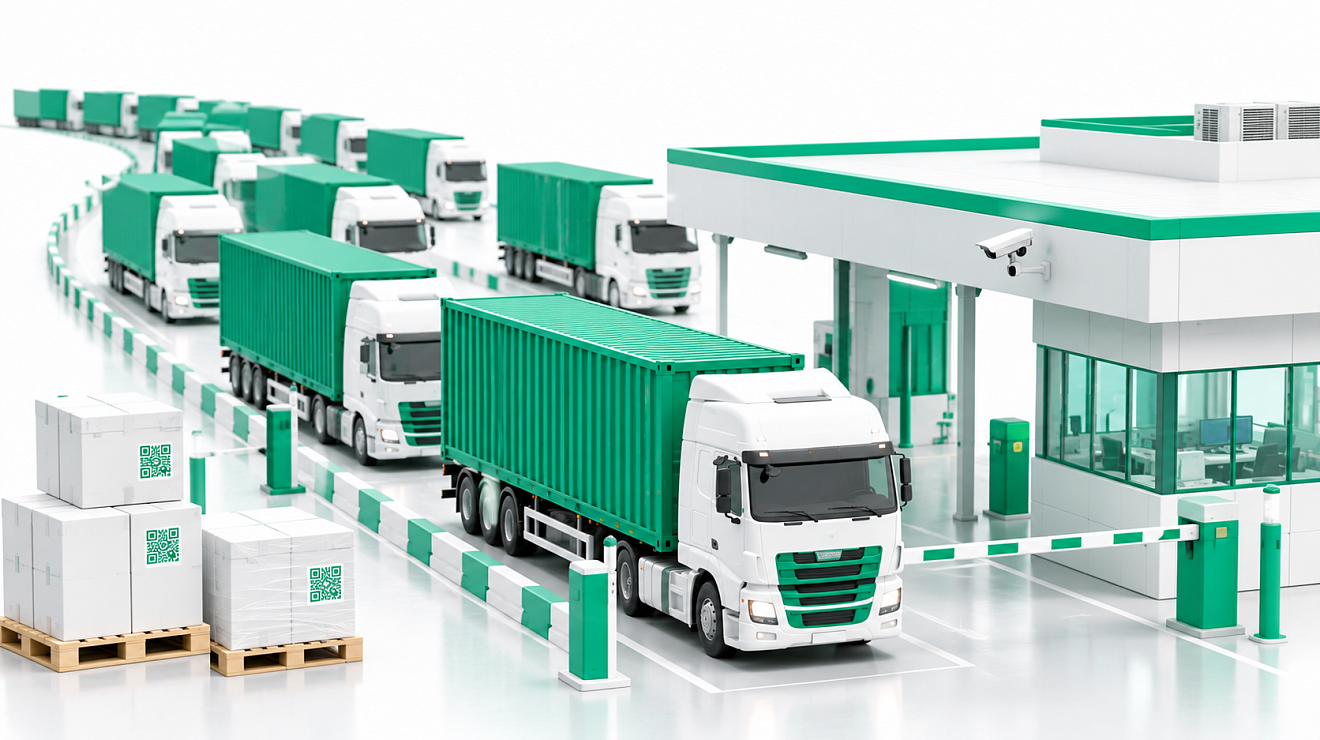

If you import labeled goods from EAEU countries, either independently or through an intermediary, starting July 1, 2027, tax authorities may begin verifying your price against their minimum benchmark: on November 19, the State Duma passed this rule in the second reading. That same week, Estonia announced the closure of all five road border checkpoints with Russia starting December 1, a queue of about 20 km formed before Zabaikalsk, and Kazakhstan suspended processing export clearances via Kuryk ferries until November 30.
Minimum Price for VAT on Imports from the EAEU Passes Second Reading
Draft Law No. 617–9 amending the Tax Code passed its second reading on November 19. Article 54.2 will be added to the code. When importing labeled goods from EAEU countries, VAT will be calculated based on the transaction price only if it is higher than the minimum price; if it is lower, it will be calculated based on the minimum price. The Federal Tax Service (FTS) will calculate minimum prices monthly and publish them on its website with a search by GTIN (Global Trade Item Number). The rule will come into force on July 1, 2027.
The rule applies to three scenarios: you import the goods yourself, you purchase goods previously imported by a foreign company, or the goods are imported for you by a commission agent, attorney, or commercial agent. Sales to individuals via marketplaces are exempt from the rule, as reported by Retail.ru and Skillbox Media. The draft law still has to pass its third reading.
If the law is adopted in this version and your EAEU supplier's price turns out to be lower than the FTS minimum price, you will have to pay the VAT difference starting July 2027. At TransGID, we do not operate under such schemes even now. We never state prices in contracts and invoices that we cannot justify to tax authorities. Why we adhere to transparent pricing is detailed in our article on official customs clearance vs. cargo delivery.
Who Is Not Affected by the Minimum Price
The minimum price rule does not apply to you if you purchase directly from a manufacturer in China and import goods under your own contract, submitting the declaration yourself or through a customs broker. In that case, VAT is calculated by customs based on the customs value, as before. The rule also does not apply to non-labeled goods from the EAEU. If you are unsure which category your scheme falls under, send us your contracts, and we will analyze whether it is affected by the new article once the final text of the law is published.
Ministry of Finance Prepares Duty Hikes on Delicacies from Unfriendly Countries
Deputy Minister of Finance Alexey Sazanov stated in the State Duma on November 19 that the Ministry of Finance will soon submit a proposal to the government to increase import duties on gourmet delicacies from unfriendly countries. The increased rates are expected to take effect starting next year, 2027. The Ministry has not yet disclosed the specific duty rates or the product list. If you import foodstuffs from Europe and are already negotiating 2027 pricing with buyers, make sure to include a clause in your contracts allowing price adjustments following duty increases. We will recalculate customs payments as soon as the list is released.
First Package of Amendments to the EAEU Customs Code Scheduled for Signing in December
EEC Minister for Customs Cooperation Sergey Shklyaev outlined two packages of amendments to the Customs Code. The first is scheduled to be signed in December at the Supreme Eurasian Economic Council meeting. It simplifies the movement of certain categories of goods, including containers, regulates piggyback transport and cabotage, and closes loopholes for fictitious transit schemes.
The second package is currently undergoing regulatory impact assessment and will not be signed in December. It introduces the institution of authorized exporters, prioritizes electronic pre-arrival information filing, and allows labeling goods at temporary storage warehouses (TSW) and bonded customs warehouses. This is crucial if you import labeled goods. In one of our case studies, spark plugs and filters for an auto repair chain were collected from 12 manufacturing plants, and we applied DataMatrix codes directly in China. Once the second package is adopted, part of this process can be transferred to a temporary storage warehouse in Russia.
10-Minute Border Crossing Procedure to Expand to Five Far Eastern Checkpoints
Deputy Prime Minister Andrey Nikitin stated that in 2027, the 10-minute border clearance pilot program will be expanded to five additional checkpoints. According to Ministry of Transport data, all five are in the Far East, and the system is already being tested at the Tagirkent-Kazmalyar border crossing on the border with Azerbaijan. The single-window border clearance bill has passed its first reading, with full deployment scheduled for March 1, 2028. The 10-minute clearance is promised to carriers who submit documentation in advance.
Deputy Minister of Transport Valentin Ivanov shared relevant statistics: border truck throughput grew from 4.3 million in 2020 to 7.2 million in 2025; this year, Pogranichny and Kraskino checkpoints on the Chinese border were upgraded. FCS Deputy Head Anna Korosteleva stated that customs control will be based on advance notification and pre-arrival data analysis, anchored by the Integrated Border Checkpoint System. Vehicles with fully verified cargo data ready before reaching the boom barrier will clear customs swiftly. At TransGID, we already reconcile invoices, packing lists, and labeling at warehouses in China prior to dispatch, as rectifying errors at the border takes significantly longer.
Estonia Closes Road Checkpoints, Latvia Clears 25% Fewer Trucks
Estonian Prime Minister Kristen Michal announced on November 20 that all five road checkpoints bordering Russia will close from December 1. These include Narva-1, Narva-2, Koidula, Luhamaa, and Saatse. In six months, the Estonian government will assess whether to revise the restrictions. According to FCS data as of November 17, Estonian road checkpoints currently operate only from 08:00 to 20:00 Moscow time, while Shumilkino and Kunichina Gora handle truck traffic intermittently.
Congestion is also mounting along the Latvian corridor. As of November 19, an average of over 100 trucks were waiting to exit via the Ubylinka border crossing, with the Latvian side processing 25% fewer vehicles than in early November. The FCS warns that restrictions along Belarus-EU borders could trigger queues at other crossing points as well. If your cargo moves by truck to or through the Baltic states, routes via Estonia must be rerouted starting December. Allow extra transit buffer time for Latvian border crossings as well.
Nearly 20 km Queue Before Zabaikalsk
TKS and the Predprinimatel publication report that ahead of the New Year, a truck queue of about 20 km has formed at the Zabaikalsk–Manzhouli crossing, with wait times reaching up to a week. Customs increased clearance capacity from 650 to 700 trucks per day, but arrivals exceed 1,000 vehicles on peak days. Market participants report that electronic queue booking slots are being resold for 9,000–30,000 rubles. Following full reconstruction, the checkpoint is designed to handle 2,400 vehicles per day.
Another operational detail for carriers: due to roadworks on highway A-350, outbound vehicles departing Russia will be routed via the bus lane during specific hours. The schedule published by the FCS is: Nov 28 (10:00–14:00), Nov 29 (10:00–16:30), Dec 1 (10:00–12:00), Dec 3 (10:00–13:30), Dec 10 (10:00–11:00). If your holiday cargo is shipped from China by truck via Zabaikalsk, factor in a one-week border buffer. In such scenarios, TransGID also calculates rail container shipping alternatives, though train slots in December also require early booking.
Kazakhstan Suspends Export Clearances via Kuryk Until November 30
From November 19 to 30, dispatch and rerouting of export cargo via the Kuryk–Port ferry service have been suspended at all railway stations across Kazakhstan. Ferries are delayed due to adverse weather, leaving 1,185 railcars backlogged toward the crossing, with some idling on rail approaches, according to InfraNews and Casp-Geo. If your export route runs through Kazakhstan and the Caspian Sea, new shipments cannot be processed along this corridor until the end of November. If your railcar is already en route, TransGID can pinpoint its location and determine the most cost-effective option: waiting for ferry operations to resume or rerouting the freight.
Rail Imports from China Up by 19.4%
Over the first ten months of the year, Russian Railways transported a record 162.2 million tons in freight traffic with China, an increase of 4.5%. Container volume reached 3.1 million TEUs, up 14.1%. Outbound traffic to China totaled 141.1 million tons (+2.5%), while inbound shipments from China reached 21.1 million tons (+19.4%). Transport of motor vehicles and auto parts grew to 1.8 million tons (+54.8%), manufactured goods reached 3 million tons (+21.8%), and chemicals climbed to 4.4 million tons (+18.6%).
Port traffic in trade with China handled 114.2 million tons (+7.1%), while overland border crossings processed 47.9 million tons, down 1.3%. Rail transit via Zabaikalsk reached 19.9 million tons (+4.9%) and 526,200 TEUs (+25.5%). Rail imports from China are outpacing exports significantly: 19.4% versus 2.5%.
Container Imports Through Far Eastern Ports Up by 41%
German Maslov, FESCO's Vice President of Logistics, stated at Transport Week that the company's container traffic volume in the Far East expanded by 55% over 10 months. For every export container transported by rail to ports, FESCO moves four import containers. According to Rossiyskaya Gazeta, cited by Alta-Soft and TKS, container imports through Far Eastern ports surged by 41% over nine months, while exports declined by 15% and cabotage dipped by 3%. Each month, ports process approximately 125,000 import containers, 40,000 export containers, and 30,000 cabotage containers. Railways dispatch over 4,000 containers daily from port terminals, targeting 6,000 per day.
A portion of container flow is loaded onto open-top wagons (gondola cars). According to the Far Eastern Railway press office, reported by PortNews and TKS, 546,400 TEUs were dispatched from the Far East in open-top railcars over ten months—a 2.4-fold increase year-on-year. This required dispatching 3,709 trains and deploying 273,200 open-top wagons. Oleg Kozhemyako, Deputy Prime Minister and Presidential Plenipotentiary Envoy to the Far Eastern Federal District, suggested lowering tariffs for container transport in open-top cars; however, no official ruling has been made by Russian Railways or regulatory authorities. TransGID operates an office in Vladivostok, and our shipments move within this freight corridor. If your container arrives at the port in December, confirm with your freight forwarder not just the vessel arrival date, but when the container will actually be cleared and dispatched from the port terminal.
Eastern Operating Domain Is Operating at Full Capacity
Andrey Nikitin noted that throughput capacity for the Baikal-Amur Mainline (BAM) and Trans-Siberian Railway will increase from 180 million tons to 210 million tons by 2030, and reach 270 million tons by the end of 2032. Construction of the second Severomuysky Tunnel commenced in 2026, and electrification of the BAM to Vanino will continue in 2027. Deputy Minister of Transport Alexey Shilo stated that the 180 million ton annual capacity is already fully utilized, while Phase 3 construction is underway, as reported by PortNews and RZD-Partner. Until Phase 3 is completed, eastbound rail network capacity has zero margin, and any disruption along the Trans-Siberian will delay your freight. We recommend booking December train capacity well in advance.
Ferries to Kaliningrad and Quotas on Corn and Soybeans
The Russian government included the project of two rail ferries for the Ust-Luga–Baltiysk route into the list of initiatives financed by the National Wealth Fund (NWF) on a repayable basis. The project is valued at nearly 47 billion rubles, with up to 38.1 billion rubles (81%) funded by the NWF and the remainder covered by the federal budget. The vessels are scheduled for completion by 2030. Mikhail Mishustin noted that this initiative will reduce business logistics costs for shipments to the Kaliningrad Region.
Another decision impacts Far Eastern exports. For 2027, the government established duty-free export quotas outside the EAEU for corn and soybeans originating from Primorye and the Amur Region: 700,000 tons of corn for Primorye and 150,000 tons for the Amur Region, plus 200,000 tons of soybeans for Primorye. These quotas are valid from January 1 to December 31, 2027, and are distributed by regional governors. If you export grain from the Far East, apply for your regional quota allocation before year-end.
Drewry Index Declines for Fourth Consecutive Week
The composite Drewry WCI Index stood at $4,176 per 40-foot container as of November 19, down 3% from the prior week. This marks the fourth consecutive weekly drop. Shanghai–Rotterdam held steady at $3,496, Shanghai–Genoa stood at $4,436 (+6%), Shanghai–Los Angeles at $7,026 (−5%), and Shanghai–New York at $8,194 (−9%). Drewry anticipates rising freight rates from Asia to Europe and the Mediterranean in the coming weeks. Russian trade lanes are not tracked by the index, so a drop in the WCI does not necessarily translate into lower freight rates to Russia.
Key Action Steps Before the New Year
- If importing labeled goods from the EAEU, incorporate potential VAT supplementary payments into contracts for the second half of 2027.
- If shipping by truck via Estonia, select an alternative border crossing before December 1 and include additional transit time, as Latvian checkpoints are also congested.
- Allow an extra week of transit time when routing via Zabaikalsk.
- Do not plan new shipments via Kuryk through November 30.
- Book rail space from China earlier than usual, and verify container port evacuation schedules in the Far East in advance.
- If importing European gourmet delicacies, include price adjustment clauses in contracts with buyers for 2027.
Send us your proforma invoice and TN FEA codes before placing orders with your supplier. We will calculate customs duties, VAT, and delivery to your warehouse via Vladivostok, Saint Petersburg, and Novorossiysk, and recommend the fastest shipping route for December.