
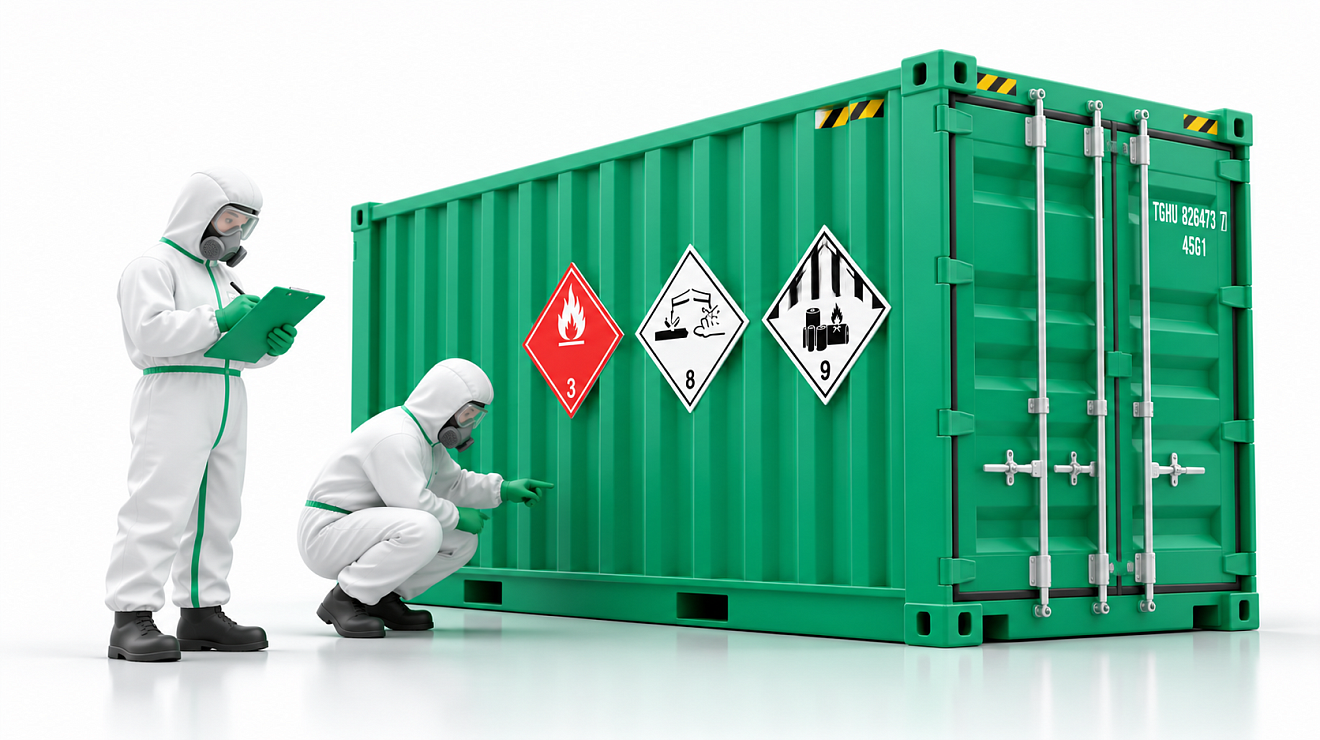

In a shipment of cables, chargers, and holders from Shenzhen, some items contained built-in lithium-ion batteries. For a warehouse, these are standard boxes, but without a safety data sheet and carrier approval, a sea shipping line could refuse to load such cargo onboard. If you are importing electronics with batteries, aerosols, paint, or perfume from China, determining whether your cargo is classified as dangerous should be done before paying the invoice, not at the port.
UN Number, Not Product Name, Determines Whether Cargo Is Dangerous
What qualifies as dangerous goods? Substances and articles assigned a UN number by transport regulations. This is a four-digit number that allows any carrier worldwide to determine the class, packaging requirements, and restrictions. Wireless earbuds and a power bank look harmless on an invoice. Under transport regulations, earbuds are considered equipment containing lithium-ion batteries, while a power bank is considered a standalone battery.
Where can you find the UN number if the supplier doesn't provide it? In the Safety Data Sheet. Chinese suppliers refer to it as MSDS or SDS. According to GOST 30333-2022, a safety data sheet contains 16 sections, and Section 14 (Transport Information) is required for shipping. It specifies the UN number, proper shipping name, hazard class, and packing group. If Section 14 contains a UN number, the cargo is dangerous, and you must check whether it qualifies for an exemption for small batteries or small consumer packaging. If it states that the product is not subject to dangerous goods transport regulations, check what standard or rule this statement refers to. For batteries, this is often the same special exemption, and the shipping line may still request documentation for such a shipment.
Section 14 of the Safety Data Sheet, not the invoice name, indicates whether the cargo is dangerous, and it must be verified before payment and vessel booking. We check three key details in the data sheet: the UN number, class, and packing group. For batteries, we check a fourth: the Wh rating marked on the casing. This is sufficient to understand which regulations apply and what additional documents to request from the supplier.
Nine Dangerous Goods Classes Are Identical for Sea, Rail, Air, and Road
How many dangerous goods classes are there? Nine. Classes 4, 5, and 6 have divisions, making 13 categories in the ADR list. Dangerous goods classification is based on the UN Model Regulations, which also serve as the basis for regulations across all transport modes; Class 3 in Shanghai means the same as Class 3 in Vladivostok.
| Class | Description | Import Example |
|---|---|---|
| 1 | Explosive substances and articles | pyrotechnics |
| 2 | Gases | aerosols (UN 1950), gas cartridges (UN 2037) |
| 3 | Flammable liquids | paints and varnishes (UN 1263), perfumery products containing solvents (UN 1266), adhesives (UN 1133) |
| 4.1 | Flammable solids, self-reactive substances, and solid desensitized explosives | matches (UN 1944) |
| 4.2 | Substances liable to spontaneous combustion | activated carbon (UN 1362) |
| 4.3 | Substances which in contact with water emit flammable gases | chemical reagents |
| 5.1 | Oxidizing substances | calcium hypochlorite for pools (UN 1748), hydrogen peroxide (UN 2014) |
| 5.2 | Organic peroxides | hardeners |
| 6.1 | Toxic substances | pesticides |
| 6.2 | Infectious substances | biological specimens (UN 3373) |
| 7 | Radioactive material | rarely encountered in standard commercial imports |
| 8 | Corrosive substances | lead-acid batteries filled with acid (UN 2794) |
| 9 | Miscellaneous dangerous substances and articles | lithium-ion batteries (UN 3480, UN 3481), environmentally hazardous substances (UN 3077) |
In our practice, we most frequently handle classes 3, 8, and 9: paints and perfumery, corrosive substances, and lithium batteries. Class 2 has its own specific features. It includes gases under pressure, which for an importer primarily means aerosol cans: deodorants, air fresheners, expanding foam, and spray paint. In the ADR list, Class 2 takes up one line, but it has three labels: red 2.1 indicates flammable gases, green 2.2 indicates non-flammable, non-toxic gases, and white 2.3 is reserved for toxic gases. Whether a specific spray can requires a red or green label depends on the percentage of flammable components in it, which is also indicated in Section 14 of the SDS.
Each Mode of Transport Has Its Own Transport Regulations
While the cargo class remains the same, the set of regulations depends on the mode of transport. Most online search results for dangerous goods refer to ADR, as truck drivers must pass ADR certification. However, importers from China working with us usually require other transport regulations.
| Transport Mode | Regulations | Your Route |
|---|---|---|
| Sea | IMDG Code (International Maritime Dangerous Goods Code) | container from Shanghai, Ningbo, or Shenzhen to Vladivostok, Saint Petersburg, or Novorossiysk |
| Rail | Annex 2 to SMGS (Regulations for the Carriage of Dangerous Goods) | container train from China via Zabaikalsk or Kazakhstan |
| Air | ICAO Technical Instructions and IATA DGR regulations | urgent delivery of samples and small batches |
| Road | ADR | delivery across Russia from a seaport or rail terminal |
The IMDG Code is mandatory for maritime transport under Chapter VII of the SOLAS Convention. If you are choosing between sea, rail, and air freight, a comparison of transport options is available on our page about cargo transportation from China. For dangerous goods, another critical question arises alongside lead times and freight rates: which carrier will accept the cargo in the first place.
On the railway between Russia and China, Annex 2 to SMGS applies. CIS regulations are not applicable here, as China is not a CIS member state. When a shipment is transported by container train via Zabaikalsk or Kazakh border crossings, dangerous cargo must be declared according to this annex.
For maritime imports, ADR includes a convenient rule: if the transport chain includes a maritime or air leg, packages labeled in accordance with the IMDG Code or ICAO Technical Instructions are accepted on the road leg. A container arriving in Vladivostok with maritime hazard placards does not need to be relabeled before truck dispatch to Moscow. Dangerous goods information is simply transferred to the transport document of the road leg. For international road transport, this involves filling out the CMR consignment note with the UN number and hazard class.
Batteries, Aerosols, and Paints Most Often Make Cargo from China Dangerous
Standalone lithium-ion batteries are classified under UN 3480, while those installed in equipment or packed with equipment fall under UN 3481. Both items belong to Class 9. ADR provides a dedicated 9A label for packages containing them, featuring seven vertical stripes in the upper half and a battery group symbol in the lower half. Cells and batteries must pass testing according to Section 38.3 of the UN Manual of Tests and Criteria; therefore, alongside the safety data sheet, the UN 38.3 Test Summary Report must be requested from the supplier.
We never take the test summary at face value. We verify its points, check the test report on the issuing laboratory's website, and match the markings on the battery with the summary character by character. We also verify whether the exact cell or battery type was tested and request the full test protocol if needed.
For small batteries, ADR contains an exemption under Special Provision 188 (SP 188), which also exists in the IMDG Code. It applies if a lithium-ion cell does not exceed 20 Wh, a battery does not exceed 100 Wh, and the rating is marked on the casing. Calculation is straightforward: multiply Ah capacity by voltage. A 10,000 mAh power bank at 3.7 V equals 37 Wh, fitting well within the battery limit, whereas a 36 V, 10 Ah battery yields 360 Wh and does not qualify for the exemption. The cell limit must also be checked: each internal cell inside the power bank must not exceed 20 Wh. The exemption applies provided all other provision conditions are met. Packages under this exemption do not require a Class 9A label; instead, they require the lithium battery mark. This is a rectangle measuring at least 100 × 100 mm with red hatched borders and the UN number. Whether a shipment qualifies for the exemption is verified by the shipper and freight forwarder during shipping preparation, though sea lines may have additional requirements for such goods. If samples with batteries are shipped via air freight from China, regulations are much stricter. We check battery watt-hour ratings, prepare the document package, and ensure packaging and labeling comply with state-of-charge restrictions and IATA DGR rules.
This was the case with a shipment we transported by sea from Shenzhen: smartphone accessories with built-in batteries from three suppliers, totaling 11.6 m³ and 2.1 tonnes. Cargo with batteries required an MSDS and carrier approval; without a complete document package, the ocean line could have refused shipment. We verified documents for the dangerous portion of the cargo, cleared them with the carrier in advance, and consolidated the goods at our Shenzhen warehouse with a full check of cargo pieces, packaging, and labeling.
Aerosols fall under UN 1950 in Class 2. Paints, varnishes, and thinners fall under UN 1263 in Class 3, and perfumery with flammable solvents falls under UN 1266 in the same class. If you are shipping canned cosmetics, nail polish, or perfume, safety data sheets must be verified for each item individually, rather than for the batch as a whole.
The Shipper Labels the Box, the Container Stuffer Affixes the Placard
Many picture dangerous goods hazard marks as an orange plate with numbers on a tanker truck. However, labeling on your cargo box will look different. Dangerous goods markings and hazard labels are applied to packages by the shipper—that is, your supplier in China or the consolidation warehouse. Placards are affixed to the container by the party stuffing it; in LCL consolidation shipments, this is done by the warehouse in China, not the ocean line.
- Each package must display the UN number preceded by the letters “UN”, with characters at least 12 mm high. For packages up to 30 liters or 30 kg, smaller sizes are allowed.
- The hazard label on a package is diamond-shaped (a square rotated 45 degrees) measuring at least 100 × 100 mm, with the hazard symbol in the upper half and the class number in the bottom corner.
- The container placard looks identical but measures at least 250 × 250 mm. It is affixed to all four sides of the container. For trucks carrying packaged dangerous goods, ADR only requires placards for classes 1 and 7.
- A truck transporting packaged dangerous goods displays plain orange plates (400 × 300 mm without numbers) at the front and rear. UN numbers and hazard identification numbers on orange plates are required for tank containers and bulk cargo.
We expect the shipper to label packages properly during packing based on SDS data, as relabeling hundreds of boxes at a transit warehouse is far more expensive and time-consuming. The UN number and package count must match across the labels, SDS, and shipping documents; this is where reconciling the packing list with the commercial invoice before dispatch proves essential.
Limited Quantities Simplify Packaging and Labeling, but Cargo Remains Dangerous
Small packaged quantities of dangerous substances are frequently shipped under limited quantities (LQ) provisions. This is governed by Chapter 3.4 of ADR, with similar provisions in the IMDG Code. The inner packaging quantity limit for each substance is specified in Table A of ADR and depends on the substance and packing group. The gross weight of a limited quantity package must not exceed 30 kg (gross, including packaging), and mistakes often occur if documents specify only net weight without packaging.
Limited quantity packages are marked with a specific mark; under ADR, UN numbers and hazard class labels are not required, and outer packaging does not have to be UN-tested. The mark is a diamond measuring at least 100 × 100 mm with black top and bottom points and a white center. If a truck carries over 8 tonnes of such cargo and has a maximum permissible mass over 12 tonnes, the mark must also be affixed to the vehicle. For very small quantities, excepted quantities provisions exist under Chapter 3.5, with their own specific mark displaying the hazard class number.
For you, this means a shipment of bottled perfumes can be transported more affordably and simply than a drum of solvent. Cargo under limited quantities remains classified as dangerous goods; therefore, we still declare it to the shipping line and await formal booking confirmation for the specific vessel. In this case, boxes bear the limited quantity mark instead of the UN number and hazard label.
Each Sea Line Sets Its Own Fine for Undeclared Dangerous Cargo
Sea carriers specify penalties for undeclared or misdeclared dangerous cargo in their terms, with amounts set independently by each line. In the 2025 notice from carrier RCL, the penalty for undeclared dangerous goods is USD 30,000 per container. For high-risk cargo—defined by the line to include Class 2.1 flammable gases and large Class 9 lithium batteries—the penalty is USD 100,000 per container plus a USD 250,000 security deposit. If the deposit fails to cover actual costs, the carrier reserves the right to claim additional damages, blacklist the client, and terminate the contract, even after cargo has been loaded onboard.
In an LCL container, an error by one supplier affects the entire shipment. When consolidating cargo from multiple factories at a warehouse in China, dangerous items must be detected before loading. Otherwise, an entire consolidated container belonging to multiple clients faces severe fines and delays due to a single undeclared box. That is why cargo consolidation at our warehouse in China begins with thorough document verification for each item, rather than with physical loading.
When Verification Is Not Needed and What Not to Confuse Dangerous Goods Classes With
If you are shipping clothing, furniture, textiles, or spare parts without liquids, batteries, or airbags, an SDS is generally not required for transport, and this check does not apply to you. We request an SDS for all products legally required to have one. Beyond chemicals and batteries, this includes items such as charcoal and other combustible substances. We do not request an MSDS for T-shirts.
Another frequent point of confusion is mixing up different hazard classifications. The dangerous goods class under ADR describes transport risk. The harmful substance hazard class under GOST 12.1.007–76 describes one of four levels of bodily exposure, ranging from extremely hazardous to low-hazard. The waste hazard class under Federal Law No. 89-FZ defines one of five levels of environmental impact. A Class 3 substance under GOST 12.1.007 does not automatically become Class 3 dangerous cargo under ADR, and vice versa.
What to Do Before Paying the Invoice
Checking cargo characteristics is best done during contract negotiations with your supplier, while you can still adjust packaging, chemical composition, or transport modes. If dealing with a new supplier, product documents should be examined alongside company verification records; the procedure for this review is detailed in our guide on how to verify a Chinese supplier before issuing an advance payment.
- Request an SDS in Russian and English for each item containing chemicals, combustible substances, compressed gas, or batteries. If the factory does not have an SDS, it must be prepared prior to shipping.
- Locate the UN number, hazard class, and packing group in Section 14. If there is no UN number, check the explanatory reference. For batteries, this is often an exemption under Special Provision 188, which still requires the lithium battery mark on the box.
- For batteries, request the UN 38.3 test summary and verify the Wh rating marked on the casing.
- Consult your freight forwarder to verify whether the shipment qualifies for the small battery exemption or limited quantities provisions.
- Agree with the supplier that packages will be labeled during packing according to the SDS and freight forwarder instructions: UN number and hazard class label (Label 9A for Class 9 batteries; lithium battery mark or limited quantity mark for exempt shipments).
- Submit the SDS, packaging certificates, and dangerous goods declaration to your freight forwarder prior to booking so they can secure carrier approval.
TransGID does not accept dangerous goods for carriage without a Safety Data Sheet in Russian and English, a dangerous goods declaration, and packaging UN certification certificates (where UN testing is mandatory).
We transport dangerous goods of all classes except Class 1 (explosives), selecting the optimal transport mode, port, and carrier for your cargo in advance. For distribution centers in Southern Russia, this could be sea freight via Novorossiysk. All dangerous goods surcharges are factored into our calculation beforehand.
Send us your safety data sheets and commercial invoice before making payment, and we will advise under what terms carriers will accept your shipment for sea container shipping from China.