
Oversized Cargo Transportation
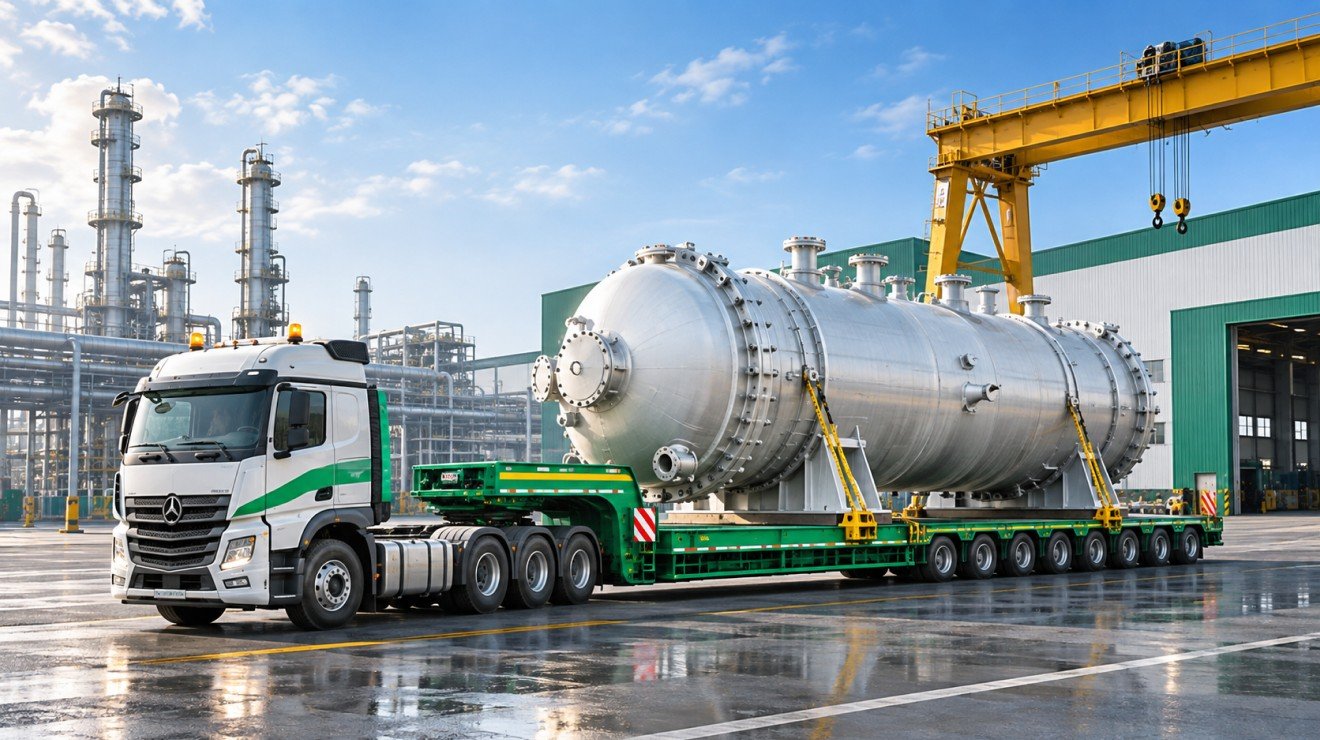
We transport oversized and heavy cargo from China and Southeast Asian countries, to and from the CIS, and across Russia by sea, rail, and road transport. We operate our own fleet, and an in-house engineer calculates the lashing and securing scheme. We obtain permits, arrange escort services, and insure cargo. There is no upper limit on weight and dimensions.
What Cargo Is Considered Oversized
Each mode of transport has its own oversized cargo limits. Cargo that travels without issues on a railway flatcar already requires a permit on a lowboy trailer. Check the table to see which case applies to yours.
Transport | Cargo is oversized if | Regulated by |
|---|---|---|
Road transport, Russia | vehicle with cargo is wider than 2.6 m, higher than 4 m, or longer than 20 m, or cargo overhangs at the rear by more than 2 m | RF Government Decree No. 2060 |
Road transport, China | vehicle with cargo is wider than 2.55 m, higher than 4 m, or longer than 18.1 m | PRC Ministry of Transport regulations on non-standard vehicles |
Rail transport | cargo on a flatcar is wider than 3.25 m or exceeds 5.3 m above top of rail | Instruction DCh-1835 |
Sea freight | cargo does not fit into a standard container in length, width, or height | shipping line terms and conditions |
The height in the table is calculated from the road surface or rail head, including the platform. Less height remains for the cargo itself, depending specifically on the lowboy trailer or railcar. An engineer will provide an exact assessment based on technical drawings.
Weight also has its limitations. In Russia, a six-axle road train with cargo is allowed up to 44 t; in China, up to 49 t. If a vehicle exceeds the weight limit by more than 10%, a special permit is required in Russia, and road damage compensation fees are added to the rate.
For standard container dimensions, please refer to the dimensions guide. If your cargo fits into them, sea container shipping will work for you, avoiding extra charges for oversized cargo. Sometimes, dismantling protruding components at the factory is sufficient.
Modes of Transport We Use
Road Transport
The company maintains its own vehicle fleet. Specialized equipment tailored to your cargo is sourced from trusted contractors: lowboy trailers, extendable platforms, and modular trailers for heavy cargo. Vehicles operating internationally hold valid cross-border permits, and drivers have active visas. These trucks face no border delays due to documentation issues.
Before dispatch, we inspect bridges, overpasses, overhead lines, and turning radii along the route. If a vehicle with cargo is wider than 3.5 m, it travels across Russia escorted by two pilot cars: front and rear. If width exceeds 5 m or length exceeds 35 m, a traffic management project is required, which we also prepare ourselves. Pilot cars are arranged through contractors and immediately included in the quote.
Rail Transport
Cargo travels on standard flatcars, while heavy or long items move on heavy-duty railcars (depressed-center flatcars) or coupled flatcars. A heavy-duty flatcar refers to a railcar with a reinforced frame and a lowered deck. An engineer calculates how far cargo exceeds the clearance gauge. This determines who approves the transportation: the railway of departure or the central directorate of Russian Railways (RZD).
Occasionally, RZD technical specifications do not provide an off-the-shelf securing method for your specific cargo. In that case, our engineer designs a customized lashing scheme with structural calculations, which we approve with the carrier. At the Chinese border, where track gauge changes, cargo is transshipped onto another flatcar. We take this transshipment into account in both the lashing scheme and delivery lead times.
Sea Freight
Cargo that fits inside a container in length but exceeds door or height limits is loaded by crane into an open top container (a container without a roof). Wide and heavy items are placed on a flat rack, a platform with end walls. According to Hapag-Lloyd specifications, a 40-foot flat rack accommodates cargo up to 11.6 m long and up to 44 t in weight, provided weight is distributed along the entire length. Cargo may exceed the platform width and height, for which shipping lines charge extra (out of gauge).
Cargo that cannot fit onto a flat rack is shipped as non-containerized cargo: a crane loads it directly into the hold or onto the deck. In maritime shipping, this is known as break bulk. Wheeled and tracked machinery boards Ro-Ro vessels under its own power. In Russia, ocean-borne oversized cargo is received in Vladivostok, Novorossiysk, or Saint Petersburg, depending on the country of origin.
Origins and Destinations
We deliver from China and Southeast Asian countries to Russia by sea, rail, or road via overland border checkpoints. We operate both import and export routes with CIS countries. Across Russia, we deliver from ports, railway stations, or production plants directly to your facility.
Most often, the route is combined: cargo arrives at a sea port and proceeds on a lowboy trailer or rail flatcar. We execute a single contract for the entire logistics chain — this is multimodal transportation.
What the Service Includes
- Lashing and securing plan. Calculated by our in-house engineer. You receive the approved plan before loading begins.
- Rosavtodor special permit. We submit the application, coordinate the route, and order a traffic management project if required.
- Railway approvals. We coordinate the securing scheme and transportation directly with RZD.
- Escort services. Pilot cars along the route, supervision during loading, transshipment, and unloading.
- Insurance. The cargo is insured throughout the entire route, including transshipments. Insurance is already included in the rate.
How We Meet Deadlines
Delivery timelines for oversized cargo depend on regulatory approvals more than on distance. A permit is tied to the route, vehicle, and cargo dimensions: if any of the three changes, the permit must be issued anew, while cargo waits at the factory, port, or temporary storage warehouse. The longest delays occur when a bridge along the route cannot support the weight or cargo cannot clear overhead lines. The law does not set fixed statutory deadlines for bridge reinforcement or lifting overhead wires.
Therefore, we prepare transportation before cargo leaves the factory:
- We take dimensions from drawings and verify them against measurements of the packed cargo.
- We select routes where cargo passes without road modification works, even if the distance is greater.
- We obtain the securing scheme and permits prior to the loading date. A permit is valid for up to 135 days, so we issue it aligned with specific dates.
- We submit customs documents in advance so cargo does not wait for release in storage.
We do not state generic delivery times here, as every route is unique. The contract specifies a timeline that already accounts for all approvals, and we adhere to it strictly.
How to Get Started
- Send a drawing or sketch of the cargo with packaged dimensions, weight, center of gravity location, and lifting points. Include loading and unloading addresses, preferred dates, and for imports — the commercial invoice and packing list.
- Our engineer will determine suitable transport modes, and we will present an optimal route with a complete calculation.
- We sign an agreement with fixed deadlines. We prepare securing plans and permits, and reserve specialized equipment.
- We supervise loading and securing, transport your cargo, and oversee unloading at your site.
The request form is located below on the page.
Cost Breakdown
There is no standard price list for oversized cargo. Two machines of identical weight from different plants will incur different rates, so we calculate each quote individually based on your cargo and route. The rate includes:
- lowboy trailer, heavy-duty flatcar, or flat rack with carrier surcharges for out-of-gauge space;
- permits, and road wear compensation fees for heavy cargo;
- pilot vehicles and traffic management plans, if required;
- fastening materials, crane services, and rigging operations during loading, transshipment, and unloading;
- calculation of the securing scheme and cargo insurance.
Customs duties and taxes are not included in the freight rate: they are paid directly to the state budget.
Related Services
- Customs clearance handled by our licensed customs representative.
- Rail freight from China and Russian ports for cargo within standard loading gauges.
- Road transport from China for consignments not requiring lowboy trailers.
Frequently Asked Questions
Are there any restrictions on cargo weight and dimensions?
No. Weight and dimensions determine which transport mode and route to use, and how long preparations will take. Send your drawings, and our engineer will explain how to deliver your specific cargo.
What should I do if no drawing is available?
An equipment datasheet and photos of the cargo with a tape measure will suffice. Request the weight and center of gravity coordinates from the manufacturer: without them, an engineer cannot design the securing scheme.
Can the cargo be shipped in parts?
Yes, and it is often more cost-effective. Request the manufacturer to dispatch machinery in sections or dismantle protruding components. Often, most parts can then travel in standard containers, leaving only one oversized unit.
Do I need to insure cargo separately?
No. Insurance is already included in our freight rate and covers the entire journey, including transshipments.
How long does transportation take?
This depends on the route, mode of transport, and whether approvals from road authorities or RZD are required. The timeline will be specified in your quote and incorporated into the contract.
Oversized Cargo Transportation with TransGID
Other TransGID services

Sea container shipping
We select the port and route tailored to your needs: Vladivostok, Novorossiysk, or Saint…

Air Freight
Urgent air freight from China, Turkey, and the UAE. Cargo handling and customs clearance…

Rail freight from China and Russian ports
Accelerated container trains from China to anywhere in Russia. Delivery of imported cargo…

LCL Cargo Delivery
LCL shipping for sellers and trading companies. We consolidate goods and deliver…

Sea freight via Novorossiysk
Terminal services, freight forwarding, import and export

Cargo Delivery from the UAE: Import and Export Control
Official export of goods from Dubai with issuance of MOFA certificates and ECNP permits…

Road Freight from China
TIR FTL and LTL: truck dispatch for loading within 24 hours

Customs Clearance
Licensed customs representative and single FEA operator

Reefer container transportation
We deliver cosmetics, food products, pharmaceuticals, and chemical products in reefer…

International Multimodal Cargo Transportation
Delivery of import consignments from Asia, the Middle East, and Europe using multiple…