
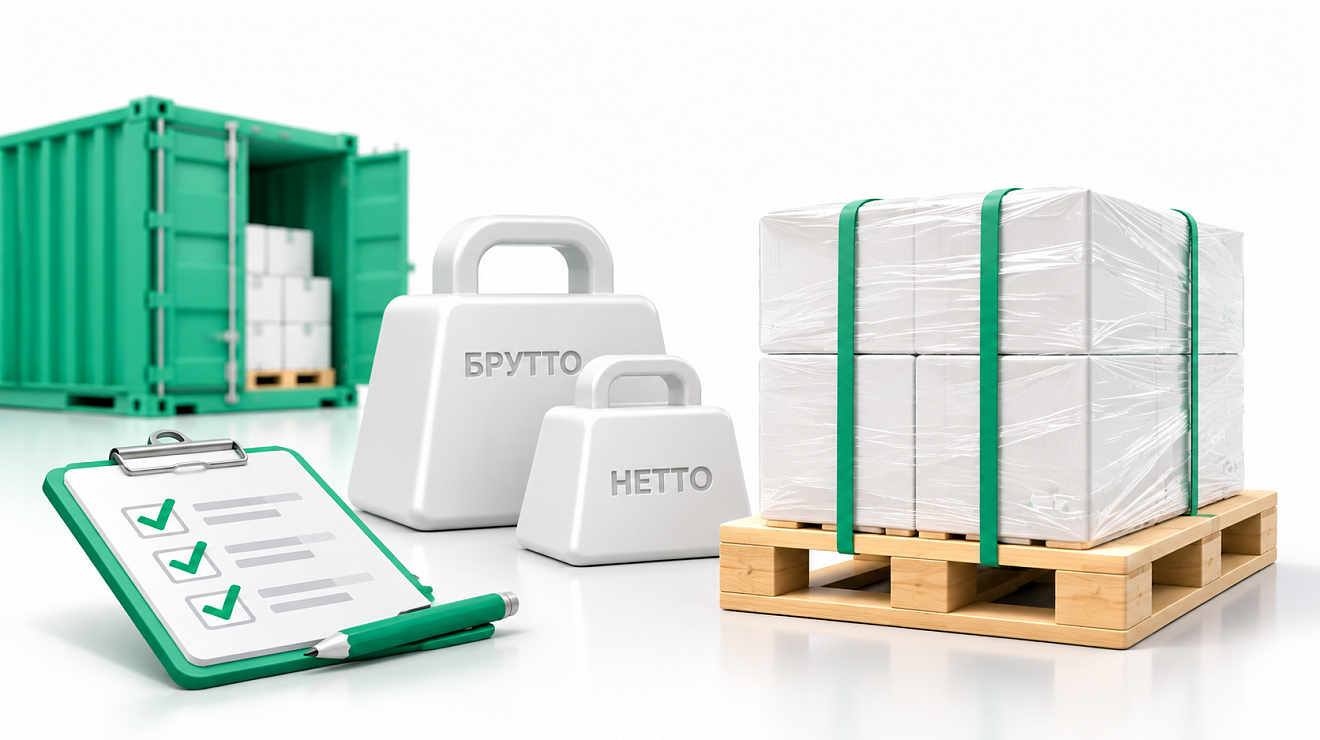

Net weight is the pure weight of the goods, gross weight is the weight with packaging, and for retail shopping this definition is sufficient. In commercial shipments, it is not. A supplier states a gross weight of 1,312 kg in the packing list, the warehouse in China weighs the consignment and gets 1,562 kg, and you look at the discrepancy trying to decide whom to trust. The difference is exactly ten pallets of 25 kg each. Both figures are correct, they simply measured different things, but you cannot just enter either of them into the waybill.
Net and gross mass differ by packaging, and the boundary depends on the document
Is weight with packaging net or gross? Usually gross, and a procurement specialist does not need an explanation of the difference between gross and net weight. The dispute starts elsewhere: net mass is the clean weight, but in a goods declaration (DT, commonly referred to as GTD) that is not always the case.
Is net weight with or without packaging? The procedure for completing a DT was approved by Decision No. 257 of the Customs Union Commission, and in Box 38, net includes primary packaging if the goods are sold at retail in it or if it cannot be separated before consumption without spoiling the goods. So make sure to clarify what is considered tare in this specific document. That is where we begin our shipment verification.
In Box 38 of the DT, the mass of goods is indicated with primary packaging if sold at retail in it or if it cannot be separated, followed after a slash by the mass without packaging. Box 35 adds the packaging required for goods preservation prior to release into circulation, but excluding containers and transport equipment. Box 11 of the CMR contains the gross weight of the cargo handed over to the carrier. The mass for the vessel includes all container contents plus its tare.
Where the goods end and tare begins
To avoid confusing tare, gross, and net, it is most practical to break the shipment down into layers and determine where each layer belongs. Net and gross cargo mass are calculated across the same layers, with only the boundary shifting.
| Layer | Box 38, Net | Box 35, Gross | Mass for vessel |
|---|---|---|---|
| Primary packaging (tube, vial, can/jar) | included if sold at retail in it or cannot be separated before consumption | included | included |
| Shipping box, stretch wrap, wooden crate | not included | included if required to preserve goods prior to release into circulation | included |
| Pallet | not included | not explicitly named, decided by the declarant filing the DT | included |
| Container | not included | not included | included |
The most ambiguous item here is primary packaging. After the value in Box 38, separated by a slash, the mass without any packaging is also stated if such information is available in shipping, commercial, or other documents, or on the packaging. Thus, net weight can be expressed by two numbers in a single box. It is advisable to tell the supplier in advance that you need both. A cardboard carton over a tube is more debatable than the tube itself. We review such items with you before filing, as the regulations refer specifically to primary packaging, not any consumer packaging.
The regulations do not provide an unambiguous answer regarding pallets. Box 35 excludes containers and other transport equipment, but pallets are not explicitly named there, whereas Box 31 requires pallets and their quantity to be recorded in a separate entry. Since there is no direct answer, we examine how pallets are recorded in the packing list and waybill, and calculate Box 35 consistently for the entire batch so that any variance from the waybill can be demonstrated numerically.
Repackaging can also alter the supplier's figures. When collecting fragile circuit boards and sensors weighing 350 kg from a new supplier in Shenzhen, the factory packaging proved fragile, and the cargo was fully repacked into rigid wooden crates at the warehouse. Following such handling, the gross weight from the factory packing list is no longer suitable for either the waybill or the declaration.
One shipment yields five different figures from 960 to 3,762 kg
Let us take a hypothetical shipment; all figures below are for illustrative purposes. It consists of 9,600 tubes of cream, each containing 100 g of product and 20 g of tube tare. The tubes are packed in 200 boxes of 48 units each, each box weighing 800 g; the boxes are placed on 10 pallets of 25 kg each, and the pallets are loaded into a container with a nominal tare of 2,200 kg.
| Item calculated | Calculation | Mass, kg |
|---|---|---|
| Contents, value after the slash in Box 38 | 9,600 × 0.100 | 960.000 |
| Cream in tubes, net in Box 38 | 9,600 × 0.120 | 1,152.000 |
| With boxes, gross excluding pallets | 1,152 + 200 × 0.800 | 1,312.000 |
| With pallets, as shown on warehouse scales | 1,312 + 10 × 25 | 1,562.000 |
| With container, mass for vessel | 1,562 + 2,200 | 3,762.000 |
The regulations require values in Boxes 35 and 38 to be rounded to three decimal places, which is why three decimals are shown in the table. This is where the 250 kg difference comes from: the packing list accounted for boxes, while the scales also weighed the pallets. There is no error in calculation, but if the shipment travels on pallets and 1,312 kg is entered on the waybill, customs scales will flag the difference as a document discrepancy. When we encounter such conflicting numbers, we request pallet weights and breakdown by package from the supplier before deciding whether reweighing is required.
What is indicated in the gross weight box, in CMR, and in the packing list
Weight in shipping documents is calculated for different purposes, so numbers may not match. However, each must be reconcilable with the others.
| Document | Weight type | What we check |
|---|---|---|
| Packing list | net and gross per package as calculated by the supplier | whether pallets are included, whether package sums reconcile |
| CMR, Box 11 | cargo gross weight in kilograms, including pallets if transported by truck | number of packages, volume in Box 12, match with actual loading |
| DT, Box 35 | gross for each item | total sum across items and how pallets are accounted for |
| DT, Box 38 | net with primary packaging and value after the slash | what qualifies as primary packaging |
| Verified Gross Mass for vessel (VGM) | verified gross mass of the container | who provides verification and by which of the two methods |
The initial figure usually appears in the packing list, and any discrepancy spreads to the rest of the documentation. We have separately analyzed how to reconcile a packing list with an invoice and which declaration boxes are populated with its data.
Next to the weight in the packing list and in Box 12 of the CMR is the volume. It is checked separately based on cargo package measurements, and you may find our guide on calculating shipment volume in m³ helpful.
For road freight, Article 6 of the CMR Convention, under which the CMR consignment note is issued, requires the gross cargo weight or quantity expressed in other units, while remaining silent on pallets. However, during customs inspection, the waybill is compared against scales, so if pallets travel in the truck, we include them in the CMR weight. This means it cannot be directly compared to Box 35. We carry out the reconciliation of the CMR with the packing list before the truck leaves the warehouse.
Duty in euros per kilogram is calculated from net weight
It is often said that customs decisions hinge solely on gross weight, but this is untrue for duty rates per kilogram. Under Article 51 of the EAEU Customs Code, the taxable base for such duty is the physical characteristic of the goods, including mass with primary packaging that is inseparable from the goods prior to consumption or in which they are sold at retail. Shipping cartons are not included here.
Specific duty rates like this are not limited to exotic commodities. For cotton T-shirts under FEA commodity code 6109 10 000 0, Alta and IFCG directories in November 2026 indicate a base duty rate of €1.75 per kilogram. Check the rate for your code prior to declaration, as the rate applicable is the one in effect on the date of declaration registration. When the duty rate is set as a combined rate (both as a percentage and in euros per kilogram), net weight also factors into the calculation.
Let us assess the cost of error using our sample shipment at a hypothetical rate of €2 per kilogram. At a net weight of 1,152 kg, customs duty will be €2,304. Declaring a gross weight of 1,312 kg results in an overpayment of €320. Declaring only the bare contents of 960 kg drops the duty to €1,920, and customs may penalize the €384 underpayment under Article 16.2 of the Administrative Offenses Code. With VAT, the variance increases further, as customs duty forms part of the VAT base. Formulas for other customs charges are detailed in our guide on how to calculate customs payments.
With an ad valorem (percentage) rate, weight does not form the tax base, but net weight determines the price per kilogram. Customs value is divided by net weight, and the resulting unit price is evaluated against customs value profiles. Inflating net weight lowers the per-kilogram price, which may trigger valuation scrutiny from customs authorities. This is precisely why we examine the price per kilogram prior to filing, and you can calculate your shipment’s duties in advance with our customs calculator.
A truck cares about total weight, while LCL also depends on volume
A truck does not care what is written in Box 38; total mass bears on the roadway. For a 297-ton shipment of chickpeas for export through Novorossiysk, we distributed the cargo across 11 twenty-foot containers, exactly 27 tons each, and transported it in bulk to remain within statutory axle load limits. That was an export cargo without pallets, but the same calculation applies to heavy import shipments, simply with pallets added.
Calculate heavy cargo at gross weight including pallets and verify against Euro-truck body dimensions and payload capacity before booking transport. We do not provide a universal ceiling, as it depends on the vehicle itself, its axle configuration, and applicable road regulations.
In sea freight, an additional parameter comes into play. Under SOLAS amendments, the shipper is required to verify the gross mass of the container (VGM); otherwise, the container will not be loaded onto the vessel. There are two verification methods: weighing the sealed container, or adding the mass of all contents (including pallets, dunnage, and securing material) to the container tare weight. The shipper is considered the party named as shipper in the bill of lading, so when importing from China, clarify beforehand who handles this in your supply chain. Permissible payload depends on the container type, which is selected according to our container dimensions table.
In LCL shipping, the ocean consolidator typically calculates freight based on the higher of the two values, where 1 ton equals 1 m³. Specific tariff conditions supersede general rules. For example, our shipment of smartphone accessories from three suppliers in Shenzhen weighed 2.1 tons with a volume of 11.6 m³, and with this ratio, chargeable freight is calculated based on volume.
If the cargo weight in tons is considerably lower than its volume in cubic meters, reweighing solely for freight rating makes little sense. To understand how the actual freight cost is determined, see the W/M rule for LCL cargo.
The carrier is not obligated to weigh, but may be held liable for weight
Under Article 8 of the CMR Convention, upon taking over the cargo, the carrier checks the number of packages, their marks, and external condition. Gross weight is checked only if requested by the sender. If no check took place, the weight in the waybill is stated based on the sender's declaration, yet at border crossings the carrier can also be held liable. If your supplier is named as sender in the CMR, request such verification in advance.
Part 3 of Article 16.1 of the Administrative Offenses Code provides for fines for corporate entities ranging from 50,000 to 100,000 rubles for providing inaccurate gross weight information using invalid documents, with or without confiscation of goods. In case No. 5–298/2017 of the Pskov City Court, actual weight was 1,617 kg higher than the 7,574 kg declared in the CMR, invoice, and packing list; the carrier was fined 51,000 rubles, with the court noting that no reservations were entered on the consignment note. In case No. 5–1157/2023 of the Kirovsky District Court of St. Petersburg, a 460 kg discrepancy against 3,830 kg declared resulted in liability for the customs representative filing the transit declaration, and the goods were confiscated. The Plenum of the Supreme Court, in Ruling No. 18 dated October 24, 2006, explains that for the carrier, the magnitude of the discrepancy and whether it was apparent are crucial factors, making outcomes context-dependent. The hypothetical 250 kg discrepancy against 1,312 kg is proportionally comparable to the first case.
Declarants and customs representatives are governed by a different provision, Part 2 of Article 16.2 of the Administrative Offenses Code. If inaccurate information in the declaration led or could have led to underpayment of customs duties and taxes, it imposes a corporate fine ranging from one-half to twice the unpaid amount, with or without confiscation. We will never manipulate weight figures to fit a specific duty rate or target price per kilogram: under Article 405 of the EAEU Customs Code, TransGID as a licensed customs representative shares joint and several liability with you for duty and tax payments.
Discrepancies often occur inadvertently, and it is best to catch them while the shipment is still in China. In a 900 kg consolidated shipment of auto parts, suppliers submitted their initial package and weight figures, but after palletization and recount, the actual metrics differed. Warehouse verification identified this prior to departure.
When a dispute over grams changes nothing
Debates over primary packaging are irrelevant for bulk goods shipped without packaging. For cargo shipped in bulk (dry bulk, liquid bulk, or break bulk), Box 38 receives the total mass, eliminating tare considerations. With an ad valorem duty rate and volume-based freight rating, twenty grams of tube weight change neither duty nor freight charges, and we will not ask you to weigh every single carton. Nevertheless, price per kilogram is still calculated from net weight, so verifying overall mass remains necessary.
Verification remains essential because Article 16.1 penalizes weight inaccuracies in documentation regardless of the duty amount. However, inspecting the total batch and pallets without individual unit recounts is sufficient.
Five reconciliations before shipment
The first three checks are best conducted while goods remain at the supplier's warehouse, and the last two closer to dispatch.
- Request from the supplier the bare net weight, net weight with primary packaging, and gross weight separately for each package.
- Clarify the weight of boxes, crates, and pallets, as well as their count, so any variance from warehouse scales can be reconciled mathematically.
- Determine the FEA commodity code and the duty rate structure. For specific rates per kilogram, verify net weight with extra care; for percentage rates, evaluate the resulting per-kilogram price.
- Before the truck departs, verify gross weight in the packing list and CMR, and calculate Box 35 adjusted for pallets. Any unexplained deviation must be investigated prior to shipment.
- If the cargo travels by sea, find out who certifies the container verified gross mass (VGM) for the vessel and by what method.
If goods originate from multiple suppliers, the numbers will likely need recalculation after consolidation. Send us the packing list prior to dispatch, and we will verify weights and package counts at our warehouse in China during LCL shipping, before the figures are submitted into the DT and CMR.