
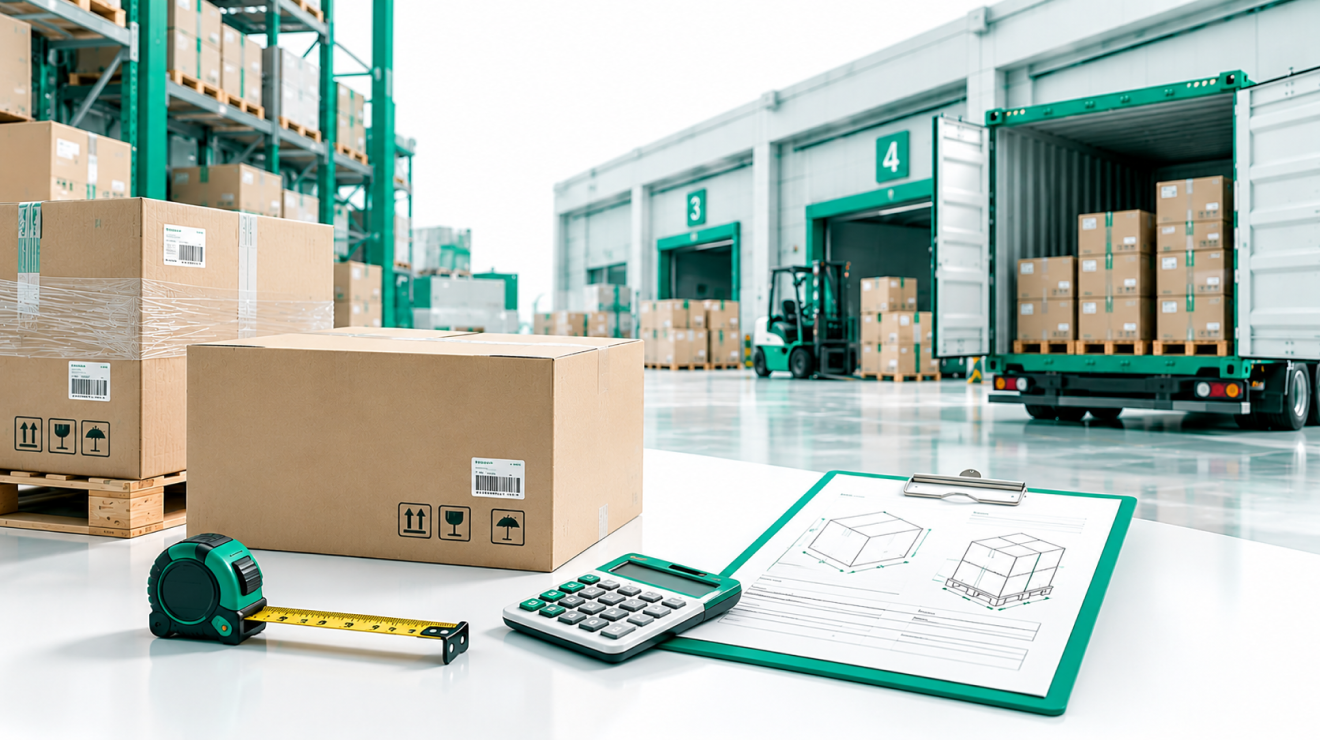

A factory sends the batch cubic volume, you book space in LCL cargo based on that figure, but during loading, the goods are packed in master cartons, and the shipment no longer fits into the booked space. Nobody violated the length × width × height formula. The mistake lies in the dimensions entered into it, and in the fact that after booking, the volume will be remeasured at the warehouse.
Volume formula and converting millimeters to meters
To calculate box volume, multiply its length by width and height. Calculating volume in m³ works under one condition: all three dimensions must be in meters before multiplying them. To convert the dimensions of a 60 × 40 × 45 cm box into m³, write them as 0.6 × 0.4 × 0.45 m, resulting in a package volume of 0.108 m³. In correspondence, volume is written both as m3 and m³ (CBM); they represent the same unit.
We convert each dimension into meters before multiplying because manual cubic calculation easily leads to two mistakes: multiplying centimeters and dividing by a thousand instead of a million, suddenly giving the box a volume of 108 m³, or converting only two out of the three dimensions into meters.
| Dimension units | How to convert to meters | Example for a 60 × 40 × 45 cm carton |
|---|---|---|
| millimeters | divide each dimension by 1,000 | 600 × 400 × 450 mm = 0.6 × 0.4 × 0.45 m = 0.108 m³ |
| centimeters | divide each dimension by 100 | 60 × 40 × 45 cm = 0.6 × 0.4 × 0.45 m = 0.108 m³ |
| cubic centimeters, already multiplied | divide total by 1,000,000 | 108,000 cm³ = 0.108 m³ |
| cubic millimeters, already multiplied | divide total by 1,000,000,000 | 108,000,000 mm³ = 0.108 m³ |
| liters | divide total by 1,000 | 108 L = 0.108 m³ |
If the cargo is non-rectangular, such as a cable reel or a machine tool with a protruding casing, it is measured by its extreme points, as if placed inside an imaginary box. It does not matter to the carrier that part of this box is empty, because the cargo occupies that entire footprint and envelope inside the vehicle.
Volume is calculated based on master cartons, not the goods
Booking volume refers to the external dimensions of the shipping unit to be transported: master carton or pallet including the pallet base, multiplied by the number of units and calculated in meters.
In our experience, clients or factories often provide cubic volume based on the product itself, excluding shipping boxes. Typically, a factory packs individual retail units into larger corrugated boxes known as master cartons. Upon loading, the cargo is already packed in these cartons, resulting in a larger volume, and the shipment might not fit into the allocated space. That is why we require volume measurements including master cartons for booking.
The difference easily adds up to an entire cubic meter. As an example, take a product in an individual box measuring 20 × 15 × 10 cm, packed 24 pieces per master carton measuring 62 × 42 × 32 cm. Calculating by product gives 0.003 m³ × 24 = 0.072 m³, while the master carton measures 0.083 m³—16% larger. One hundred such cartons result in 7.2 m³ based on product volume and 8.3 m³ in reality, and that extra cubic meter will no longer fit into the booked space.
If the factory's calculation does not specify carton dimensions and carton quantity, it is most likely product volume. Ask for the master carton dimensions and the number of cartons in the shipment; the number of units per carton will also help verify the shipment against the purchase order. We do not accept volume figures based solely on the product without cartons for booking until the factory provides master carton dimensions and carton count.
Where the formula calculation doesn't help
Everything below applies to LCL (groupage) cargo, where volume directly translates into freight cost. If you are shipping a full container load (FCL), precision to the hundredth of a cubic meter does not affect the freight rate, as you pay for the entire container. In FCL, volume is needed to verify whether the cargo fits, making total weight and floor layout more important than decimal places.
For irregularly shaped cargo, the formula based on extreme dimensions indicates only the minimum space it will occupy. If machinery or unpackaged furniture cannot be stacked or have other cargo placed flush against it, much more vehicle space is lost than just the bounding box. For such cargo, we prefer reviewing photos with dimensions.
An online volume calculator in m³ won't prevent the primary mistake either. It will simply multiply the same three figures without indicating that they were taken from the individual retail package rather than the master carton.
Pallets are measured including the pallet base and box overhangs
When cargo travels on pallets, the shipping unit is no longer an individual carton, but the entire pallet. To calculate pallet volume in m³, measure height from the floor to the top of the stack, including the pallet base. According to the EPAL specification, a standard Euro pallet measures 1200 × 800 mm with a height of 144 mm. The length and width of the pallet are taken from the greater dimension—either the edge of the pallet or the most protruding cartons.
Let's calculate a sample pallet. Four 60 × 40 × 45 cm cartons fit per tier on a Euro pallet; three tiers equal 135 cm, or 149.4 cm including the pallet base. Pallet volume is 1.2 × 0.8 × 1.494 = 1.43 m³, while the twelve cartons alone measure 1.30 m³. The pallet base adds roughly 11% to the shipment, even with perfect stacking and zero overhang. If a carton hangs 5 cm over the edge, the entire pallet is measured by that overhang.
Whether to transport cargo in cartons or palletized is decided jointly with you for each specific shipment. Pallets protect fragile goods and speed up handling, but for lightweight, bulky goods, they increase the exact chargeable metric in LCL shipping. If goods are transported on pallets, always calculate the batch by pallet dimensions.
Shipment volume is summed up by package groups and rounded once
To calculate the total cargo volume in m³, divide the packages into groups of identical dimensions, multiply the volume of one package in each group by its quantity, and sum up the group results. Averaging dimensions across the shipment is prohibited, as an average carton derived from large and small ones means nothing in reality.
Below is a sample shipment from a factory. Figures are illustrative and serve solely to demonstrate the calculation.
| Package group | Package dimensions | Single package volume | Packages | Group volume |
|---|---|---|---|---|
| cartons A | 60 × 40 × 45 cm | 0.108 m³ | 80 | 8.64 m³ |
| cartons B | 52 × 36 × 30 cm | 0.05616 m³ | 45 | 2.5272 m³ |
| pallets with equipment | 120 × 80 × 155 cm with pallet | 1.488 m³ | 2 | 2.976 m³ |
| total | 127 packages | 14.1432 m³, rounded up to hundredths, 14.15 m³ |
Do not round unit or group volumes; round the shipment total once, upwards to hundredths of a cubic meter. Measure the dimensions of each package up to the nearest whole centimeter; this reflects measurement accuracy rather than volume rounding. If the volume of carton B is prematurely rounded to 0.06 m³, the group will yield 2.7 m³, causing the shipment to increase on paper by 0.17 m³ without a single extra carton. Measure bulging cartons at their widest point, as warehouse staff will inevitably measure them there.
When a consignment is sourced from multiple suppliers, each volume is calculated separately, and the precise total only emerges at the consolidation warehouse. This was the case during the cargo consolidation from three suppliers in Shenzhen: smartphone accessories totaling 11.6 m³ and 2.1 tons, where packages, packaging, and labeling were checked at our warehouse prior to dispatch. If calculating such a shipment yourself, maintain a table by supplier.
The consolidation warehouse will remeasure cargo, and billing will be based on their measurement
The volume submitted during booking serves to reserve space and estimate the freight quote, while the final figure is determined by the warehouse measurement. Flexport notes in its guidance on cargo measurement discrepancies that LCL cargo is measured at the consolidation warehouse before container loading and freight billing is based on that measurement. The primary reason for discrepancies is stated plainly: the supplier provided an estimate, while palletizing and outer packaging added volume.
We observe the same at our warehouses in China. In an LTL auto parts shipment of 900 kg, suppliers delivered goods to the warehouse and submitted their own package count and weight data, but after repalletizing and recounting, the actual figures differed. The discrepancy was identified at the warehouse prior to dispatch.
From there, volume turns into cost. How LCL rates are calculated under the weight or measure rule is detailed in the article on the w/m rule in LCL. Simply put, if cargo is lightweight and billed by volume, and you booked 12 m³ while the warehouse measured 13.5 m³, you will be billed for 13.5 m³.
Warehouse measurements can also be erroneous and should be audited. In August 2026, the Nigerian Shippers' Council handled a dispute regarding a six-piece LCL consignment: the packing list stated 0.55 m³, the consolidator billed for 1.10 m³, while a joint remeasurement established 0.75 m³. Both parties made errors, so in case of a discrepancy, request the dimensions of each package from the warehouse and recalculate the total based on them.
The same volume must appear in the packing list and in box 12 of the CMR
The calculated volume does not remain solely in correspondence with your freight forwarder. In the packing list, the factory details packages, packaging, weight, and sometimes volume. If the booking reflects volume including master cartons while the packing list reflects product dimensions, the discrepancy will emerge when reconciling the packing list with the invoice and the actual goods.
In road transport, volume is entered into the CMR consignment note. Box 11 is reserved for gross weight in kilograms, and box 12 for volume in cubic meters. How each box is filled and at what stage is covered in our guide on how to complete a CMR consignment note. For volume calculation purposes, it is vital that shipping documents state the figure after final packaging. If the warehouse remeasures the cargo and the verified figure changes, the packing list and waybill are updated accordingly prior to dispatch.
We request that volume in the packing list be calculated exactly as in the booking—based on master cartons or pallets. This ensures that the booking, warehouse measurement, and shipping documents reflect a consistent figure, eliminating the need for retroactive reconciliations.
Volume determines the choice of truck, container, or aircraft
Shipment volume affects more than just LCL pricing. It also dictates equipment and vehicle selection. Trailer capacity is calculated using internal body dimensions, whereas cargo is measured by external package dimensions, leaving a necessary margin for stacking and securing. To see how much fits into a standard truck, refer to our overview on curtainsider trailer dimensions and payload.
The same applies to containers for sea and rail freight. Internal dimensions and door openings differ between 20ft and 40ft containers, making it easiest to choose equipment using our container dimensions table once shipment volume has been calculated by package.
Volume also determines whether to consolidate cargo into a dedicated container (FCL). In one of our projects, we spent three weeks delivering parts from twelve factories to a terminal in Shanghai, and the entire consignment fit precisely into two 40ft containers. Switching to parts consolidation from 12 factories into full container loads rather than LCL saved the client roughly 20% of their logistics budget. Calculating this in advance was possible only by assessing the combined volume from all factories.
In air freight, volume is converted to volumetric (chargeable) weight, and charges apply to whichever is greater: gross weight or volumetric weight. As a result, lightweight, bulky air cargo costs more than its gross weight would suggest, and accurate package volume is just as crucial for express air shipments as for ocean freight. The volumetric ratio depends on the carrier; how it is calculated for air freight delivery from China is detailed on our service page.
What to send to the freight forwarder so the volume matches on the first try
Before booking, request from the factory and forward to us several key figures for each package group:
- outer dimensions of the master carton or pallet in centimeters;
- quantity of such packages in the shipment;
- gross weight per package;
- whether the cargo is shipped loose in cartons or palletized, and whether it is stackable, as this determines how much space it will occupy in the vehicle.
Using these data points, we calculate the volume identically to how the warehouse will measure it later, securing space for the actual shipment.
If your shipment is sourced from multiple factories and moves as a single consignment, send us the package dimensions for each supplier. We will calculate the volume and select an optimal LCL consolidated freight delivery option for your cargo prior to booking, based on master carton dimensions provided in advance, and verify the final shipment figures at our warehouse in China upon tallying the packages.