
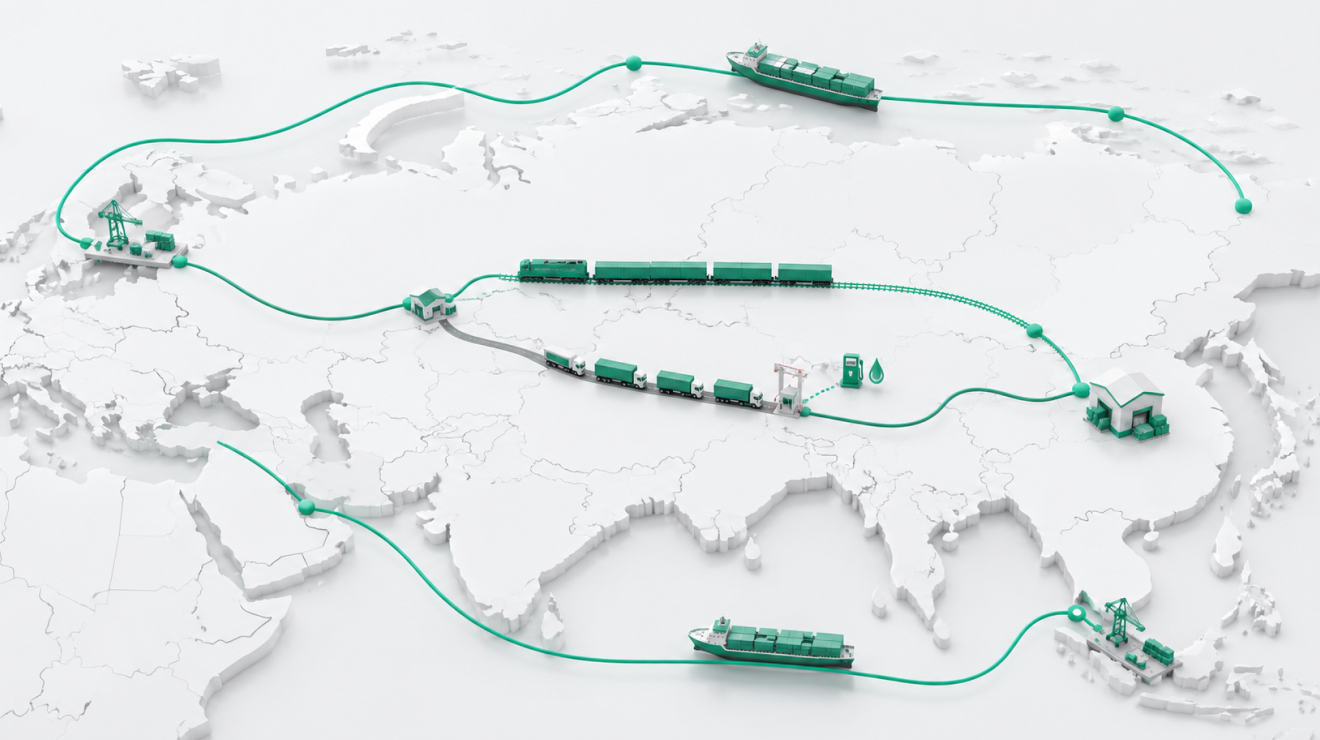

Between July 15 and July 21, 2026, road freight from China rose in price by 15–25% due to queues at gas stations and at Zabaikalsk. By the end of the week, Deputy Prime Minister Alexander Novak had already stated that the fuel market had partially stabilized. The Northern Sea Route and container imports grew in volume, while the Ministry of Industry and Trade and the EAEU are tightening digital control over documents and transit.
Road freight from China and shift to sea and rail
Kommersant reported on July 15 a 15–25% increase in rates on the Chinese road route over the month. Market participants attribute this to trucks standing idle at gas stations and at the border, rather than fuel price surcharges. At Zabaikalsk, fuel tankers were granted a priority lane, slowing down the overall cargo flow. Zabaikalsk–Moscow transit is estimated at 10–12 days, 23% longer than before.
Some importers are splitting shipments and shifting to multimodal schemes. Ocean freight and rail rates are following suit. Rate increases of around $100 per TEU and $200 per FEU are reported via Novorossiysk, and $200 and $400 via Vladivostok. Available slots for August are being booked well in advance. The Ministry of Transport points out that since March, import containers by rail from China have been exceeding 2025 levels by more than 35% monthly. Far Eastern terminals are operating at approximately 66% capacity.
Fuel circuit: from embargo to market stabilization
A ban on diesel fuel exports from Russia has been in effect since July 8 until the end of the month. Earlier, the government had already banned the export of gasoline and jet fuel. According to data cited by Logirus referencing S&P Global, Russia's diesel exports in June amounted to 14.8 million barrels. This is half the January volume. By July 13, price quotes at ARA ports in Northwest Europe reached $70.3 per barrel. Turkey and Brazil are seeking alternatives to Russian supplies.
On July 21, Alexander Novak stated that the measures are delivering results. Restrictions at gas stations are being lifted in many regions, and queues are dissipating. Separately, the government maintains control over supplies to agricultural producers during the harvesting season and the Northern delivery of jet fuel and winter diesel. Tensions still persist in certain regions. Targeted efforts are being carried out with oil companies.
Declarations without amendments and EAEU seals starting July 31
On July 17, Logirus reviewed a draft order of the Ministry of Industry and Trade introducing new forms of certificates and declarations. Public discussions run until August 11, 2026, with the planned rollout of the regulations scheduled for March 1, 2027. Amending an already registered declaration will not be permitted, so companies will need to issue a new one. Requirements for foreign manufacturer identification, up to GLN or GLONASS coordinates, are being added to the records.
On July 31, the second phase of electronic navigation seals in the EAEU kicks off. Mandatory tracking is being extended to all customs road transit, while light industry and radio electronics are being added to the list for rail transport. The seal is applied in the country of route origin. Payment is collected at a single point. For rail operators, the seal number becomes part of the transit declaration details, and without synchronizing the application, trains risk being delayed at the border.
Northern Sea Route, containers, and oil corridors
On July 16, Interfax quoted Rosatom head Alexey Likhachev. By mid-July, 18.8 million tons of cargo had been transported along the Northern Sea Route. This is 13.7% more than a year ago. The forecast for 2026 stands at 40 million tons compared to 37 million in 2025.
On July 20, PortNews published an assessment by Delo Group. Russia's container market reached 3.8 million TEU in the first half of the year (+7.1% year-on-year). In June, the market reached 668 thousand TEU. This is a 15-year high. Imports through Far Eastern ports increased by 38%, through land border crossings with Asia by 25%, and Saint Petersburg–Kaliningrad coastal shipping by 71%.
Oil infrastructure raised two risk flags during the same week. Kazakhstan confirmed that there would be no supplies to Germany via the Druzhba oil pipeline in July and August due to technical constraints on transit through Russia. On July 17, a drone attacked an empty tanker near the CPC terminal near Novorossiysk; the fire was extinguished. Kazakhstan's Ministry of Energy and the consortium itself reported that crude loading proceeds as scheduled. Volumes in the east and in the Arctic are growing, while export oil routes remain vulnerable.
On July 21, Logirus also reported a local disruption on the Armenian route. Farmers blocked the Yerevan–Yeraskh highway after tomato exports to Russia stalled. For high-volume container flows, this is negligible, but for perishable goods, it means border delays.
The week's takeaway for logistics managers is clear. The fuel factor has already affected road, ocean freight, and rail rates, while regulators are preparing a tighter digital framework for FEA. While gas stations are returning to normal operations and the Northern Sea Route alongside Far Eastern imports generate volume, it makes sense to factor in seals, new declaration rules, and lead-time buffers on the China leg in advance.