
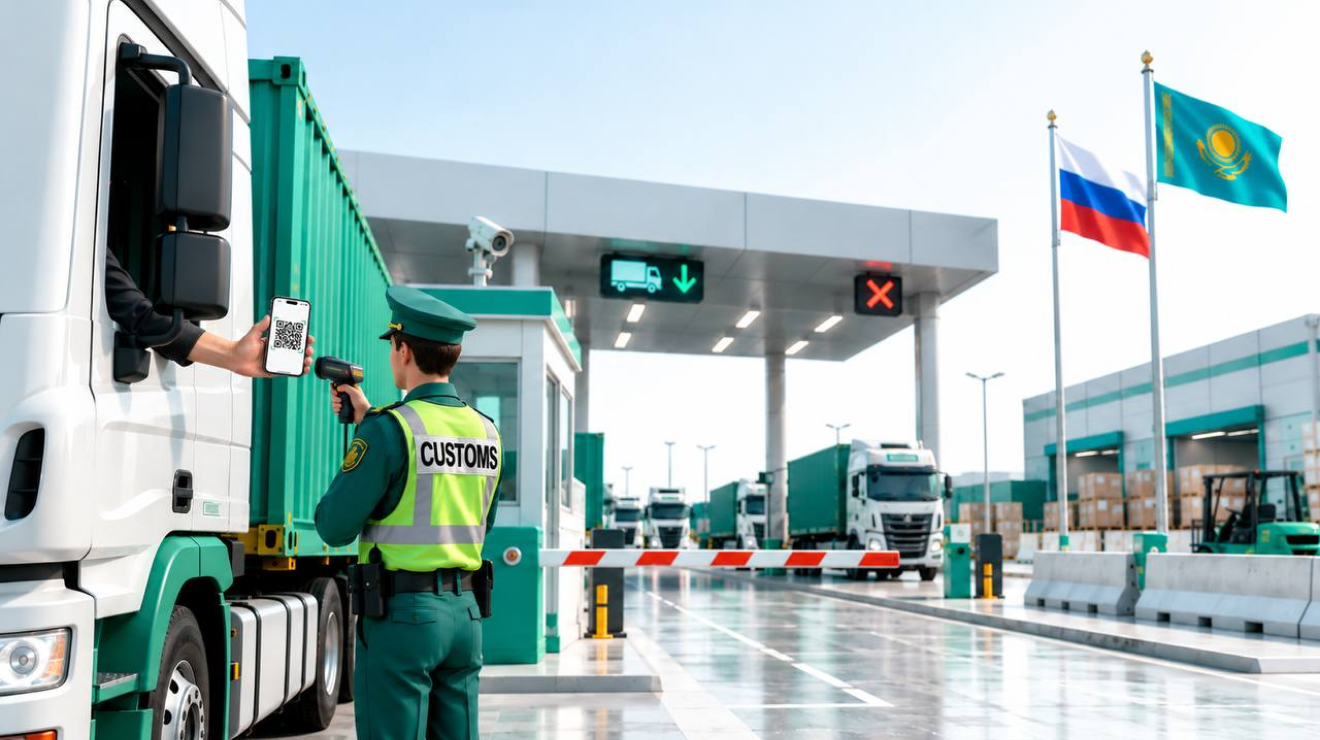

Since June 1, customs turned back 749 trucks at the Tyumen border section with Kazakhstan. The reason is the same for all: the driver failed to follow the procedure for presenting the SPOT system QR code. We transport LCL cargo from China to Moscow via Kazakhstan, making this the key news of the week for us. If your shipment takes the same route, this is major news for you as well. Three more updates concern money and transit times: starting November 1, duties on select apparel rise up to 15%, grain has congested access routes to Baltic ports, and ocean freight rates from Asia to Europe are increasing for the second consecutive week.
If your shipment arrives at customs in November or December, verify three points. For truck deliveries via Kazakhstan, the driver must possess the SPOT QR code before reaching the border. For apparel, recalculate customs duties based on the FEA commodity code; for specific codes covering coats, suits, and trousers, the rate is 15% instead of 10% from November 1. For containers moving through Baltic ports, factor in an extra few days for port approaches.
749 trucks turned back to Kazakhstan due to SPOT QR code
SPOT (Goods Delivery Expectation Confirmation System) has been effective since June 1, 2026. It verifies imports from EAEU countries via QR code and automatically scans vehicle license plates at the border. According to the Ural Customs Directorate reported by TKS, over 45 thousand trucks have passed through the Tyumen border section since then, with 749 turned back to Kazakhstan. Chelyabinsk customs (Bugristoye, Nikolayevka, and Mariinsky checkpoints) cleared over 39 thousand vehicles and identified 907 violations related to SPOT.
At the FCS board meeting on October 23, Valery Pikalyov stated that nearly 258 thousand QR codes were inspected, with 8,867 of them (around 3.4%) proving invalid. Two days later, Finance Minister Anton Siluanov outlined the FCS priorities for the coming years in an address to customs officials. Key targets include transitioning to 100% automated clearance for low-risk shipments and deploying smart checkpoints. Additionally, the FCS set a target of 10-minute truck inspections, with five checkpoints in the Far East expected to pioneer the process next year. The specific checkpoints have not yet been disclosed.
Our LCL cargo from China to Moscow via Kazakhstan takes 12–14 days. If a vehicle is turned back at the border, maintaining this schedule is impossible. That is why we verify the QR code before the truck arrives at the border, not during the crossing. If you arrange shipping independently and only provide the carrier with an invoice, clarify who is responsible for the code. Congestion at Bugristoye is unlikely to ease soon. The Ministry of Transport plans to double checkpoint capacity from 2,000 to 4,000 vehicles per day, but not until 2028.
Coats, suits, and trousers subject to 15% duty from November 1
EEC Council Decision No. 110 of September 9 raised import duties on certain apparel and industrial goods. As reported by Alta-Soft, the decision takes effect on November 1, 2026, with elevated rates applying through September 30, 2027, inclusive. The rates below are drawn directly from the text of the decision; previous rates for shirts were unavailable in public sources.
| Commodity | FEA Commodity Code | Prior to November 1 | From November 1 |
|---|---|---|---|
| Women's knitted coats, short coats, cloaks | 6102 30 100 0 | 10%, min. 2.25 EUR/kg | 15%, min. 2.25 EUR/kg |
| Suits and ensembles, workwear, trousers | specific codes in 6103, 6104, 6203, 6204 | 10%, min. 1.88 EUR/kg | 15%, min. 1.88 EUR/kg |
| Men's shirts | 6205 90 800 9 | — | 15%, min. 1.5 EUR/kg |
| Valves for operation at −40 °C and below in hydrogen sulfide environments | 8481 80 631 0, 8481 80 850 1 | 0% | 5% |
| Motors exceeding 375 kW | 8501 34 000 0 | 0% | 5% |
| Cameras for underwater, aerial, medical, or forensic photography | 9006 30 000 0 | 0% | 5% |
Customs duties are calculated at the rate effective on the registration date of the goods declaration (TD / GTD), rather than the supplier dispatch date. For a shipment of coats departing Guangzhou in October and clearing customs in November, you will pay the 15% rate. We recalculate such consignments for each code individually, as a single clothing shipment often contains both listed trousers and neighboring unlisted codes.
Who remains unaffected by SPOT and new duties
SPOT monitors imports originating from EAEU member states. If your container travels by sea from China to Vladivostok and clears customs there, no QR code is required, and truck turnbacks will not impact you. Tariff increases apply solely to commodities under codes specified in Decision No. 110. If you import consumer electronics or auto parts, your duty rates remain unchanged from November 1. The bearing labeling pilot is voluntary, with no mandatory compliance required.
Bearings can be labeled starting November, tableware required from spring 2027
Government Decree No. 1347 of October 14 launches a labeling pilot within Chestny ZNAK from November 1, 2026, to August 31, 2027. The scope covers diesel-generator and gas-piston units, their engines and generators, elevator components, and bearings for all applications. Consequently, automotive bearings fall under the pilot. Participation is voluntary, codes are provided free of charge, and methodical guidelines will be approved by the Ministry of Industry and Trade by January 20, 2027.
Regulations for tableware are stricter. Decree No. 1374 of October 21 introduces mandatory labeling for household and interior goods: tableware, cutlery, kitchen utensils, cleaning products, and home decor. System registration is mandatory from March 1, 2027, and starting April 1, 2027, importers must apply codes and report commercial release data. According to HSE estimates, counterfeit goods account for up to 26% of this market segment.
If you are procuring tableware from China for spring delivery, arrange labeling with your supplier now. For one of our clients, we applied DataMatrix codes to auto parts directly in China prior to departure from our Shanghai terminal, as certain items required labeling prior to border crossing. The consignment moved directly to online marketplaces right after customs release.
EEC targets certificates issued without testing
EEC Minister for Technical Regulation Aleksandr Subbotin announced comprehensive measures against illicit certification and non-compliant conformity assessment bodies and test laboratories. The Commission proposes cross-border information sharing, a unified digital registry of test reports, and AI-driven verification. The document has been submitted for approval to governments of all five EAEU member states, with proposals to be tabled at the Eurasian Intergovernmental Council in December. The unified register currently includes 2,957 conformity assessment bodies, including 409 certification bodies and 2,395 testing laboratories.
The concept behind the registry is straightforward: identifying certificates issued without physical testing will become far easier. Since we share responsibility for customs declarations alongside you, an invalid certificate presents the same risk to us as customs undervaluation. We previously held a client's apparel shipment at our Guangzhou warehouse until labels compliant with TR CU 017/2011 were applied and the declaration of conformity was issued. The cargo cleared customs without additional inquiries or inspections.
10 recycling fee categories to be introduced for mining excavators
The Ministry of Industry and Trade has drafted a decree updating the recycling fee on heavy machinery. Drilling equipment, specifically geological exploration rigs and blast-hole drilling machines, will be separated into a distinct category. Mining excavators exceeding 250 hp currently incur a single flat rate, but proposals suggest splitting them into 10 categories based on engine power. According to the explanatory note cited by Interfax, the current fee for such an excavator in 2026 stands at 4.2 million rubles.
Specific rates for the new categories and the effective date have not yet been published. However, Kommersant notes that base rates are already scheduled to rise by 10–20% from early 2027 due to annual indexation. If you import heavy machinery from China, we advise calculating post-New Year delivery contracts incorporating the 10–20% indexation adjustment.
Grain congests access routes to Baltic ports
Grain export flows have shifted from the Black Sea to the Baltic region. According to the Russian Grain Union, the country shipped 1.135 million tons from October 1 to 20, compared to 4.515 million tons a year earlier. Simultaneously, Baltic port shipments surged 11-fold to 875 thousand tons, while Novorossiysk handled 59.6 thousand tons compared to 1.7 million tons previously. In September, Russian Railways loaded 2.8 million tons of export grain, an 80% year-on-year increase.
Rail infrastructure is straining under this volume. Delovoy Peterburg reports that Baltic ports processed over 1.2 million tons of grain in September, up from 47 thousand tons the previous year. Abandoned freight trains are idling on approaches to the Ust-Luga station, and grain shipments face delays of at least three days. Containers and general cargo utilize the same rail approaches. If you are expecting container arrivals via Baltic ports, we recommend factoring in a buffer of several days over the coming weeks.
Traffic stalled near Yekaterinburg following derailment of 20 railcars
On October 26 at 01:30 local time, 20 freight train cars derailed on the Makartsevo–Sedelnikovo section of the Sverdlovsk Railway, causing 7 tank cars to catch fire. No casualties were reported. The clearance gauge of the adjacent track was obstructed, suspending rail traffic on the Reshety–Aramil stretch. Recovery operations involve 106 personnel and 31 units of specialized equipment, with transport investigative authorities examining the causes. Traffic resumption had not been announced at the time of publication.
If your container is routed by rail through the Yekaterinburg railway hub, check with your freight carrier regarding possible route diversions and updated transit times. We address such operational questions proactively, rather than waiting for the scheduled arrival date.
Asia–Europe rates rise, Maersk intends to return to Suez
The Drewry WCI climbed 2% to $4,585 per 40-foot container as of October 22, reaching a 15-week high. Rates for Shanghai–Rotterdam rose to $3,632 (+3%), and Shanghai–Genoa stood at $4,152 (+5%). Xeneta data from October 23 placed the spot rate from the Far East to Northern Europe at $3,698 (+6.8% weekly), and to the Mediterranean at $4,442 (+5.8%). Rates have grown for two consecutive weeks, with Drewry forecasting further moderate gains next week driven by capacity constraints and blank sailings.
Concurrently, Maersk aims to return vessels to the Suez Canal route. During a meeting with the Suez Canal Authority, Maersk COO Rabab Boulos expressed expectations that all company services will resume transiting the canal by March 2027. Between January and September, Maersk vessels traversed Suez 276 times, compared to 146 during the same period last year. This development is crucial for us, as TransGID operates its own terminal in Novorossiysk, serving cargo routed from Asia via Suez. However, March 2027 remains a projection rather than a guarantee, and we do not factor a Suez return into our November freight quotations.
Eastern Operating Domain congested from both sea and land
FESCO China Direct Line, covering four shipping lines linking Vladivostok Sea Commercial Port with ports across China, transported 259 thousand TEU in nine months—a 31% increase year-on-year. Import volumes increased by 72%. In November, FESCO plans to expand weekly capacity past 7 thousand TEU. Higher container slot availability on the China–Vladivostok route will help minimize dwell times at Chinese ports.
Overland transit further strains the Eastern Operating Domain infrastructure. China Railway Harbin Group reported 6,024 China–Europe freight trains traversing the eastern corridor since the beginning of the year, up 40.3% year-on-year. These trains transit via Russian border crossings. Container traffic across the Russian Railways network is also up, with an increase of nearly 5% over nine months compared to the previous year. An Infoline review cited by Vedomosti and Lenta.ru indicates that nearly half of cargo owners and logistics operators anticipate Q4 operational conditions across the rail network to be more challenging than Q3.
With our headquarters located in Vladivostok, we calculate total transit time to Moscow across three components: sea leg, port dwell time awaiting train departure, and rail haulage. If meeting delivery deadlines is critical for your business, ask your carrier to quote port dwell time separately.
What to recalculate for November and December shipments
Customs duties for November apparel shipments are assessed at the rate effective on the goods declaration registration date; calculate 15% for coats, suits, and trousers on the list. Truck deliveries via Kazakhstan cannot proceed past the border without a valid SPOT QR code. Container shipments through Baltic ports may experience delays of several days, and transit schedules via Yekaterinburg should be confirmed directly with your carrier. When requesting ocean freight rates from Asia to Europe, ensure they include explicit validity periods, as rates have risen for the second week running.
Send us your FEA commodity code and proforma invoice before placing orders with suppliers. TransGID will calculate customs duties according to the November 1 rates and advise whether mandatory labeling and QR codes are required for your shipping route.