
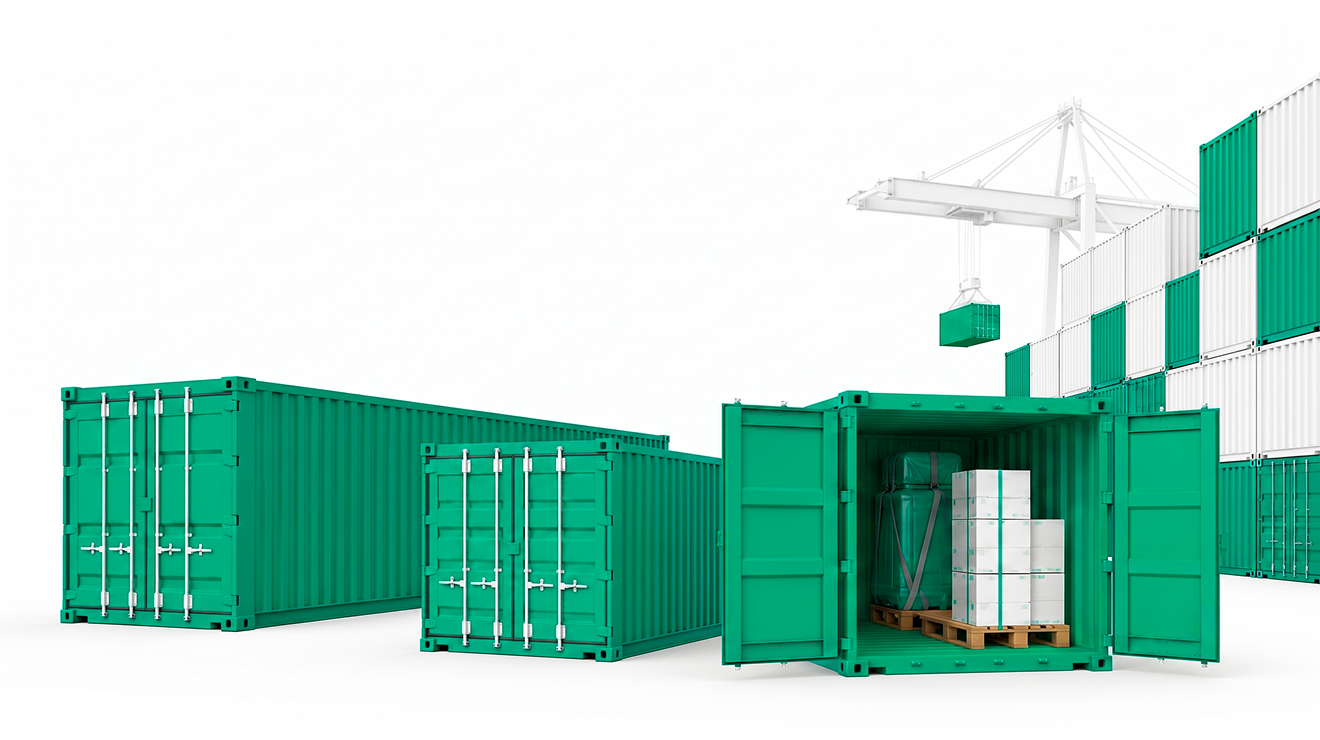

A machine tool 2.40 m high arrived at the warehouse for a 40-foot dry container. The internal height of the container was 2.39 m, everything matched the catalog, but the door opening on that specific unit turned out to be 2,280 mm. The cargo would not fit, the truck stood idle for 24 hours, and the shipment had to be reloaded into a High Cube container. External dimensions in feet are identical for containers, but door openings, tare weight, and payload vary by centimeters and tons from batch to batch. Below are the ISO dimensions, internal measurements, door openings, pallet capacities, and weight limits, along with an essential caveat regarding where catalog figures cease to work.
Door openings and cargo density matter before feet
Compare the height of the cargo unit with the door opening. For a standard DC, this is 2,280–2,291 mm; for a High Cube, it is 2,585–2,597 mm. Next, estimate the cargo density. For a 20′ DC, it is approximately 650–850 kg/m³; for a 40′ DC, around 370–430 kg/m³. Only then should you look at container length in feet.
This sequence is deliberate and essential. The door opening filters out the majority of problematic requests, because free centimeters inside the container are useless if the cargo cannot pass between the door leaves. Density is the second deciding factor, showing whether you will hit the limit in weight (tons) or volume (cubic meters) first.
Dense cargo—such as metal, stone, cement, and machinery—reaches maximum payload capacity long before filling the volume. A 20-foot container is usually sufficient, and two 20-foot containers are often more cost-effective than a single 40-foot container, as their total combined payload is higher. Lightweight, bulky cargo behaves in the opposite way. Furniture, insulation, empty packaging, and e-commerce goods fill up cubic capacity before reaching weight limits; in this case, High Cube containers reduce the number of required boxes.
We ask our clients to provide dimensions in millimeters for each cargo piece rather than approximate length in feet. For a batch, please also specify the number of pieces, pallet count, stackability, and loading method. This information allows us to calculate optimal transport options before booking a slot.
When this table does not apply
All information below describes ISO Series 1 containers used in sea, rail, and road multimodal transport. These specifications do not apply outside this scope.
Medium-duty 3- and 5-ton railway containers operate under their own dimensions, feature different securing systems, and have different widths. They are covered in a dedicated section below. North American 53-foot containers for domestic US transit are completely excluded from the Series 1 classification.
Container wear category is another critical factor. Operators grade container fleets into categories from 0 to 3. Units graded 0–2 are suitable for cargo transportation, whereas category 3 is designated for static warehouse storage only and may not sustain nominal payload capacity or permissible stacking loads. Externally, they have identical dimensions in feet, making them indistinguishable on paper. Always verify the condition category prior to booking, especially if a container is offered significantly below market rates.
How to read container markings
In freight requests and catalogs, the same container type may have different designations. Letter codes should always be interpreted alongside the description and length, as different operators may use similar yet non-identical abbreviations.
| Code | Meaning |
|---|---|
| DC, DV, GP, ST | Standard enclosed dry container (Dry Container, Dry Van, General Purpose, Standard) |
| HC, HQ, High Cube | High-cube container. External height of 2,896 mm vs. 2,591 mm for a standard unit, adding approx. 30 cm of usable internal height |
| PW, HCPW, Pallet Wide | Increased internal width: approx. 2,432–2,444 mm, allowing three 800 mm Euro-pallets to fit in a row side by side with functional clearance |
| RF, RE, RT, Reefer | Refrigerated container. Insulation and the refrigeration unit reduce usable internal volume compared to a dry container of equal length |
| OT, Open Top | Open-top container with a removable tarpaulin, loaded from above by crane |
| HT, Hard Top | Removable rigid steel roof. Suitable when crane top-loading is required followed by transport in an enclosed, rigid compartment |
| FR, Flatrack, Platform | Platform with fixed or collapsible end frames, or flat platform. Sized based on usable bed area and lashing points rather than enclosed cubic volume |
| TN, TG, TD | Tank containers; a tank fitted within a standard ISO structural steel frame |
| BU, BK | Bulk cargo containers equipped with top loading hatches and discharge valves |
| VH | Ventilated container with natural or mechanical air exchange systems |
A twenty-foot container equals one TEU (Twenty-foot Equivalent Unit); a forty-foot container equals one FEU, or two TEU. The 40′ mark designates length, while the following suffix specifies the container type. For example, 40DC is standard, 40HC is high cube, and 40HCPW is high cube pallet wide.
External dimensions according to ISO 668 and GOST
External envelope dimensions are governed by ISO 668 (2020 edition, including Amd 1:2022). In Russia, GOST R 53350-2009 (based on ISO 668) is in force; it establishes identical external dimensions, maximum gross mass, minimum internal dimensions, and minimum door openings.
Width across all Series 1 containers is standardized at 2,438 mm. The external height of a standard dry container is 2,591 mm, and for a High Cube, it is 2,896 mm.
| Size | ISO Code | Length, mm | Width, mm | Height, mm |
|---|---|---|---|---|
| 10′ DC | 1D | 2,991 | 2,438 | 2,591 |
| 20′ DC | 1CC | 6,058 | 2,438 | 2,591 |
| 20′ HC | 1CCC | 6,058 | 2,438 | 2,896 |
| 40′ DC / DV | 1AA | 12,192 | 2,438 | 2,591 |
| 40′ HC | 1AAA | 12,192 | 2,438 | 2,896 |
| 45′ HC | 1EEE | 13,716 | 2,438 | 2,896 |
The standard establishes an overall dimensional envelope, but does not guarantee that every container of a given model will have identical internal dimensions. Manufacturers may use thicker wall panels, different flooring materials, reinforced corner posts, or refrigeration equipment, leading to variations in internal volume. Rely on these tables for external lengths and widths; all internal clearances must be verified for the specific physical unit.
Dry containers: 10, 20, 40, and 45 feet
10-foot containers and storage units
Ten-foot containers are used far less frequently than 20- and 40-foot units. They are typically deployed for smaller shipments, storage, or regional multimodal solutions where a 20′ container is oversized. Internal volume is approximately 15 m³.
Watch out for a common pitfall: static storage boxes are often sold under the guise of 10-foot shipping containers. While visually similar, storage boxes lack standard corner castings and valid CSC certification, meaning they cannot be accepted for sea, rail, or intermodal freight carriage.
20-foot DC and HC containers
The 20′ DC remains the benchmark container for dense and heavy cargo. Internal dimensions range from 5,898–5,905 × 2,350–2,352 × 2,390–2,393 mm, with a volume of 33–33.2 m³ and a door opening of approximately 2,336 × 2,280 mm. Usable payload varies across production series between 21,600 and 28,300 kg.
The 20′ HC has the same length but greater height. Internal height is 2,693–2,698 mm, with an internal volume of 37.4–38.4 m³. It is ideal for lightweight, high-cube cargo and tall packaging. However, internal width is identical to a standard 20′ container, so if cargo is too wide for the door, extra height will not solve the issue.
40-foot DC, HC, and HCPW containers
The 40′ DC is selected for elongated or voluminous consignments that do not exceed standard height requirements. Internal dimensions: 12,032–12,039 × 2,350 × 2,372–2,393 mm, with a volume of 67.3–67.8 m³.
The 40′ HC is approximately 30 cm higher, offering internal dimensions of 12,032–12,093 × 2,330–2,352 × 2,693–2,698 mm and a volume of 75.6–76.5 m³. The extra foot of vertical space provides an additional 8–9 m³ on the same platform footprint, making the 40′ High Cube the most prevalent container on ocean shipping lines today.
The 40′ HCPW is wider. Internal width is 2,432–2,444 mm compared to 2,350 mm on standard units—an increase of 8–9 cm. Internal volume is 78.8–79.3 m³, accommodating up to 30 Euro-pallets instead of 25. The external width of a Pallet Wide container is 2,500 mm, which approaches the Russian road transport limit of 2.55 m under cargo transport regulations (Decree of the Government of the Russian Federation No. 2200). Semi-trailer selection and road routing must be coordinated separately from ocean slot booking.
45-foot DC, HC, and Pallet Wide containers
A 45-foot container is 1,524 mm longer than a 40-foot unit. Standard models feature an internal width of 2,310–2,350 mm; HC variants have an internal height of 2,640–2,700 mm, yielding a total volume of 81–86 m³ for 45′ DC and HC.
The 45′ PW features internal measurements of approx. 13,510 × 2,440 × 2,550 mm with an 85.1 m³ capacity; the 45′ HCPW has an internal height of 2,670 mm and an internal volume of 88.7–89.5 m³. Pallet capacity reaches 30 to 33 units. For any 45-foot container, road-train combination length, total vehicle height, terminal restrictions, and carrier equipment availability must be verified in advance, as 45′ units are not available at all ports.
If cargo is moved by sea, line equipment availability should always be confirmed before rate calculation. Step-by-step procedures and transit times are detailed on our sea container shipping page. If your shipment does not fill an entire container, consider comparing this option with our LCL cargo delivery service to pay only for the volume actually utilized.
Why cargo fits inside but cannot pass through the door
This is where problems such as the warehouse machinery issue mentioned earlier occur. Standard 20′ and 40′ DC containers feature a door opening of approximately 2,336–2,343 mm in width and 2,280–2,291 mm in height. On High Cube containers, the door opening height increases to 2,585–2,597 mm with the same width.
A cargo piece 2.40 m high will not enter a DC container, even if the internal clearance above the door is adequate. Loading is constrained by the structural door header frame, not the ceiling. Door sills, hinges, corrugations, packaging, and forklift entry angles can also create obstructions.
If the cargo does not fit through the DC door opening, standard dry containers must be ruled out before calculating cubic volume and feet. The next step is evaluating High Cube, Open Top, or Flat Rack equipment. For heavy machinery loaded by overhead crane, an Open Top container eliminates door constraints entirely. Flat Racks are required when side loading is also needed. For tall pallet stacks, a 40′ HC is usually sufficient, offering greater vertical entry clearance and safety margins for lashing.
Refrigerated, Open Top, Flat Rack, and tank containers
Refrigerated containers (Reefers)
Reefer containers maintain preset temperature levels for food products, pharmaceuticals, and fresh flowers. The cooling unit, thermal insulation, and air ducting reduce usable internal space. A 20′ RF provides an internal area of approx. 5.45 × 2.26 × 2.28 m with 26.5–28 m³; a 40′ RF offers 11.56 × 2.29 × 2.28 m and approx. 60 m³; a 40′ HC RF delivers 11.56 × 2.29 × 2.50 m and approx. 66 m³.
When booking, specify precise cargo dimensions along with target temperature range, humidity, ventilation settings, pre-cooling requirements, and genset/power availability along the entire transit route. The refrigeration unit is designed to maintain set temperatures, not to rapidly chill warm cargo, unless specifically engineered for pull-down operations.
Open Top and Hard Top containers
Open Top containers are used when cargo cannot be loaded horizontally through doors or must be lowered vertically by crane. The roof is covered with a removable tarpaulin. Internal volume of a 20′ OT is approx. 32–32.6 m³, and 66.7 m³ for a 40′ OT. For out-of-gauge (OOG) height cargo, lashing, over-height limits, and transit routing require special approval.
Hard Top containers feature a removable rigid steel roof; on select models, the door header can also be swung out or removed. They are used for heavy equipment and steel products requiring crane loading combined with rigid, weatherproof protection during transit.
Flat Rack and platform containers
Flat Racks consist of a reinforced base frame with fixed or collapsible end walls. They are engineered for out-of-gauge machinery, structural steel, pipes, machine tools, and industrial transformers.
Critical calculation parameters include usable deck length and width, end-wall height, cargo weight, center of gravity, lashing points, and side/top overhangs. Tare weight for a 20′ Flat Rack is typically 2,400–3,250 kg, and 4,800–5,530 kg for a 40′ unit, with reinforced 40′ models rated up to a maximum gross weight of 45,000–52,500 kg.
Tank containers and bulk equipment
A tank container consists of an insulated or uninsulated pressure vessel mounted within an ISO structural frame. Key parameters include capacity, working and test pressure, vessel material, thermal regulation, valving, and hazardous materials certification. Capacities for common models range from 17,500 to 30,000 liters; comparing tank capacity directly with 20′ dry container volume is incorrect. Hazardous goods require verification of technical passports, placards, and compliance with ADR or IMDG regulations.
Bulk containers for dry bulk cargo feature loading hatches, discharge chutes, and liners. Ventilated containers are primarily utilized for agricultural products like coffee and cocoa beans. Insulated containers maintain temperature passively without active refrigeration; for active cooling, a reefer is required.
Tare weight, payload, and gross mass
Shipping documents refer to four distinct weight metrics that are often confused. Tare weight represents the unladen mass of the container. Payload indicates the maximum permissible weight of the cargo itself. Maximum Gross Mass (Max Gross) represents the total combined mass of the container and its cargo. Actual Gross Mass indicates the verified scale weight of the loaded unit.
The calculation is straightforward: Max Gross minus tare weight equals the maximum cargo payload. However, in actual transportation, the lowest of three regulatory constraints applies: the rating of the container itself, route limitations, or line/terminal infrastructure limits.
The standard gross rating for Series 1 containers is 30,480 kg, as stamped on most CSC plates. Amendment 1 to ISO 668 and Russian GOST R 53350 allow containers with ratings up to 36,000 kg subject to verified manufacturing and testing; therefore, some 40′ and 45′ catalogs list ratings of 32,500–35,000 kg. This is an engineered feature rather than a catalog typo, and it must correspond exactly to the container door plate.
Permissible payload must be calculated from the Max Gross mass on the physical CSC plate of that exact unit minus its stamped tare weight. Generic payload figures from rate sheets cannot be used for Verified Gross Mass (VGM) declarations. Under SOLAS regulations effective since July 1, 2016, shippers are legally required to provide the carrier with a Verified Gross Mass (VGM) prior to vessel loading, established either by weighing the packed container or by adding the certified weights of the cargo, packaging, securing gear, and tare mass. A container exceeding the rating stamped on its CSC plate will be denied vessel loading.
Road transit introduces additional restrictions. Total commercial vehicle height (including cargo) in Russia is capped at 4.0 meters under Decree No. 2200; a High Cube container measuring 2,896 mm on a high-deck chassis will approach or exceed this threshold. Gross vehicle weight ratings depend on axle configurations: 5-axle road combinations are limited to 40 tons total weight, while 6-axle configurations allow up to 44 tons. Ocean carriers may accept 30.48 tons gross, but road transport regulations may restrict loading earlier.
Heavy cargo may fit inside a 40′ HC container by volume but exceed payload limits or concentrated floor load thresholds. In such cases, options include 20′ DC units, multiple containers, or heavy-duty Flat Racks. Concentrating excessive weight against a single wall is strictly prohibited; cargo weight must be evenly distributed along the floor centerline and secured against transit shifting.
Euro-pallets and loading patterns
A standard Euro-pallet measures 1,200 × 800 mm. In a standard ISO container with an internal width of roughly 2,350 mm, three 800 mm pallets cannot fit across the width in a single row (requiring at least 2,400 mm). In Pallet Wide containers (internal width: 2,432–2,444 mm), this configuration is achievable with operational clearance.
Typical single-tier pallet capacities: approx. 11 Euro-pallets in a 20′ DC or HC; 14 in a 20′ PW; 23–25 in a 40′ DC or HC; 30 in a 40′ PW and HCPW; 30 in a 45′ PW; and 33 in a 45′ HCPW. These figures are guidelines rather than guarantees. Overhanging cargo, non-standard pallet decks, strapping, edge protectors, or cargo that cannot be stowed flush will alter the stowage layout.
Drafting a stowage plan is far more reliable than mental estimates. Start with a floor plan based on the verified internal length and width of the container, check both pallet orientations (1,200 mm lengthwise and 800 mm lengthwise), account for pallet height including cargo and potential second tiers, and leave necessary clearance for dunnage, anti-slip mats, and door clearance.
Two-tier stacking doubles pallet capacity only if the combined pallet and cargo height fits within internal clearances and the container floor rating supports the concentrated load. For shipments of 30 or more pallets, evaluate 40′ HCPW, 45′ PW, and 45′ HCPW containers. If pallets are heavy, verify weight limits first: available cubic space does not imply permission to load up to the roof.
3- and 5-ton containers on the domestic railway network
In addition to ISO marine containers, medium-duty containers operate on the domestic railway and road networks. A 3-ton container features external dimensions of 2.10 × 1.325 × 2.40 m and internal dimensions of 1.93 × 1.225 × 2.13 m, with an internal volume of 5.16 m³. A 5-ton container measures 2.65 × 2.10 × 2.40 m externally and 2.515 × 1.95 × 2.13 m internally, with an internal volume of 10.4 m³.
These cannot be classified as ISO containers. They feature different lifting eyes, distinct dimensional footprints, and cannot directly replace ISO corner-fitted containers without transshipment. Commercial catalogs occasionally reference outdated GOST standards that have long been superseded for heavy-duty freight containers. Always confirm container specification numbers and routing eligibility via the owner's equipment certificate.
Following port clearance, containers typically continue onward by rail. Routing options and terms are outlined on our rail freight from China and Russian ports page.
Summary tables of dimensions and weight
Value ranges in these tables are deliberate: different production batches of the same container type vary in tare weight and payload. Variations of 1–3 cm in internal length and width between series are normal industry tolerances.
Internal dimensions and capacity
| Container Type | Code | Internal Length, m | Width, m | Height, m | Volume, m³ | Door Opening: W × H, m | Euro-pallets, pcs |
|---|---|---|---|---|---|---|---|
| Dry Freight Containers | |||||||
| 10′ Standard | 10DC | 2.83 | 2.33 | 2.31 | 15 | 2.27 × 2.31 | — |
| 20′ Standard | 20DC / DV / GP | 5.90–5.94 | 2.35 | 2.38–2.39 | 33–33.2 | 2.34 × 2.28 | 11 |
| 20′ High Cube | 20HC | 5.90 | 2.35 | 2.69–2.70 | 37.4–38.4 | 2.34 × 2.58 | 11 |
| 40′ Standard | 40DC / DV | 12.03–12.04 | 2.35 | 2.37–2.39 | 67.3–67.8 | 2.34 × 2.28 | 23–25 |
| 40′ High Cube | 40HC | 12.03–12.09 | 2.33–2.35 | 2.69–2.70 | 75.6–76.5 | 2.34 × 2.58 | 23–25 |
| 45′ Standard | 45DC | 13.51 | 2.31–2.35 | 2.55 | 81–83 | 2.31–2.34 × 2.28 | 27 |
| 45′ High Cube | 45HC | 13.51 | 2.31–2.35 | 2.64–2.70 | 82.5–86 | 2.31–2.34 × 2.57 | 27 |
| Pallet Wide | |||||||
| 20′ Pallet Wide | 20PW | 5.90 | 2.43–2.44 | 2.39 | 34 | 2.42 × 2.28 | 14 |
| 40′ High Cube Pallet Wide | 40HCPW | 12.04 | 2.43–2.44 | 2.69 | 78.8–79.3 | 2.42 × 2.58 | 30 |
| 45′ Pallet Wide | 45PW | 13.51 | 2.44 | 2.55 | 85.1 | 2.42 × 2.44 | 30 |
| 45′ High Cube Pallet Wide | 45HCPW | 13.51 | 2.44 | 2.67 | 88.7–89.5 | 2.42 × 2.58 | 33 |
| Open Top, Hard Top, and Flat Rack | |||||||
| Open Top 20′ | 20OT | 5.90 | 2.32–2.35 | 2.35 | 32–32.6 | 2.26–2.34 × 2.24–2.35 | 11 |
| Open Top 40′ | 40OT | 12.02 | 2.35 | 2.33 | 66.7 | 2.34 × 2.23 | 25 |
| Hard Top 40′ | 40HT | 12.02 | 2.35 | 2.33 | 66.7 | 2.34 × 2.23 | 24–25 |
| Flat Rack 20′ | 20FR | bed 5.64–5.85 | 2.08–2.40 | by model | not applicable | no doors | — |
| Flat Rack 40′ | 40FR | bed 11.66–11.88 | 2.08–2.40 | by model | not applicable | no doors | — |
| Refrigerated | |||||||
| Reefer 20′ | 20RF | 5.45 | 2.26 | 2.28 | 26.5–28 | 2.24–2.29 × 2.22–2.26 | 10 |
| Reefer 40′ | 40RF | 11.56 | 2.29 | 2.28 | 60.2 | 2.29 × 2.24 | 23 |
| Reefer 40′ HC | 40HCRF | 11.56 | 2.29 | 2.50 | 66.1 | 2.29 × 2.48 | 23 |
For Flat Racks, height and width refer to the usable platform area and end frame structures rather than enclosed internal cubic space. For refrigerated containers, pallet capacity depends on mandatory clearances required for air circulation.
Tare weight, payload, and gross mass
| Type | Code | Tare, kg | Payload, kg | Max Gross, kg |
|---|---|---|---|---|
| 20′ Standard | 20DC | 2,145–2,370 | 21,600–28,335 | 24,000–30,480 |
| 20′ High Cube | 20HC | 2,320–2,560 | 27,900–28,140 | 30,480 |
| 40′ Standard | 40DC | 3,620–4,000 | 24,800–28,880 | 28,800–30,480 |
| 40′ High Cube | 40HC | 3,740–4,200 | 26,280–28,740 | 30,480–32,500 |
| 40′ High Cube Pallet Wide | 40HCPW | 4,200–4,400 | 26,280–30,720 | 30,480–35,000 |
| 45′ PW | 45PW | 4,180–4,250 | 29,800–30,000 | 32,500–34,000 |
| 45′ HCPW | 45HCPW | 4,250–5,080 | 28,920–29,750 | 34,000 |
| Open Top 20′ | 20OT | 2,440 | 21,560 | 24,000 |
| Open Top 40′ | 40OT | 4,430 | 31,570 | 36,000 |
| Hard Top 40′ | 40HT | 4,430 | 31,570 | 36,000 |
| Flat Rack 20′ | 20FR | 2,400–3,250 | 20,000–31,260 | 30,480–34,000 |
| Flat Rack 40′ | 40FR | 4,800–5,530 | 39,400–47,370 | 45,000–52,500 |
| Reefer 20′ | 20RF | 2,900–3,500 | 23,500–27,000 | 27,000–30,480 |
| Reefer 40′ | 40RF | 4,370 | 26,110 | 30,480 |
| Reefer 40′ HC | 40HCRF | 4,200 | 26,280 | 30,480 |
The greatest variations occur in Flat Rack, Open Top, Pallet Wide, and refrigerated equipment, where payload discrepancies between manufacturers can reach several metric tons.
How to check catalog specs against the door plate
Mounted on the right-hand door of every certified container is the CSC Safety Approval Plate. It indicates the Maximum Gross Weight, Tare Weight, Allowable Stacking Load, and the date of next periodic inspection. Taking a photo of this plate prior to booking takes thirty seconds and prevents half of all loading ramp disputes.
While CSC certification confirms a container's structural safety for international carriage, it does not ensure that your specific cargo will fit. Dimensions must be verified independently: internal length using a measuring tape if clearances are tight, and door openings unconditionally. Catalog internal lengths for 40-foot units vary from 12,032 to 12,093 mm; for machinery or structural racking, these six centimeters can be decisive.
You should also inspect manufacturing year, floor integrity, weather tightness, and lashing ring condition. If the estimated cargo gross weight approaches the rating indicated on the plate, allow a safety margin for lashing gear and never rely on generic payload figures from another container of the same class.
Frequently asked questions
Which container is larger: 20′ HC or 40′ DC?
A 40′ DC is nearly twice as long, offering an internal volume of approximately 67 m³ compared to 37.4–38.4 m³ for a 20′ HC. A 20-foot High Cube is chosen when additional height is needed but cargo length and weight stay within 20-foot parameters.
Why does cargo fit inside but fail to enter the container?
The door opening is narrower and lower than the internal container profile: 2,280–2,291 mm in height on a standard DC versus 2,390 mm inside. Detailed calculations are provided in the section on door openings.
Can 30 tons of cargo be loaded into a 40-foot container?
This cannot be determined from standard reference tables alone. You must check the Max Gross and tare weight of the specific unit, along with shipping line, rail carrier, terminal, and road transport axle limits. Standard 40-foot containers typically have payloads between 25 and 29 tons; loading 30 tons requires specialized calculation or heavy-duty equipment.
How many Euro-pallets fit in a 40-foot container?
As a benchmark: 23–25 pallets in a standard 40′ DC or HC, and up to 30 pallets in a 40′ HCPW. The exact count depends on the stowage scheme, cargo height, pallet overhang, stacking capability, and lashing requirements.
How does a Pallet Wide container differ from a standard container?
It provides an extra 8–9 cm of internal floor width, allowing three Euro-pallets to fit side by side. However, shipping line availability and road transport dimensions must be approved in advance: external width is 2,500 mm compared to standard 2,438 mm.
Which specifications are considered definitive?
The technical data of the specific physical container: internal dimensions, door opening clearance, tare weight, Max Gross rating, and CSC validity date. Reference tables serve for preliminary planning and equipment comparison, whereas loading operations must rely strictly on the door plate data.
If you need a calculation for a specific shipment, send us the dimensions of your cargo units in millimeters, total weight, and pallet count. We will select the optimal container type and verify all constraints across the entire route, including road transit legs.