
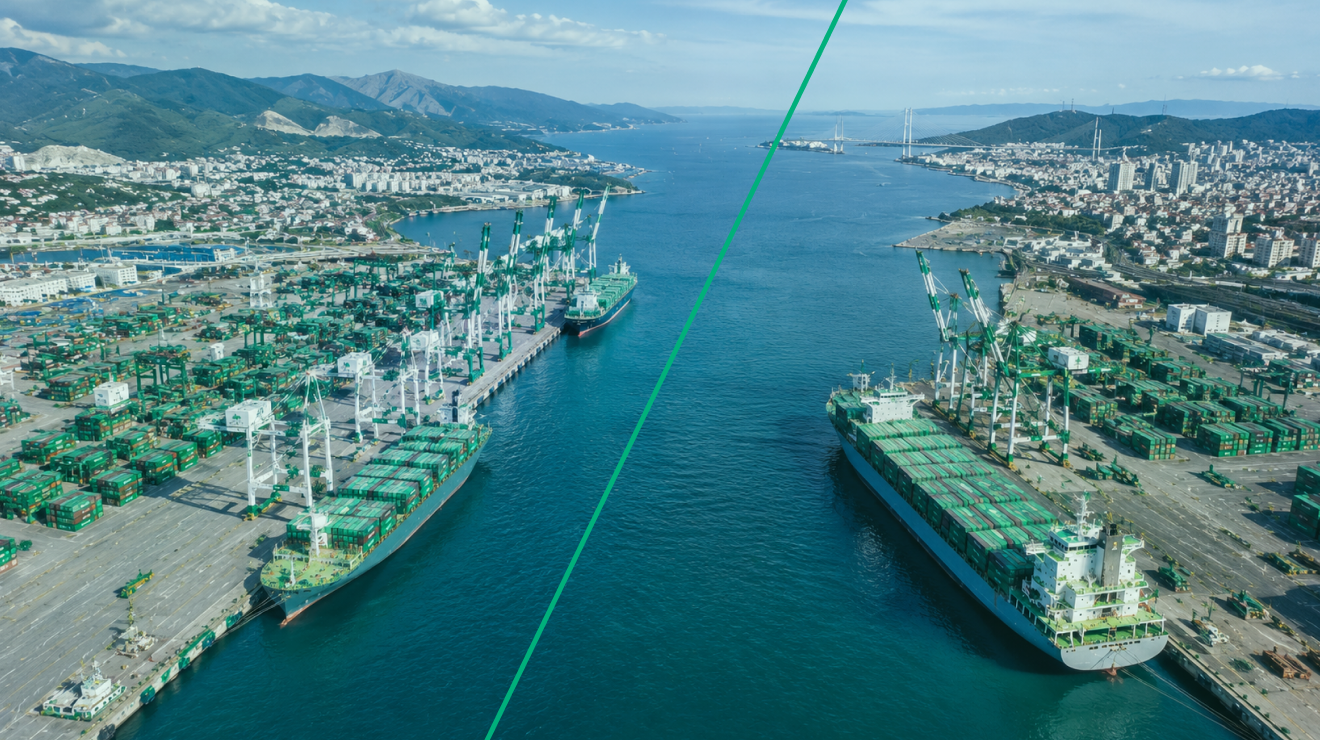

Novorossiysk and Vladivostok account for nearly half of all Russian container turnover: by the end of 2025, about 2.58 million TEU out of 5.34 million TEU nationwide passed through these two ports. However, the logic of choosing between them does not simply boil down to whether the cargo originates from the East or the West. It is sometimes more cost-effective to ship Turkish textiles via Vladivostok, and Chinese electronics via Novorossiysk. Everything is determined by three parameters: where the cargo originates, where it is being delivered, and the cost per overland kilometer from the port to the consignee's warehouse.
Geography as the First Filter
Novorossiysk is located 1,227 km from Moscow along the M-4 Don highway. Vladivostok is 9,288 km from the capital via the Trans-Siberian Railway. The higher the cost of storage and working capital, the stronger the argument in favor of a shorter leg from the port to the warehouse.
For companies in Krasnodar Krai, Rostov, Stavropol, or Voronezh, Novorossiysk is not just an alternative, but the obvious choice. Trucking from the port to Rostov takes 5–7 hours. From Vladivostok, those same Rostov-based consignees wait 12–14 days by rail plus one to two days for door delivery.
Moscow and Central Russia represent a zone of direct competition between the ports. Here, the final calculation is influenced not only by distance, but also by train frequency, main-line congestion, and risk surcharges. The Urals, Siberia, and the Far East are regions where Novorossiysk falls short. Shipping from Krasnodar Krai to Krasnoyarsk or Khabarovsk takes longer and costs more than receiving cargo directly in Vladivostok.
Turkey — Novorossiysk's Main Advantage
Of all Novorossiysk's advantages, the most obvious is its proximity to Turkish ports. Istanbul and Novorossiysk are separated by the Black Sea, spanning roughly 1,100 km. A vessel from Ambarli or Gebze takes 36–55 hours to reach Novorossiysk. Factoring in loading, customs clearance, and discharge, the complete cycle takes 3–14 days depending on documentation readiness.
The route from Istanbul to Vladivostok passes through the Suez Canal, the Indian Ocean, and the Sea of Japan. There is no direct scheduled service. Cargo is transported with transshipment in Singapore or Busan, resulting in an overall transit time of 35–50 days compared to 3–14 via Novorossiysk.
According to wwlogist.com, ocean freight for a 20-foot container from Ambarli (Istanbul) to Novorossiysk is $550, and $650 for a 40-foot container (rates valid until July 31, 2026). From Mersin to Novorossiysk, a 20-foot container costs $900, and a 40-foot container costs $1,100. For comparison, freight from Istanbul to Vladivostok starts at $750 for a 20-foot container and $950 for a 40-foot container. That means Novorossiysk saves $200–400 per container on the sea leg alone, while delivering a 25–40 day time advantage for the consignee.
Turkish suppliers deliver textiles, building materials, rolled steel, household chemicals, furniture hardware, marble tiles, canned goods, and industrial equipment. These goods account for a substantial portion of Russian imports. According to TurkStat, Turkey-Russia trade turnover in 2025 reached $49.1 billion — and a significant share of physical cargo moves by sea across the Black Sea, meaning through Novorossiysk. Selecting any other port for such shipments requires explicit justification — the logic is that clear.
India, the UAE, and the Middle East
India supplies Russia with pharmaceuticals, textiles, chemical raw materials, auto parts, and agricultural products. Ports of origin include Nhava Sheva (Mumbai), Mundra, and Chennai. FESCO Transportation Group operates the direct FIL-W line (FESCO Indian Line Westbound) along the Nhava Sheva – Mundra – Jebel Ali – Novorossiysk route. Transit time is 18–25 days along the India – UAE – Novorossiysk route, with departures every two weeks.
There are no direct lines from Vladivostok to Indian ports. Cargo travels with transshipment in Singapore, Busan, or Colombo, pushing the total transit time to 28–45 days. For urgent pharmaceutical batches where shelf life is critical, a difference of 10–25 days can determine the success of a deal.
From the UAE (Jebel Ali, Hamriyah), the same FESCO FIL-W line delivers cargo to Novorossiysk in 18–25 days — versus 35–50 days with transshipments via Vladivostok. The UAE market serves as a re-export hub for European brands, Asian electronics, and US goods entering Russia via the Emirates under current sanctions conditions.
Egypt and the Mediterranean represent another advantage for Novorossiysk. Egyptian foodstuffs and chemicals move across the Mediterranean with discharge in Novorossiysk — routing them to Vladivostok would require an additional 2–3 weeks and a noticeable freight increase.
Rail Leg — A 10-Day Difference
Ocean freight is the first component of delivery cost. The second is the rail leg from the port to the consignee's warehouse. Here, Novorossiysk holds a structural advantage over Vladivostok when delivering to Moscow and Central Russia.
The regular container train FESCO Novorossiysk Moscow Shuttle (FNMS) travels from Novorossiysk to Silikatnaya station in Moscow in 3 days. The train departs once a week and carries import cargo from China, India, the UAE, and Turkey. The distance is 1,227 km.
According to FESCO, the Vladivostok – Moscow container train (FMS) covers the distance in 10–14 days. Service to Silikatnaya station takes 10 days, while delivery to Khovrino and Bely Rast takes 11 days. Train frequency is high, with up to 20 departures per day from Vladivostok to Moscow. However, there is no avoiding the 9,000+ km distance.
Total delivery time by sea plus rail for typical routes:
| Route | Sea Leg | Rail to Moscow | Total |
|---|---|---|---|
| Istanbul → Novorossiysk → Moscow | 3–7 days | 3 days | 6–10 days |
| Nhava Sheva (India) → Novorossiysk → Moscow | 18–25 days | 3 days | 21–28 days |
| Shanghai → Novorossiysk → Moscow | 35–50 days | 3 days | 38–53 days |
| Shanghai → Vladivostok → Moscow | 5–10 days | 10–14 days | 15–24 days |
| Nhava Sheva → Vladivostok (with transshipment) → Moscow | 28–45 days | 10–14 days | 38–59 days |
Vladivostok is faster for China. For India, Turkey, and the UAE, Novorossiysk is faster or comparable with lower overall lead time. This table does not account for Eastern Polygon congestion, which can add 5–10 days from Vladivostok during peak periods.
The Eastern Polygon comprises the BAM and Trans-Siberian railways. Deputy Prime Minister Yury Trutnev publicly acknowledged that the infrastructure is struggling to handle cargo volumes. In 2022–2024, Russian imports pivoted from west to east, placing a load on the Far East for which it was unprepared. By the end of 2024, the polygon's throughput capacity reached 180 million tons. The government plans to increase it to 210 million tons by 2030 and 270 million tons by 2032, backed by an approved Stage III modernization program worth 3.7 trillion rubles. However, until construction wraps up, regular delays on approaches to Far Eastern ports persist.
During such periods, the estimated 10–14 days from Vladivostok to Moscow stretch to 15–20, giving Novorossiysk a real transit-time advantage for Central Russia that exceeds nominal figures.
Container Costs in Figures
Total delivery cost consists of ocean freight, surcharges, port handling fees, customs clearance, and rail haulage. Below is the freight breakdown based on current 2026 market rates, excluding VAT and customs duties.
| Route (Port of Origin → Port of Destination) | 20-Foot Container | 40-Foot Container |
|---|---|---|
| Ambarli (Istanbul) → Novorossiysk | $550 | $650 |
| Gebze (Istanbul) → Novorossiysk | $550 | $650 |
| Mersin → Novorossiysk | $900 | $1,100 |
| Ambarli (Istanbul) → Vladivostok | $750 | $950 |
| Shanghai/Ningbo → Vladivostok (FCL) | $1,400–2,200 | $1,700–3,000 |
| Shanghai/Ningbo → Novorossiysk (FCL) | $3,900–4,500 | $6,500–7,000 |
On the Turkish route, the advantage in favor of Novorossiysk amounts to $200–400 per container on freight alone, along with a 4–6 week transit difference. For Chinese shipments, ocean freight via Novorossiysk is roughly $1,700–5,300 more expensive per container; therefore, in a direct comparison, China to the port of Vladivostok is considerably more economical.
However, ocean freight is not the only expense line. According to logistics rate aggregators, rail haulage for a Vladivostok – Moscow container runs $1,200–2,000 per 40-foot container depending on season and capacity utilization. Novorossiysk – Moscow on the regular FNMS train costs $600–900 for the same container. The rail rate difference ($300–1,100) partially offsets the higher ocean freight for non-Chinese origins.
For groupage cargo (LCL), the picture is similar: rates from Istanbul to Novorossiysk start at $150 per cubic meter, while rates from Chinese ports to Vladivostok start at $100–130 per cubic meter. When looking at total expenses to Moscow, the spread is small — the final choice is governed by the country of origin.
Black Sea Route Risks
Novorossiysk is located in an area with heightened geopolitical risks. Following a series of attacks on tankers in the Black Sea throughout 2023–2025, insurers revised war risk insurance terms. Rates surged from 0.25–0.3% of vessel value in early 2023 to 0.6–1% by January 2026 — a three-fold increase over three years. This was reported by Deutsche Welle citing Marsh insurance broker data.
Shipping lines pass these costs on to clients via the War Risk Surcharge (WRS) or Emergency Conflict Surcharge (ECS). As of March 2026, several carriers apply these surcharges to all cargo bound for Novorossiysk, Saint Petersburg, and Kaliningrad. The surcharge amounts are:
- 20-foot container — $1,500–2,000
- 40-foot container — $3,000
- Reefer or special equipment — $3,500–4,000
A $3,000 surcharge for a 40-foot container wipes out all freight savings from Turkey, turning the low-cost Black Sea route into a more expensive option than it appears at first glance. Therefore, a final calculation always requires checking whether a specific carrier applies WRS on the planned shipping date.
Starting July 1, 2026, transit fees through the Bosporus and Dardanelles straits will also increase from $5.83 to $6.70 per ton. For a 2,000 TEU container vessel at average utilization, this adds about $3–5 to the cost of each container. While not catastrophic, combined with WRS, it puts considerable upward pressure on routing costs via Novorossiysk. This was reported by RBC in a logistics market review for June 2026.
Port infrastructure constraints represent an additional risk. According to Novomorsnab General Director Alexey Garmash at the ShippingRU conference in March 2025, Novorossiysk experiences bottleneck issues delivering cargo to the port by both rail and road. This constrained container volume growth throughout 2025, even as demand for port services rose. The NUTEP terminal increased handling to 624,000 TEU (+1.9%) in 2025, and the NLE terminal reached 468,000 TEU (+11.8%). Yet hinterland approach infrastructure remains a key bottleneck.
Despite these risks, Novorossiysk ranked third among all Russian ports in container throughput in 2025 with a 20.8% market share and 1.11 million TEU handled. According to Infranews, the Azov-Black Sea Basin grew by 4.4% — despite war surcharges, higher insurance rates, and terminal approach challenges. Freight continues through the Black Sea port because certain directions simply offer no competitive alternative.
When Vladivostok Is Still More Cost-Effective
China is the primary scenario favoring the eastern corridor. Direct liner services from Shanghai, Ningbo, Shenzhen, and Qingdao to Vladivostok take 5–10 days. Via Novorossiysk, the same shipment moves with transshipment in Singapore or through Suez in 35–50 days. Total transit time for China – Moscow via Vladivostok is 15–24 days, versus 38–53 days via Novorossiysk. That is pure logistics math, not preference.
Consignees in Siberia, the Urals, and the Far East almost always choose Vladivostok: the distance is shorter, and rail rates are lower. Southeast Asia (Vietnam, Indonesia, Malaysia) follows the same logic: Ho Chi Minh to Vladivostok takes 25–30 days, compared to 45–60 days with transshipment to Novorossiysk. South Korea and Japan are uncontested: Busan to Vladivostok is just 3 days by sea.
Decision Matrix for Importers
This summary matrix helps quickly identify the optimal point of entry for your cargo.
| Country of Origin | Consignee in SFD / CFD | Consignee in Siberia / UFD / FEFD | Recommended Port |
|---|---|---|---|
| Turkey | ✓ | — | Novorossiysk |
| Turkey | — | ✓ | Individual evaluation |
| India | ✓ | — | Novorossiysk |
| UAE / Middle East | ✓ | — | Novorossiysk |
| China (direct lines) | ✓ (if not urgent) | ✓ | Vladivostok |
| China (urgent, via SFD) | ✓ | — | Vladivostok → trucking to SFD or individual evaluation |
| Southeast Asia | — | ✓ | Vladivostok |
| Korea / Japan | Any | Any | Vladivostok |
| Egypt / Mediterranean | ✓ | — | Novorossiysk |
Three variables that alter the outcome:
- War Risk Surcharge is active — adds $1,500–4,000 to routing via Novorossiysk. If the route remains cheaper, book it; if not, evaluate Vladivostok with transshipment.
- Eastern Polygon is at peak congestion — actual transit from Vladivostok to Moscow stretches to 15–20 days, narrowing the lead-time gap with Novorossiysk for Chinese shipments.
- Reefer cargo — WRS for refrigerated containers reaches $3,500–4,000 per unit. When moving perishable goods from Turkey or Egypt, war surcharges can outweigh all benefits of the shorter distance.
The 7,200 km International North–South Transport Corridor (INSTC) theoretically connects Russia with India via Iran. In 2024, Russian Railways transported 12.9 million tons (+3%) along this corridor, but volumes dropped to 9.9 million tons in 2025. According to Infoline Analytics, the decline could reach 25% in 2026 due to regional instability in the Middle East, as reported by Vedomosti. Against this backdrop, Novorossiysk with its direct FESCO FIL-W service remains more predictable and reliable than the INSTC for Indian imports.
Novorossiysk is more cost-effective than Vladivostok if two conditions are met simultaneously: the cargo does not originate in China or the APR, and the final consignee is located west of the Yekaterinburg–Samara–Volgograd line. Everything else comes down to basic arithmetic. Factor in sea freight, rail tariffs, WRS, and storage charges for extra transit days. The port that yields the lower total landed cost within your required timeline is the right choice.
The choice between ports can shift several times a year alongside changes in WRS, seasonal rail surcharges, and Black Sea insurance premiums. Before placing any booking, verify four key parameters: whether War Risk Surcharge applies and its current rate, Eastern Polygon congestion levels, the consignee's delivery location, and whether the goods require reefer equipment. These four variables determine which port delivers the lowest landed cost within the target schedule.
Each port fulfills distinct operational requirements. When your supplier is located on the shores of the Sea of Marmara or the Persian Gulf and the consignee is in Central Russia, Novorossiysk saves both transit time and money. When the supplier is in Shanghai and the consignee is in Novosibirsk, Vladivostok is the clear winner.