
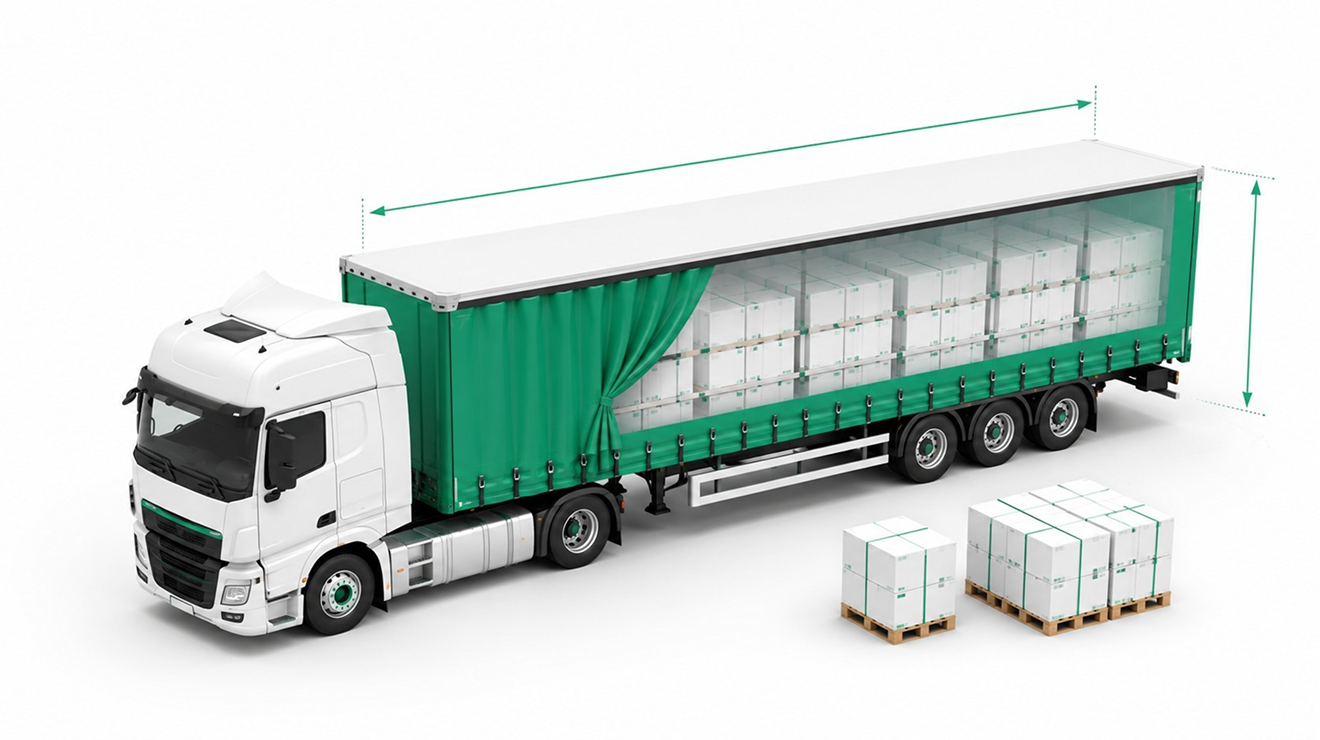

In freight transportation, a euro truck (eurofura) refers to a semi-trailer truck with a 13.6 m curtainside semi-trailer—these figures form the basis for pallet loading patterns and cubic capacity calculations across Russia and the CIS. With identical semi-trailer length and width, the volume of a euro truck ranges from 82 to 92 m³ depending on side height, while payload capacity stays within 20–24 tons.
What is a euro truck
A euro truck is not a specific truck model, but a widespread road train configuration: a prime mover plus a curtainside semi-trailer tailored for europallets. The name became standard because the trailer body is aligned with the unified European standard—the 1200 × 800 mm pallet, with door openings and internal geometry standardized across most manufacturers.
A curtainside trailer allows access to cargo from four sides: rear doors, sliding roof for top loading, and removable side curtains. Therefore, the euro truck maintains leadership in LTL and FTL trucking legs. The frame and specific vertical posts can be dismantled for oversized and long-length freight, allowing the same vehicle to handle palletized and non-standard cargo without swapping transport.
The format has its drawbacks. A curtain holds heat poorly and does not protect against precipitation as effectively as the rigid body of a refrigerated or dry van. Therefore, temperature-sensitive and high-value cargo requires another type of semi-trailer, while the euro truck is reserved for dry palletized general cargo. Under ambient heat exceeding 30 °C, the curtain interior heats up almost like direct sunlight. Consequently, temperature-sensitive chemicals or pharmaceuticals are never transported in it, even if dry and light.
Euro truck dimensions in meters
Length and width across most manufacturers rarely differ; the main variance lies in internal body height. Standard euro truck dimensions are outlined below, aligning with regulatory limits across most European and Russian roadways, meaning standard international routes require no individual permits.
- internal length — 13.6 m;
- internal width — 2.45 m, external width including mirrors — up to 2.6 m;
- internal cargo height — from 2.45 to 2.8 m, depending on modification;
- rear door opening — approx. 2.4 m wide and slightly lower than internal body height.
Trailer width and length stay practically constant from model to model, with height being the main variable. Krone, Schmitz, Kögel, and Lamberet—major trailer builders in the market—share this core set of dimensions: length, width, and height. However, actual internal dimensions of an operational unit may deviate from catalog specs by 3–5 cm due to manufacturing tolerances and wear; this must be factored in when planning tight loads. External width across mirrors is equally critical: exceeding 2.55 m classifies freight as oversized, requiring special route permits.
Euro truck volume and loading capacity in cubic meters
Usable cubic volume depends on internal side height at a fixed length of 13.6 m and width of 2.45 m. Manufacturers classify modifications by body volume—ranging from 82 to 92 m³.
- 82 m³ — standard height of 2.45 m, standard base version;
- 86 m³ — body height of 2.6 m;
- 90 m³ — body height of 2.7 m;
- 92 m³ — body height of 2.8 m, representing the upper limit for non-permitted transport routes.
Actual usable volume is defined by the semi-trailer certificate of registration rather than generalized industry charts—side and floor construction tolerances vary across series even within one manufacturer. Verify vehicle registration documents against actual dimensions before booking dispatch.
Height selection is rarely governed solely by cargo volume. On routes featuring low bridges, overpasses, or ferry connections, 92 m³ units may be barred without special approvals, whereas an 82 m³ version proceeds unrestricted—a crucial point to clarify prior to vehicle positioning.
How many europallets fit in a euro truck
The standard floor capacity of a euro truck is 33 europallets (1200 × 800 mm) in a single tier. This capacity is determined by the floor area of 13.6 × 2.45 m (approx. 33 m²) and a three-row-wide loading pattern with minimal clearance along the posts. The length accommodates 11 consecutive pallets, yielding 11 rows of 3 pallets each.
Double stacking is permissible exclusively for lightweight, stable, stack-rated cargo, and only in high-cube trailers (86–92 m³). An 82 m³ trailer leaves virtually no vertical margin if individual pallet height exceeds 1.2 m. Calculating exact pallet counts and packaging configurations requires custom load planning rather than a blanket rule. Experienced freight forwarders consistently reserve a 5–10 cm rear clearance buffer instead of treating full floor length as loadable space; otherwise, the final pallet row prevents rear doors from latching.
Weight and payload capacity of a euro truck
Volume is not the sole constraint. Gross vehicle weight (GVW) in Russia is regulated by statutory maximum permissible vehicle weight standards—40 tons for a 5-axle combination (two-axle tractor plus three-axle semi-trailer) and 44 tons for a 6-axle combination. Subtracting curb weight yields allowable payload capacity. Exceeding limits requires an oversized/heavy-haul permit on pre-approved routes; failing this, roadside weight inspection checkpoints will turn vehicles back or mandate partial unloading.
- empty curtainside semi-trailer curb weight: 6–7 tons;
- curb weight of tractor unit: 7–9 tons;
- axle load limits are regulated independently—up to 11.5 tons on the tractor drive axle and up to 8 tons per semi-trailer axle.
The remaining gross mass determines payload capacity—typically 20–24 tons in practice, depending on tare weight. It is easy to miscalculate here: lightweight high-cube freight is volume-constrained, while dense freight is axle-load and gross-weight-constrained. These metrics must never be confused when calculating load plans. Before departure, vehicles undergo certified axle weighing—excess axle loading triggers heavy carrier fines alongside mandatory cargo reduction to legal limits.
Curtainside semi-trailer design and structure
A euro semi-trailer is built on a high-tensile steel frame with longitudinal chassis members, a 27–30 mm plywood cargo floor, vertical sliding pillars, and side curtains mounted on roller track mechanisms. Most designs incorporate a sliding roof, enabling overhead loading via overhead crane or forklift without tearing down corner structures or detaching curtains.
Beyond the standard euro trailer, the market features high-capacity modifications—Jumbo and Mega trailers, raising internal height up to 3 m for volumes approaching 100 m³. These are specialized road assets subject to individual route constraints, not merely standard trailers under an alternate name.
Euro truck, reefer, and flatbed: choosing the right body type
A standard curtainside trailer handles dry palletized or boxed general cargo—electronics, building supplies, automotive components, and shelf-stable packaged foods. For specialized cargo profiles, the market utilizes dedicated 13.6 m body styles:
- refrigerated trailer maintains strict climate control from –20 to +20 °C for food products, cold chain goods, and pharmaceuticals;
- insulated (isothermal) van retains internal ambient conditions longer than a curtain without active refrigeration units, suitable for regional runs without extreme heat;
- open flatbed or drop-side trailer is impervious to weather using tarpaulins or deployed bare, suited for structural steel, pipe, machinery, and top-crane handling.
Select equipment based on cargo characteristics, not habit. A curtain reduces handling costs and fits standard pallet freight; however, for perishable or oversized cargo, incurring the operational risks of a curtain ends up costlier than booking the correct body type initially. The rate differential between a curtain and a reefer is typically offset by avoiding a single spoiled consignment.
Common dimension calculation errors
Even experienced supply chain managers make recurring errors when securing trailer space:
- calculating by external instead of internal dimensions, eliminating clearances around door frames and pillars;
- assuming uniform height across all euro trailers, ignoring variants between 82 and 92 m³;
- conflating cubic capacity with weight ratings, failing to establish whether volume or weight limits are reached first;
- disregarding physical equipment condition—interior wall indentations and floor wear diminish theoretical volume;
- booking a standard 82 m³ specification for double-stack cargo, causing major bottlenecks during warehouse loading.
Each pitfall is mitigated by clarifying one detail with the carrier before dispatch: the exact sub-model positioned and its verified internal dimensions, rather than catalog specs.
Euro truck ordering checklist
Audit freight specifications against the designated road vehicle before signing transport orders:
- Measure overall freight dimensions including packaging and determine double-stack compatibility.
- Compare cargo height against internal vertical clearance (82, 86, 90, or 92 m³ specs).
- Check gross shipment weight against actual payload capacity of the specific road train.
- Audit routing for overhead bridges, elevated roadways, and ferry clearances if trailer height exceeds 2.7 m.
- Request trailer photos and technical registration data if cargo tolerances are extremely tight.
- Explicitly stipulate the agreed trailer configuration and payload threshold directly in the transport booking form.
If you require dedicated road transport tailored to specific cargo geometry or cross-border logistics, TransGID will select the optimal trailer modification and formalize routing parameters in the transport order, including clearance tolerances and infrastructure permits. Learn more: Trucking from China.