
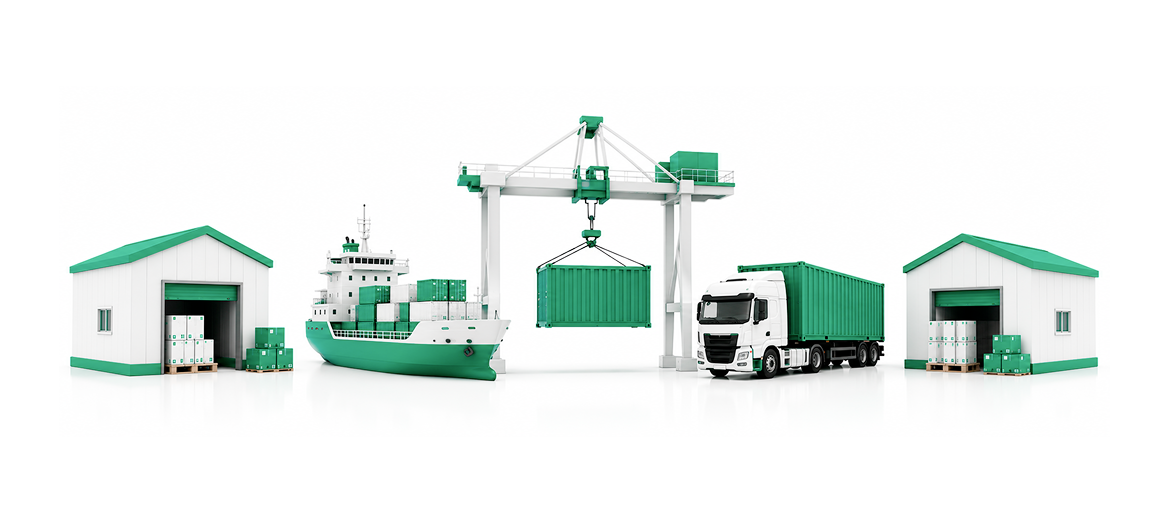

Incoterms are international rules that define the obligations of the seller and buyer in the delivery of goods.
They help to agree in advance on:
- who organizes transportation;
- who pays for delivery;
- who handles customs clearance;
- who insures the cargo;
- at what point risks transfer from the seller to the buyer.
Each term is designated by a three-letter code: EXW, FCA, FOB, CIF, DDP, and others. The chosen term must be specified in the contract and affects freight costs, expense allocation, and the liability of the parties.
It is important to understand that Incoterms only govern delivery terms of goods. The rules do not determine payment procedures, transfer of title, liability for breach of contract, or dispute resolution procedures. These conditions must be stipulated separately in the contract.
Under Incoterms 2020, there are 11 delivery terms. They differ in the scope of obligations of the seller and buyer, allocation of expenses, and the point of risk transfer.
How to Read the Incoterms Diagram
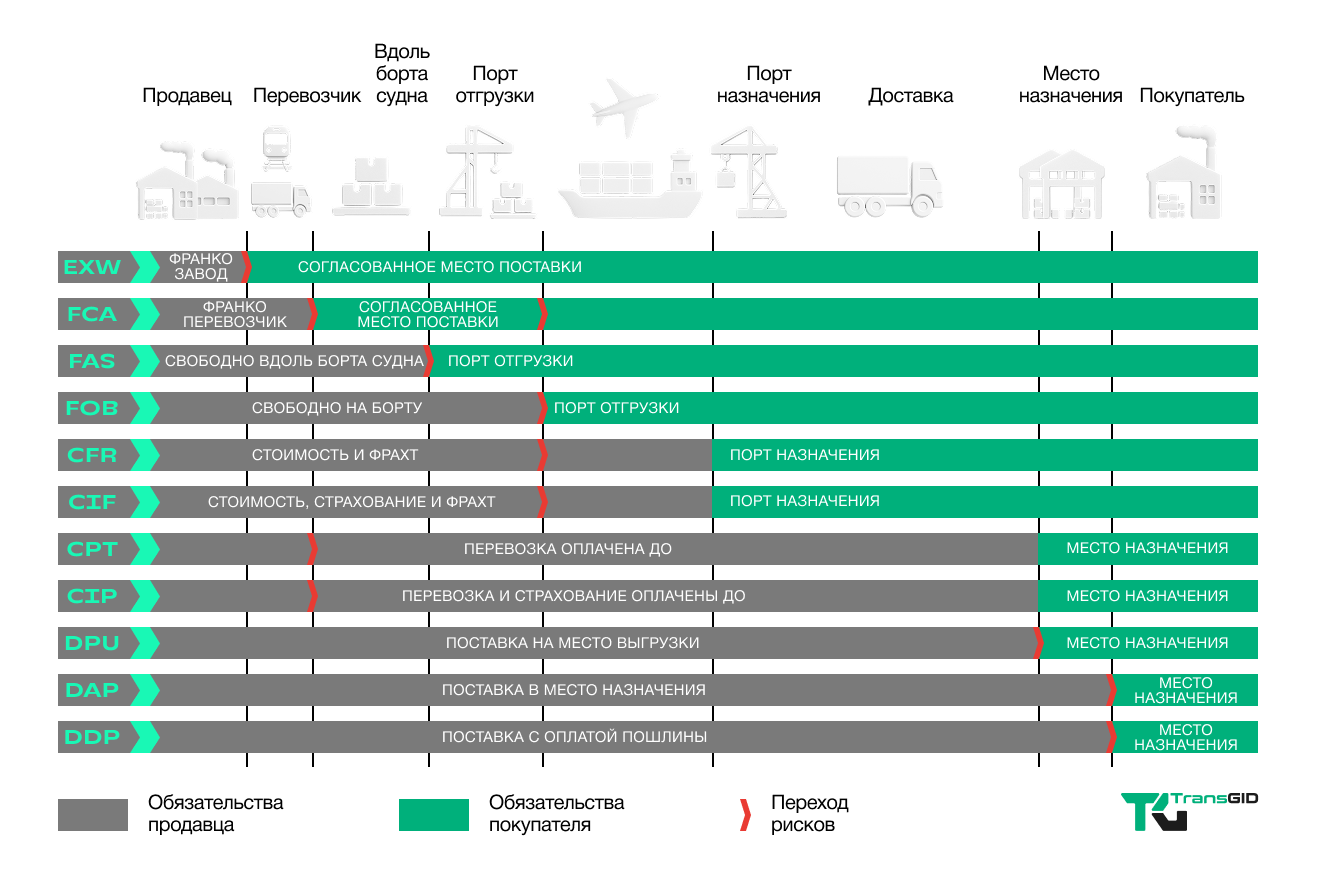
Incoterms 2020 diagram
The grey area shows the scope of the seller's responsibility. The green area indicates the buyer's responsibility. The red mark indicates the point where risk transfers from the seller to the buyer.
The lower the term is positioned, the more obligations the seller assumes.
The minimum seller responsibility is provided under EXW. The maximum is under DDP.
When choosing a delivery term, it is enough to answer three questions:
- Who pays?
- Who is responsible for the cargo?
- Who handles customs clearance?
Therefore, we have created a simpler table for a better understanding of Incoterms:
| Term | Transport | Who pays for main carriage | Who handles export clearance | Who handles import clearance | Point of risk transfer |
|---|---|---|---|---|---|
| EXW | Any | Buyer | Buyer | Buyer | At seller's warehouse |
| FCA | Any | Buyer | Seller | Buyer | Upon handover to carrier |
| FAS | Sea | Buyer | Seller | Buyer | Alongside ship |
| FOB | Sea | Buyer | Seller | Buyer | On board the vessel |
| CFR | Sea | Seller | Seller | Buyer | On board the vessel |
| CIF | Sea | Seller | Seller | Buyer | On board the vessel |
| CPT | Any | Seller | Seller | Buyer | Upon handover to carrier |
| CIP | Any | Seller | Seller | Buyer | Upon handover to carrier |
| DAP | Any | Seller | Seller | Buyer | At destination before unloading |
| DPU | Any | Seller | Seller | Buyer | After unloading |
| DDP | Any | Seller | Seller | Seller | At destination |
Below we examine each delivery term in detail, its specific features, and the allocation of responsibilities between seller and buyer.
EXW (Ex Works)
EXW is the term with minimum obligations for the seller. The seller makes the goods available at an agreed location, usually their warehouse. All further costs, customs formalities, and risks are assumed by the buyer.
This option is suitable for companies that manage logistics independently and work with their own carriers.
Seller obligations:
- Pack the goods
- Mark the cargo
- Provide goods at the agreed location
- Hand over documents
Buyer obligations:
- Load the goods
- Arrange transportation
- Handle export clearance
- Handle import clearance
- Pay for delivery
Risk transfer: upon handover of goods at the agreed location.
FCA (Free Carrier)
Under FCA, the seller delivers the goods to the carrier nominated by the buyer. The seller also handles export customs clearance.
One of the most popular terms in international road and container freight.
Seller obligations:
- Pack the goods
- Mark the cargo
- Carry out export customs clearance
- Hand over goods to the carrier
Buyer obligations:
- Arrange main carriage
- Pay for freight
- Handle import clearance
- Accept the goods
Risk transfer: at the moment of handing over the goods to the carrier.
FAS (Free Alongside Ship)
This term applies only to sea and inland waterway transport. The seller delivers the cargo to the port and places it alongside the vessel.
After this, responsibility transfers to the buyer.
Seller obligations:
- Pack the goods
- Carry out export customs clearance
- Deliver cargo to the port
- Place cargo alongside the vessel
Buyer obligations:
- Charter the vessel
- Arrange loading on board the vessel
- Pay for ocean freight
- Handle import clearance
Risk transfer: after placing cargo alongside the vessel.
FOB (Free On Board)
Under FOB, the seller not only delivers the cargo to the port, but also loads it on board the vessel.
After loading, responsibility for the goods transfers to the buyer.
Seller obligations:
- Pack the goods
- Carry out export customs clearance
- Deliver cargo to the port
- Load goods on board the vessel
Buyer obligations:
- Charter the vessel
- Pay for ocean freight
- Handle import clearance
- Arrange on-carriage
Risk transfer: after loading on board the vessel.
CFR (Cost and Freight)
The seller pays for ocean freight to the port of destination, but the risk of loss or damage to goods transfers to the buyer at the port of departure.
Because of this, CFR is often confused with turnkey delivery.
Seller obligations:
- Carry out export customs clearance
- Load goods on board the vessel
Pay ocean freight
Buyer obligations:
- Handle import clearance
- Arrange delivery after arrival
- Assume risks after loading
Risk transfer: after loading on board the vessel.
CIF (Cost, Insurance and Freight)
The terms are similar to CFR, but in addition, the seller is obliged to procure cargo insurance.
Insurance is procured in favor of the buyer.
Seller obligations:
- Carry out export customs clearance
- Load goods on board the vessel
- Pay ocean freight
- Insure the cargo
Buyer obligations:
- Handle import clearance
- Arrange further delivery
- Assume risks after loading
Risk transfer: after loading on board the vessel.
CPT (Carriage Paid To)
The seller organizes and pays for carriage to the agreed destination point.
At the same time, risk transfers to the buyer much earlier — upon handover to the first carrier.
Seller obligations:
- Carry out export customs clearance
- Hand over cargo to the carrier
- Pay for carriage to destination
Buyer obligations:
- Handle import clearance
- Assume risks upon handover to the carrier
- Arrange unloading
Risk transfer: upon handover to the first carrier.
CIP (Carriage and Insurance Paid To)
The term is similar to CPT, but the seller is additionally obliged to insure the cargo for the entire route.
Often used in multimodal transportation.
Seller obligations:
- Carry out export customs clearance
- Pay for carriage
- Insure the cargo
- Hand over goods to the carrier
Buyer obligations:
- Handle import clearance
- Arrange unloading
Risk transfer: upon handover to the first carrier.
DAP (Delivered At Place)
The seller delivers the goods to the agreed destination point and bears risks for almost the entire route.
Unloading is performed by the buyer.
Seller obligations:
- Arrange transportation
- Carry out export customs clearance
- Deliver goods to destination
Buyer obligations:
- Unload the goods
- Handle import clearance
Risk transfer: at destination before unloading.
DPU (Delivered at Place Unloaded)
The only Incoterms rule where the seller is required to arrange and pay for unloading the goods.
Seller obligations:
- Arrange transportation
- Carry out export customs clearance
- Deliver goods to destination
- Unload the goods
Buyer obligations:
- Handle import clearance
Risk transfer: after unloading is completed.
DDP (Delivered Duty Paid)
Maximum scope of seller obligations. The seller arranges carriage, export and import customs clearance, and pays customs duties and taxes.
For shipments to Russia, the feasibility of using DDP must be agreed upon separately prior to signing the contract.
Seller obligations:
- Arrange transportation
- Carry out export customs clearance
- Perform import clearance
- Pay duties and taxes
- Deliver goods to destination
Buyer obligations:
- Accept the goods
Risk transfer: at destination.
How to Choose a Delivery Term
Incoterms 2020 help the seller and buyer determine obligations, costs, and the point of risk transfer in advance for international supply of goods.
The choice of delivery term depends on who should control the carriage and bear the main delivery expenses.
| Term | When to choose |
|---|---|
| EXW | When the buyer independently organizes all logistics |
| FCA | For most international container and road shipments |
| FAS | For specific ocean shipments of bulk and breakbulk cargo |
| FOB | For sea freight when the seller is responsible for loading on board the vessel |
| CFR | When the seller pays ocean freight but does not insure the cargo |
| CIF | When the buyer requires cargo insurance covered by the seller |
| CPT | For multimodal transportation without mandatory insurance |
| CIP | For multimodal transportation with cargo insurance |
| DAP | When the seller delivers cargo to an agreed place, and the buyer handles import clearance |
| DPU | When the seller must not only deliver but also unload the goods |
| DDP | When the seller assumes virtually all delivery and customs clearance procedures |
There is no one-size-fits-all delivery term. For every shipment, it is essential to consider the route, mode of transport, insurance requirements, and cost allocation between the parties.
If you have any doubts when choosing a delivery term, TransGID specialists will help you select the optimal option tailored to your route, transport mode, cargo characteristics, and delivery requirements.